

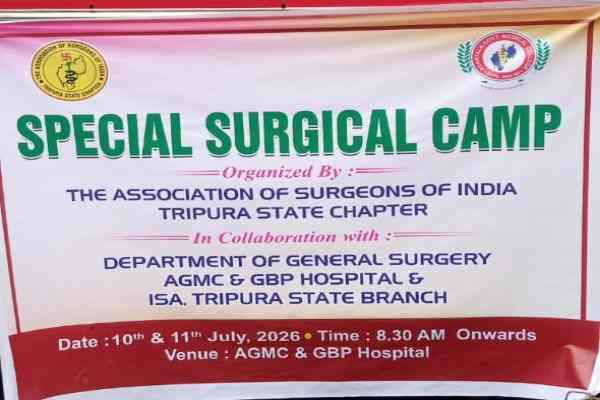
A joint initiative by Agartala Government Medical College (AGMC), GBP Hospital and two leading medical associations has helped reduce Tripura’s surgical backlog. The two-day Special Surgical Camp completed 36 surgeries, enabling many patients to undergo operations earlier than scheduled while showcasing a collaborative model for strengthening public healthcare.
Agartala: A collaborative healthcare initiative involving Agartala Government Medical College (AGMC) and GBP Hospital, the Association of Surgeons of India (ASI), Tripura State Chapter, and the Indian Society of Anaesthesiologists (ISA), Tripura State Chapter has delivered faster surgical care to patients while demonstrating how professional partnerships can strengthen public health services in Tripura.
The two-day Special Surgical Camp, organised on July 10 and 11, concluded after doctors successfully performed 36 surgeries on patients who had been waiting for operations.
Hospital authorities said the initiative was designed to reduce the growing surgical backlog at the state’s premier government referral hospital and provide timely treatment to patients.
The programme was conducted under the guidance of Chief Minister Prof. (Dr.) Manik Saha, with a focus on improving access to specialised surgical care and enhancing the efficiency of the public healthcare system.
Joint initiative targets surgical waiting list
Tripura’s only tertiary-level government hospital receives a heavy inflow of patients from across the state every day. The increasing demand for specialised treatment often results in long waiting periods for elective surgeries.
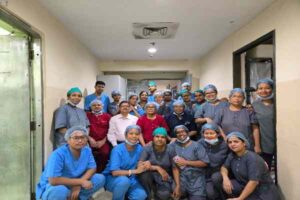
To address this challenge, AGMC and GBP Hospital partnered with two of the country’s leading professional medical organisations to organise a focused surgical drive.
The objective was simple—perform more surgeries within a short period without affecting routine emergency medical services.
Hospital officials said the initiative allowed several patients to undergo surgery well before their previously scheduled dates, reducing anxiety and improving access to treatment.
Doctors complete 36 surgeries in two days
The surgical teams completed 29 operations on the opening day of the camp out of 35 patients who had been scheduled for surgery. On the second day, doctors successfully performed surgeries on another seven patients, taking the total number of procedures to 36.
The operations covered a broad range of surgical conditions. These included laparoscopic cholecystectomy, open cholecystectomy, breast surgery, pilonidal sinus surgery, lipoma excision, and emergency surgery for intestinal perforation, among other procedures.
Hospital authorities said the successful completion of these operations reflected meticulous planning and effective coordination among different departments.
Medical associations strengthen government healthcare
Officials described the camp as an example of how collaboration between professional medical associations and government hospitals can improve healthcare delivery.
The Association of Surgeons of India and the Indian Society of Anaesthesiologists joined hands with AGMC’s Departments of General Surgery and Anaesthesiology to mobilise experienced specialists and optimise surgical resources.
Doctors, anaesthesiologists, nursing personnel and technical staff worked together to maximise the utilisation of operation theatres throughout the two-day programme.
Hospital officials believe such collaborative models can help government hospitals increase surgical capacity without requiring major expansion of infrastructure.
Coordinated teamwork drives success
The success of the Special Surgical Camp depended on the combined efforts of multiple healthcare teams.
The Heads of the Departments of Surgery and Anaesthesiology supervised the programme. Surgeons coordinated closely with anaesthesiologists, operation theatre nursing officers, OT technologists, General Duty Assistants (GDAs), sanitation workers and other support staff.
This coordinated approach ensured smooth scheduling, efficient use of operation theatres and uninterrupted patient care from admission to post-operative recovery.
Officials said the teamwork also helped maintain high standards of patient safety despite the increased surgical workload.
Model for improving healthcare access
Healthcare experts increasingly view focused surgical camps as an effective strategy for reducing waiting lists in high-volume government hospitals. Such programmes enable hospitals to clear accumulated cases while continuing routine emergency and outpatient services.
For patients, shorter waiting times often translate into faster recovery, reduced complications and lower financial burden arising from delayed treatment.
The AGMC initiative demonstrates how institutional collaboration and better resource management can improve healthcare delivery without disrupting regular hospital operations.
More special surgical camps planned
Encouraged by the outcome, AGMC and GBP Hospital plans to organise similar fast-track surgical camps regularly. Hospital authorities believe periodic surgical drives will help reduce the backlog of pending operations and improve access to specialised healthcare across Tripura.
Officials also expect continued collaboration with professional medical associations to further strengthen the state’s tertiary healthcare services and enhance treatment outcomes for patients.
The Medical Superintendent of AGMC and GBP Hospital, in a press release, said the institution will continue organising such collaborative surgical initiatives to expand surgical capacity, shorten waiting lists and ensure timely treatment for patients requiring specialised care.
