

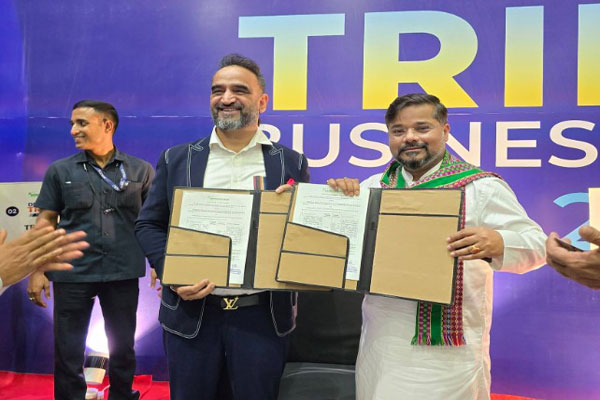
Tripura is preparing for a major transformation in its transport sector after securing investment commitments of around ₹2,240 crore in electric vehicle (EV) and civil aviation projects during the Destination Tripura Business Conclave 2026. The proposed projects aim to accelerate EV adoption, strengthen regional and emergency air connectivity, create skilled jobs and position the state as Northeast India’s emerging green transport hub.
Agartala: Tripura has unveiled an ambitious roadmap to reshape its transport sector with signing MoUs worth around ₹2,240 crore in electric mobility and civil aviation with companies. The proposals, announced after the Desination Tripura Business Conclave 2026, which ended on July 10, represent one of the state’s most significant attempts to build a sustainable transport ecosystem while expanding regional and emergency air connectivity.
| Related news: Global Tech Firms, Infra Firms Among Corporate Giants Eye Investment Opportunities in Tripura |
According to the official information gathered by the Enewstime Editor’s Desk, the proposed investments account for the largest share of the Memorandums of Understanding (MoUs) signed by the state’s Transport Department during the conclave. Together, they cover almost every segment of modern transportation, including electric vehicle manufacturing, battery production, charging infrastructure, EV fleet deployment, aviation services, pilot training institutes and seaplane operations.
Officials believe the projects could transform Tripura into a regional centre for clean mobility while opening new opportunities in aviation, tourism and logistics.
Electric mobility emerges as the biggest growth driver
Electric mobility dominated the transport sector announcements, reflecting the state’s long-term strategy to reduce dependence on fossil fuels and build a cleaner public transport system.
Unlike isolated EV initiatives seen elsewhere, the proposals seek to establish an integrated electric mobility ecosystem. The projects span battery manufacturing, vehicle production, charging networks, public transport electrification, mobility services and workforce training.
One of the most significant proposals comes from Urja Global Limited, which has committed ₹200 crore towards EV manufacturing and charging infrastructure. Another ₹200 crore investment has been proposed by Niljyoti Mobility for developing EV-as-a-Service solutions, a model expected to encourage wider adoption of electric vehicles without requiring customers to purchase them outright.
The state’s plan to introduce 1,000 electric cars has also received a major boost. Convergence Energy Services Limited (CESL) has signed an MoU involving ₹120 crore to support deployment of the electric fleet. The initiative is expected to strengthen government mobility, public transport and commercial transport services while significantly reducing vehicle emissions.
Manufacturing ecosystem gathers momentum
Tripura’s clean mobility strategy extends beyond vehicle deployment.
The state also aims to develop a domestic manufacturing base capable of supporting the growing EV market.
Kakkar Smart Energy Ventures has proposed investing ₹100 crore in EV battery manufacturing. The project could help establish local supply chains for one of the most critical components of electric vehicles.
Another ₹100 crore investment has been committed by Elvania for EV manufacturing, indicating growing investor confidence in Tripura’s industrial potential.
Industry experts believe that creating manufacturing facilities within the state can reduce transportation costs, generate employment and attract ancillary industries in the coming years.
Charging infrastructure to expand across the state
A reliable charging network remains essential for large-scale EV adoption.
Recognising this requirement, multiple investors have committed funds for charging stations and associated infrastructure.
Hub and Smoke Mobility plans to invest ₹50 crore in EV cab deployment and charging stations.
Spectracom has proposed an investment of ₹15 crore for EV charging infrastructure, while Laxmi EV Charging has committed ₹3 crore for expanding charging facilities.
The Transport Department has also received a proposal worth ₹10 crore for deploying 10 electric buses, which could strengthen sustainable public transport services.
Together, these projects are expected to reduce range anxiety among EV users while encouraging greater adoption of electric vehicles across both urban and semi-urban areas.
Building a skilled EV workforce
The transition towards electric mobility requires trained technicians, engineers and service professionals.
To address this emerging requirement, Chara Group of Services Pvt. Ltd. has proposed an investment of ₹5 crore to establish automotive and EV transition training facilities.
Officials expect the initiative to prepare local youth for employment in the rapidly expanding electric mobility sector while reducing dependence on skilled manpower from outside the state.
Civil aviation receives the largest single investment
While electric mobility dominates in terms of the number of projects, civil aviation has attracted the largest individual investment commitment.
Jet Serve Aviation Pvt. Ltd. has signed an MoU worth ₹1,500 crore for civil aviation projects. It is the biggest investment proposal under the Transport Department and highlights increasing investor interest in aviation infrastructure within the state.
The proposal is expected to strengthen Tripura’s aviation ecosystem and improve connectivity with other parts of India.
Regional connectivity and emergency aviation
The state’s aviation plans extend beyond commercial flights.
PS Hindustan Tourism and Infrastructure (India) Pvt. Ltd. has proposed investing ₹120 crore in regional aviation, tourism and emergency mobility.
The project could improve connectivity to remote areas while supporting emergency medical transportation and tourism-related aviation services.
Officials believe enhanced regional connectivity will complement Tripura’s broader economic development strategy by facilitating faster movement of people, goods and services.
Aviation training and seaplane services on the horizon
Tripura also aims to build aviation-related skills within the state.
Wing Tech Institute of Aviation has committed ₹150 crore to establish a state-of-the-art aviation training institute.
The proposed institute is expected to create opportunities for aspiring pilots, aircraft maintenance engineers and aviation professionals from Tripura and neighbouring states.
Meanwhile, Rampworks Aviation Pvt. Ltd. has proposed an investment of ₹100 crore for seaplane operations and another aviation training institute.
If implemented, seaplane services could open new tourism circuits while providing faster connectivity to difficult-to-access locations.
A broader vision for sustainable transport
Taken together, the investment proposals indicate that Tripura is pursuing a twin-track strategy. The first focuses on creating a comprehensive green mobility ecosystem through EV manufacturing, charging infrastructure and clean public transport. The second seeks to strengthen aviation infrastructure to improve regional connectivity, tourism and emergency response capabilities.
The approach aligns with India’s larger push towards sustainable transportation and reduced carbon emissions while creating new industrial and employment opportunities.
According to Transport Department data, 22 companies have signed MoUs involving investments worth ₹3,056.50 crore. Electric mobility and civil aviation together account for nearly ₹2,240 crore, making them the dominant sectors in the department’s investment portfolio.
If these proposals progress as planned, Tripura could emerge as one of the Northeast’s leading centres for green transportation and regional aviation over the coming years, supporting industrial growth, employment generation and cleaner mobility across the state.
