

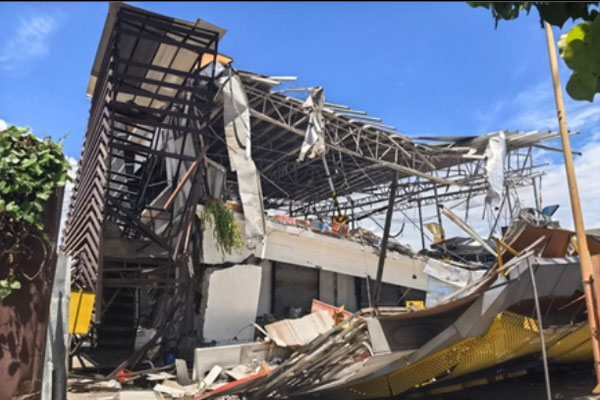
A powerful magnitude 7.8 earthquake struck southern Mindanao, Philippines, on June 8, pushing up the death toll to 61 and injuring 1,403 others. The disaster damaged thousands of homes, schools and public facilities. Rescue operations continue as authorities assess losses exceeding Rs 1.5 billion across affected regions.
Quick Glance
- Death toll: 61 people killed, 1,403 injured and 40 missing after the Mindanao earthquake.
- Major impact: Around 173,000 families and nearly 724,000 people affected across southern Mindanao.
- Infrastructure loss: More than 54,000 houses damaged along with roads, bridges, airports and ports.
- Relief efforts: Philippine agencies continue rescue, evacuation and rehabilitation operations.
Manila: A massive magnitude 7.8 earthquake that struck off the southern coast of Mindanao has caused widespread destruction across the Philippines. The death toll has increased to 61, while infrastructure losses have crossed Rs 1.5 billion, according to the latest report from the National Disaster Risk Reduction and Management Council (NDRRMC).
The earthquake hit on June 8 and triggered a major emergency situation in several parts of Mindanao. The disaster injured 1,403 people. Meanwhile, 40 people remain missing. Rescue teams are continuing search operations in remote and badly affected areas.
Authorities from the Armed Forces of the Philippines (AFP) and the Philippine Coast Guard (PCG) are assisting local teams. Their focus remains on reaching isolated communities in Sarangani and Davao Occidental.
Casualties Rise as Landslides and Collapses Cause Deaths
The NDRRMC confirmed that the majority of fatalities occurred in Region 12, also known as Soccsksargen. The region recorded 54 deaths. Another seven deaths were reported from the Davao Region.
Officials said landslides, falling debris and collapsed buildings caused most of the casualties.
The missing persons count has reached 40. The Davao Region reported 22 missing people, while Soccsksargen recorded 18 cases.
The port city of General Santos City emerged as one of the worst-hit locations. At least 13 people died there. Some victims were recovered from collapsed commercial buildings.
Earthquake Affects Nearly 724,000 People
The humanitarian impact of the earthquake continues to expand. The disaster has affected around 173,000 families across Mindanao.
The affected population is estimated at nearly 724,000 people.
Thousands of residents left their homes after buildings suffered damage. Authorities also issued tsunami-related alerts after the earthquake.
At present, 34 evacuation centres are operating. These centres are sheltering around 10,000 displaced residents.
Several local government units have declared a state of calamity. A total of 13 cities and municipalities have taken the step to speed up emergency assistance and release funds for recovery work.
Infrastructure Damage Crosses Rs 1.5 Billion
The Philippine Institute of Volcanology and Seismology (PHIVOLCS) confirmed that the earthquake was a tectonic event.
The earthquake occurred at 7:37 a.m. local time. It originated at a depth of 33 km. The epicentre was located around 32 km southwest of the coast of Maasim town, Sarangani province, on Mindanao Island.
The powerful tremors damaged homes, roads, public utilities and economic sectors.
| Sector | Damage Report |
|---|---|
| Houses | Around 54,000 homes damaged, including 9,900 completely destroyed and 44,100 partially damaged |
| Roads and Bridges | 45 road sections and 8 bridge sections affected |
| Transport Facilities | One airport and two seaports impacted |
| Electricity | Power services disrupted in 48 cities and municipalities |
| Industries | Agriculture, livestock and fisheries sectors suffered losses |
The earthquake has created major challenges for reconstruction. Officials said restoring damaged infrastructure will require significant financial resources.
Schools Among Worst Affected Facilities
The earthquake struck at a difficult time. Schools across the Philippines had recently reopened after the summer break.
The Department of Education (DepEd) reported that 8,642 schools across 43 divisions in six regions suffered damage.
In General Santos City, a two-storey school building collapsed during the earthquake. Authorities are investigating the incident and assessing the extent of damage.
Video footage from schools showed students and teachers reacting quickly during the tremors. Many evacuated classrooms, while some took shelter under desks to protect themselves.
Buildings Damaged as Residents Rush Outside
The earthquake caused structural damage to several commercial buildings.
Many signboards fell. Windows shattered. Parts of buildings collapsed in affected areas.
Residents immediately moved outdoors after feeling strong tremors. They feared additional collapses and falling debris.
Videos from disaster-hit areas showed damage to universities, restaurants and commercial establishments. Authorities are inspecting buildings to identify safety risks.
Relief Operations Continue in Affected Regions
The Philippine government has increased emergency assistance in earthquake-hit areas.
Authorities have distributed relief support worth Rs 67.6 million. The assistance includes food supplies, medical materials and temporary shelter items.
The NDRRMC, PHIVOLCS, DepEd, AFP and PCG continue coordinating rescue and recovery activities.
Officials said long-term rehabilitation will focus on rebuilding schools, roads, public utilities and agricultural infrastructure.
The recovery process is expected to continue as authorities monitor aftershocks and evaluate the complete impact of the earthquake.
People Also Ask
Q1. What was the magnitude of the Mindanao earthquake?
The Mindanao earthquake recorded a magnitude of 7.8 and struck southern Philippines on June 8.
Q2. How many people died in the Mindanao earthquake?
At least 61 people have died, while 1,403 others were injured.
Q3. Which areas were worst affected by the earthquake?
Soccsksargen, Davao Region, General Santos City, Sarangani and Davao Occidental reported major impacts.
(Report compiled and edited by Jaydip Chakrabarti with inputs from NDRRMC, PHIVOLCS, DepEd, IANS and Xinhua).
