

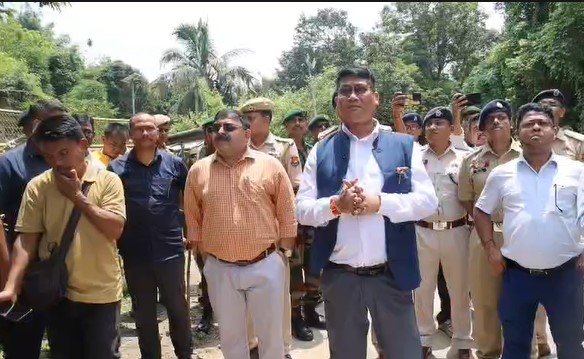
A 72-hour road and railway blockade announced by former members of disbanded militant groups in Tripura was withdrawn within six hours after discussions with the state government. Chief Minister Dr Manik Saha assured protesters that their concerns would be reviewed, leading to the removal of blockades across three locations.
Quick Glance
- Former rebel group members withdrew the 72-hour strike in Tripura after government intervention.
- Chief Minister Dr Manik Saha assured protesters that their demands would be examined.
- Blockades affected Assam-Agartala National Highway and railway services early in the morning.
- Protesters raised concerns over implementation of the September 2024 tripartite agreement.
Agartala: The 72-hour strike announced by former members of Tripura’s disbanded militant organisations ended within six hours of its beginning. The decision came after fresh discussions between the state government and protest leaders produced a breakthrough.
The protest had created concerns over transportation across Tripura. However, the situation improved after government representatives assured the protesters that their demands would receive attention.
The development came after multiple rounds of discussions involving government officials and former rebel leaders.
Initial Talks Failed to Resolve the Dispute
Before the strike started, Tribal Welfare Minister Bikash Debbarma chaired a meeting with representatives of the protesting groups. However, the discussion did not reach a final agreement.
The former militant leaders refused to withdraw the strike at that stage. They said the government and protest organisers agreed on several issues. However, some important matters remained unresolved.
The leaders later reviewed their decision but initially decided to continue with the blockade. Afterward, the government reopened discussions in the morning. A solution emerged within a few hours, according to sources aware of the matter.
CM Intervenes in Tripura Strike Issue
Chief Minister Dr Manik Saha played a key role in resolving the situation. At the time, he was in New Delhi attending a special meeting of North Eastern Chief Ministers.
According to sources, the Chief Minister assured the protesters that their legitimate demands would be considered. He also indicated that necessary steps would be taken gradually.
Following the assurance, the former rebel group representatives decided to withdraw the strike.
The intervention helped restore normal movement across affected areas of Tripura.
Blockades Removed From Three Protest Sites
After the government’s assurance, Tribal Welfare Minister Bikash Debbarma and senior police officials reached the protest locations.
They spoke with the demonstrators and assured them that their concerns would be addressed.
Soon after, protesters removed the blockades from all three locations. Traffic movement gradually returned to normal.
| Issue | Details |
|---|---|
| Strike duration announced | 72 hours |
| Strike withdrawal time | Within six hours |
| Strike start time | 6 am |
| Major affected services | Road and railway transport |
| Blockade locations | Three major locations |
Transportation Services Hit Across Tripura
The strike began at 6 am and immediately affected long-distance transportation services in the state.
Traffic movement along the Assam-Agartala National Highway faced disruption. Railway services also experienced interruptions due to the protest.
Passenger transport connecting Agartala with North Tripura, Unakoti, and Khowai districts remained largely affected during the early hours.
However, the impact remained limited in the southern districts. Highways in Sepahijala, Gomati, and South Tripura continued to function normally.
Protest Locations Included Baramura Hills and Sadhupara
Police sources said protesters gathered at three main locations.
One major blockade took place near the foothills of Baramura Hills, also known as Hatai Kotor. Another protest was organised on railway tracks near Sadhupara.
West Tripura Superintendent of Police Namit Pathak confirmed that blockades took place at three locations. He said no reports of any untoward incident were received during the protest.
Former Rebel Leaders Raise Agreement Implementation Concerns
NLFT leader Prasenjit Debbarma explained the reasons behind the blockade.
He referred to the tripartite agreement signed in New Delhi on September 4, 2024. According to him, the agreement included several important provisions for the rehabilitation and socio-economic development of former rebels.
Debbarma alleged that some government agencies preparing development projects did not properly consider key points mentioned in the memorandum of settlement.
He said the organisations opposed the projects because they believed the plans did not fully match the agreement’s objectives.
Screening Process of Former Cadres Remains a Major Demand
Another major concern raised by Debbarma was the slow progress of the screening process for former cadres linked with groups like NLFT and ATTF.
He demanded faster completion of the process. According to him, delays in the screening procedure were among the main reasons behind the decision to organise the road and railway blockade.
The protesters wanted quicker action on rehabilitation-related issues.
Protest Leaders Expect Further Government Action
Although the strike was withdrawn, Debbarma said some important concerns remained pending.
He stated that the government had provided assurances on several matters. However, he added that some critical points still needed attention.
He expressed hope that further discussions would help resolve the remaining issues.
The development highlights the continuing process of implementing agreements related to former insurgent groups in Tripura. It also reflects the role of dialogue between the government and former rebel representatives in maintaining peace and stability in the region.
