

Gist: Food output in Tripura has increased by 12% this year, with more youths joining agriculture. Agriculture Minister Ratan Lal Nath highlighted the progress at the State Level Kisan Mela
Agartala Mar 7: Food grain production in Tripura has increased by 12 percent this year compared to last year.
At the same time, more young people are joining agriculture and many are seeing positive results.
Agriculture and Farmers’ Welfare Minister Ratan Lal Nath shared this information on Friday.
He spoke after inaugurating the State Level Kisan Mela 2025–26 and the conferment of State and District Level Best Farmers Awards at Pragna Bhavan.
Farmers Key to India’s Growth
The minister said Prime Minister Narendra Modi has urged people to “produce more, connect more and export more”.
According to him, this approach will help India become a global leader.
He added that farmers play a vital role in the state’s development.
Quoting the Prime Minister, Nath said Modi often refers to four key groups—poor people, youth, women and farmers. Development of these groups, he said, will strengthen the nation.
Focus on Agriculture Development
Nath said agriculture covers several sectors. These include animal husbandry, forestry and fisheries. Therefore, farmers have wide opportunities to expand their activities.
He noted that Tripura has about 4.72 lakh farmers, while the state’s population stands at around 42.22 lakh.
The Kisan Mela was organised to honour farmers who work tirelessly to produce food.
He also said the government is taking new steps to strengthen the agricultural sector and increase the state’s Gross State Domestic Product (GSDP).
Modern Farming Methods
The minister said the Prime Minister is working to make India a global hub for grain storage.
He also described the Krishak Mela as different from other fairs.
According to him, the event focuses on farmers, innovation and agricultural development.
Tripura has about 65.57 lakh kanis of land. Out of this, around 30.17 lakh kanis are used for cultivation. Nearly 15 lakh kanis are dedicated to paddy farming.
However, the state has limited plain land and large forest areas. Therefore, the government is promoting modern and scientific farming techniques.
Progress in Paddy Production
Nath said Sepahijala District has achieved the top position in paddy self-sufficiency this year. It is followed by South Tripura District and Gomati District.
He also said Khowai District has now become self-sufficient in paddy production.
Meanwhile, the remaining districts include Dhalai District, Unakoti District, North Tripura District and West Tripura District.
The government, he said, is working to make all districts self-sufficient in paddy production.
Expansion of Organic and Natural Farming
The minister also highlighted the growth of organic farming in the state. Earlier, only 2,000 hectares were under organic cultivation.
Over the last seven years, this area has expanded to 26,500 hectares.
He said there is strong demand in Germany for Tripura’s organic products. These include bird’s eye chilli, ginger, Kalikhasa rice and turmeric.
Natural farming has also expanded to 5,550 hectares in the state.
Youth Participation Rising
Nath said food grain production has increased significantly this year. At the same time, young people are showing growing interest in agriculture.
Many of them are adopting innovative farming methods and earning profits.
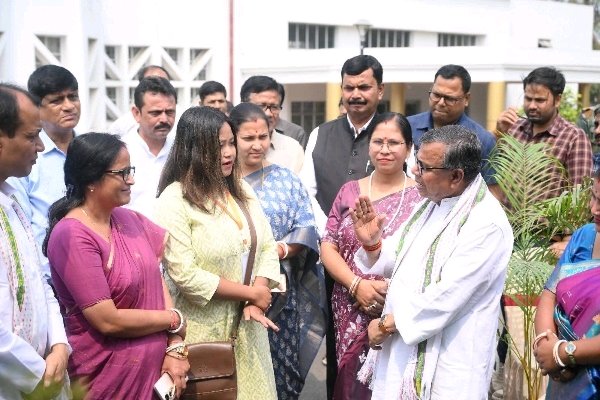
“Youth participation in agriculture has increased and they are witnessing benefits,” the minister said.
Farmers Receive Awards
During the programme, the minister honoured farmers for their achievements.
Ten farmers received state-level awards along with a cash prize of Rs 50,000 each. In addition, 80 farmers received district-level awards worth Rs 25,000 each.
Later, nearly 300 farmers will receive block-level awards with Rs 10,000 each.
