

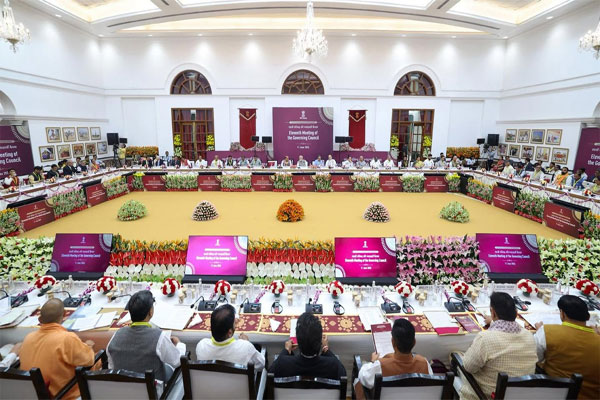
Tripura has witnessed a remarkable increase in female workforce participation over the past three years, Chief Minister Manik Saha said while addressing the 11th Governing Council Meeting of NITI Aayog. The Chief Minister attributed the growth to targeted interventions in women’s empowerment, entrepreneurship promotion, skill development and financial inclusion initiatives implemented across the state.
Quick Glance
- Female labour force participation in Tripura increased from 37.5% in 2022 to 45.9% in 2025.
- Nearly 4.96 lakh women are associated with 55,676 Self-Help Groups (SHGs).
- The state introduced the Tripura Women Entrepreneurship Policy 2025 to encourage women-led businesses.
- Women can now work night shifts with adequate safety and security arrangements.
Agartala/New Delhi: Chief Minister Dr Manik Saha while addressing the NITI Aayog Governing Council today, highlighted how women have become central to Tripura’s development journey.
He said the state government has focused on expanding economic opportunities for women through entrepreneurship, skill development and access to institutional finance. These efforts have translated into measurable improvements in workforce participation and economic engagement.
According to the Chief Minister, the female labour force participation rate in Tripura rose significantly from 37.5 percent in 2022 to 45.9 percent in 2025, reflecting the impact of sustained policy interventions.
Female Workforce Participation Shows Strong Growth
| Indicator | 2022 | 2025 |
|---|---|---|
| Female Labour Force Participation Rate | 37.5% | 45.9% |
The increase places Tripura among the states making notable progress in integrating women into the workforce and strengthening their contribution to economic development.
Self-Help Groups Strengthen Rural Women’s Economic Role
A major pillar behind this growth has been the expansion of Self-Help Groups across rural Tripura.
The Chief Minister informed the Council that nearly 4.96 lakh women are actively involved in 55,676 Self-Help Groups. These groups have become important platforms for savings, credit access, micro-enterprise development and livelihood generation.
The government has also worked to connect SHG-led enterprises with formal markets and financial institutions. This approach has helped many women transition from subsistence activities to income-generating ventures.
Samriddhi Campaign Improves Access to Finance
Dr. Saha highlighted the role of the Samriddhi Campaign in accelerating credit flow to women-led enterprises.
The initiative has enabled thousands of women entrepreneurs to access institutional finance and expand their businesses. The state government is simultaneously working to integrate SHG-based enterprises into the formal Micro, Small and Medium Enterprises (MSME) ecosystem.
Officials believe that improved access to credit remains one of the most effective ways to enhance women’s economic participation and create sustainable livelihoods.
Entrepreneurship Policy Targets Gender Gaps
To further strengthen women’s role in business and industry, the government has formulated the Tripura Women Entrepreneurship Policy 2025.
The policy aims to reduce gender disparities in entrepreneurship and encourage greater participation of women in enterprise creation. It seeks to support women through training, mentorship, market linkages and easier access to financial resources.
In addition, Women’s Industrial Training Institutes now host SHE Skills and Entrepreneurship Centres. These centres focus on equipping women with practical skills required for self-employment and modern industries.
Safety Measures Expand Employment Opportunities
The Chief Minister also pointed to another important reform.
The state government has enabled women to work in night shifts while ensuring adequate safety and security arrangements. This decision has widened employment opportunities in sectors where round-the-clock operations are common.
By addressing safety concerns, the government aims to create a more inclusive labour market and remove barriers that often restrict women’s participation in formal employment.
Skill Development Supports Women’s Economic Inclusion
Women have also benefited from broader skill development initiatives launched by the state government.
Tripura is modernising Industrial Training Institutes and introducing industry-oriented courses to improve employability. These programmes complement women-focused initiatives by preparing more women for emerging employment sectors.
The government’s larger human capital strategy combines education, healthcare, skills and entrepreneurship, creating an ecosystem that encourages greater female participation in economic activities.
News Analysis: Women-Centric Policies Deliver Measurable Results
The rise in female labour force participation from 37.5 percent to 45.9 percent within three years indicates that Tripura’s women-centric development policies are producing visible outcomes.
The government’s strategy extends beyond welfare measures. It focuses on financial inclusion, entrepreneurship, skill development and workplace accessibility. The expansion of SHGs, targeted credit programmes and entrepreneurship support mechanisms has created pathways for women to enter the formal economy.
The introduction of safety measures for night-shift employment further demonstrates an effort to remove structural barriers to women’s participation.
If the current momentum continues, women’s economic empowerment could emerge as one of the strongest drivers of Tripura’s growth story in the coming years.