

For a long time, a narrative has been constructed that present-day Tripura belonged exclusively to its tribal people and that Bengalis arrived here only later. Even when the later arrival of Bengalis is discussed, the narrative generally traces it only to Chakla Roshnabad, rarely looking further back. Yet history suggests a more complex picture.
The ancestors of present-day Bengalis established settlements in the plains of Tripura, and these groups also moved through and across the region. This may not have been true of every part of the plains, but it was certainly the case across a substantial portion of them.
However, to support this argument through history, I (the writer) must rely on the scientific evidence and methods used to reconstruct the past. The question, then, is: What are the universally recognised scientific sources of historical evidence?
The answer is cave paintings; archaeological evidence — excavated settlements, habitation layers, buildings, fortifications, roads, temples, burials, hearths, tools, and other material remains. The stratigraphic context—what lies above or below what—is particularly important. Then there is Epigraphic evidence (inscriptions) — inscriptions on stone, copper plates, pillars, temple walls, seals, etc.
These are among the strongest sources for identifying rulers, dynasties, administrative units, land grants, religious institutions and geographical names. There is also Numismatic evidence (coins) — coins help establish rulers, chronology, political authority, trade networks, economic conditions, religious symbols and sometimes territorial influence. Another source is Scientific dating.
Language — Palaeography — the scientific study of the development of scripts and handwriting. The form of letters can often provide an approximate date for an otherwise undated inscription or manuscript. There are also supporting sources such as Foreign or independent contemporary accounts — travellers, pilgrims, merchants, diplomats and chroniclers from outside the region can provide valuable corroboration. Chinese pilgrim accounts, Arab-Persian geographical writings, Tibetan sources, etc., are important examples for Indian history.
Another important source is Historical geography and toponymy — identification of ancient place-names through inscriptions, texts, maps, rivers, routes and surviving geographical names. This requires caution: similarity between two names alone is not proof that they refer to the same place.
The sources that come later include Art history and iconography — sculpture, temple architecture, terracotta, paintings, religious imagery and stylistic sequences can reveal chronology, religious affiliation and cultural connections.
Ceramic evidence (pottery) — pottery typology is extremely important archaeologically. Changes in pottery styles, manufacture and distribution can help establish chronology, settlement patterns and trade connections.
Archaeobotany and palynology — ancient seeds, grains, charcoal and pollen can reconstruct agriculture, vegetation, diet and environmental change.
There are more such sources, although they are not particularly applicable to the present discussion.
The problem lies in the tendency to write the history of present-day Tripura—or to analyse the presence of Bengalis, or, more precisely, to argue for their absence—by relying almost exclusively on the Rajmala, a chronicle produced under royal patronage, while setting aside the scientific and independent historical evidence mentioned above.
The primary objective appears to be to establish that Bengalis first arrived in Tripura only during the royal period and, subsequently, to portray the arrival of Bengalis from Chakla Roshnabad in different phases as a form of “infiltration.”
This tendency has now become a significant political instrument for leaders and political parties — whether it is the Tipra Motha associated with Pradyot Kishore in present-day Tripura, the Left Front under Nripen Chakraborty, or the BJP under Amit Shah at the national level in Delhi. I do not see Congress leaders showing much interest in addressing these issues.
At the same time, there are also some Bengalis who, after conducting only superficial research or relying on one or two books, attempt to establish the antiquity of the Bengali presence in this region. That, too, is not a sound historical approach.
Nevertheless, go anywhere in the Northeast — or, for that matter, anywhere in India — and ask people about this issue. The common perception is that Bengalis came to Tripura and gradually took over much of what had traditionally belonged to the tribal population of the State.
Many renowned historians — beginning with Ramesh Chandra Majumdar and Dinesh Chandra Sarkar, as well as numerous Indian and foreign historians and experts in archaeology, numismatics and other fields — have reconstructed the ancient history of Tripura based on scientific and historical evidence.
Yet hardly anyone, whether from the tribal or non-tribal community, reads these works. Even when they do, many choose to disregard them and, driven by political interests, create confusion and promote historically inaccurate narratives.
The fundamental mistake in attempts to discuss the entire history of Tripura is to use the state’s present-day geographical boundaries as the framework for understanding its past. This approach continues even today.
What is often overlooked is that the present geographical boundaries of Tripura are relatively recent.
The fact is that a large part of present-day Tripura, particularly its plains, was once part of a much larger political and cultural region that extended across vast areas of present-day Bangladesh. The rulers, kings, and inhabitants of these regions belonged to populations from which present-day Bengali society ultimately emerged.
Their language was not Bengali in its present form. In ancient times, it would have existed in earlier linguistic forms that eventually contributed to the development of Bengali. Yet, from an anthropological perspective and on the basis of other scientific evidence, these populations can be understood as among the ancestors of today’s Bengalis.
Have you ever heard anyone, among those busy constructing a distorted history of present-day Tripura, or those using history as a political instrument, explain who built the Buddhist stupa at Boxanagar, whose development dates from the 6th century and continued until the 12th century? Or who created the Buddhist and Hindu archaeological remains at Pilak, dating from the eighth and ninth centuries? Or who created the remarkable Unakoti in northern Tripura?
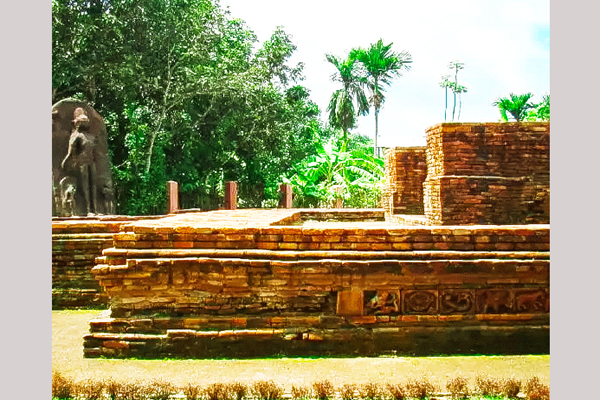
How could such extensive Buddhist activity have taken place without some form of royal patronage? Notably, the kings of Tripura were not Buddhists, nor does the Rajmala contain any mention of Buddhist establishments at Boxanagar or Pilak.
A few days ago, I mentioned in a post that many people cite “Kartripura,” mentioned in the Allahabad Prashasti alongside Samatata, as the earliest scientific evidence for the antiquity of Tripura.
However, scientific analysis has led many historians, as well as the Archaeological Survey of India (ASI), to identify Kartripura with a place in present-day Uttarakhand.
The fact remains that, before the 15th century — more precisely, before the reign of Ratna Manikya in 1464 — there are no permanent scientific remains, in the conventional sense, that can be definitively attributed to the royal dynasty or its achievements in present-day Tripura.
That, however, does not mean that the region was uninhabited or that Bengalis were absent from it. From at least the 6th century onward, evidence from Boxanagar and the other scientific and historical sources mentioned above points to the presence of proto-Bengali populations in the plains of this region. Their language may not be the Bengali that we speak nowadays, but they were our ancestors and they were here.
Some of these people may have been Buddhists, while others may have been Hindus. Their religious identities may have varied, but the evidence indicates that they were present in this region.
I will discuss this evidence and its historical significance in greater detail in subsequent posts.
Just keep two things in mind:
-
The geographical boundaries of ancient Tripura were not the same as those of present-day Tripura. More accurately, its plains formed part of a much larger Bengali empire.
-
The Deva, Chandra, Khadga and other dynasties have been mentioned repeatedly, as have Samatata, Harikela, Pattachera and other ancient kingdoms and regions. These were the dynasties/kingdoms of those ancient Bengalis.
The main point is this: when Bengali kings were ruling this region, establishing monuments at places such as Boxanagar, Pilak and Unakoti, and Bengali populations were settling here, establishing markets and developing settlements, the Tripuri kingdom had not yet been established.
The Tripuris entered and established themselves in the hilly regions of present-day Tripura several centuries later.
So, if the question is now asked — who are the indigenous people of this region?
Then Bengalis are certainly among them.
(The write-up is an English translation by the Enewstime Desk of a Facebook post by veteran Journalist and Editor-in-Chief of Tripuranet.com, Manas Pal. The original post is embedded below)
