

As the country works towards Viksit Bharat 2047, ISRO is emerging not only as a space exploration agency but also as a driver of innovation, self-reliance and technological progress.
India space programme is no longer defined only by rockets, satellites and missions to the Moon or Mars. Its deeper impact can be seen in agriculture, communication, weather forecasting, disaster management, navigation, education, healthcare and national security.
National Space Day is observed on August 23, commemorating the Chandrayaan-3 landing in 2023. ISRO describes the 2026 observance as the third National Space Day.
This is the larger significance of National Space Day as India advances towards the vision of Viksit Bharat 2047. Space technology is increasingly becoming a tool for improving everyday life and strengthening the country technological and economic capabilities.
The idea behind Space Day can therefore be summed up as innovating for a developed India — an India that is technologically advanced, self-reliant, economically stronger and capable of solving complex challenges through indigenous innovation.
From Space Exploration to National Development
The Indian Space Research Organisation (ISRO) has played a central role in this transformation. Its primary objective has been to develop space technology and apply it to national needs.
Today, satellite systems support telecommunications, television broadcasting, weather forecasting, resource mapping, navigation and disaster management. Earth observation satellites provide valuable data for agriculture, infrastructure planning and environmental monitoring.
These capabilities have also strengthened the vision of Atmanirbhar Bharat. India is increasingly developing critical technologies within the country instead of depending entirely on foreign systems.
The indigenous 32-bit Vikram processor for space applications and a 28-nanometre baseband ASIC designed to support NavIC and other GNSS signals are examples of this technological transition. Such developments indicate that India is moving beyond the use of space technology towards designing and owning critical technologies.
2026: A New Generation of Space Innovators
The year 2026 has further demonstrated how ISRO is bringing students and young innovators into the space ecosystem.
The Bharatiya Antariksh Hackathon 2026 attracted more than one lakh students. Participants worked on challenges involving geospatial technology, space science, image processing and artificial intelligence and machine learning.
Another significant initiative is the ISRO Robotics Challenge–URSC 2026. The programme challenged students to develop autonomous systems capable of surveying, navigation, feature detection, landing, data transfer and charging in GPS-denied environments.
Nearly 590 teams registered for the challenge. The scale of participation reflects a growing interest among young Indians in solving real-world technological problems.
Such initiatives are important because they turn students from passive users of technology into potential creators of future space systems.
ISRO achievements during 2025–26 also reflected growing cooperation with industries, startups and academic institutions. This expanding network is helping create a broader Indian space ecosystem beyond government laboratories.
URSC: The Quiet Powerhouse Behind India Satellites
Among the lesser-known pillars of India space programme is the U. R. Rao Satellite Centre (URSC) in Bengaluru.
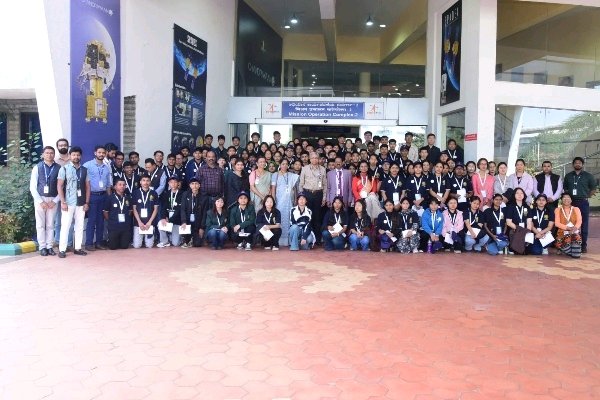
The centre is a key facility for designing, developing and building satellites for communication, navigation, meteorology, remote sensing, scientific research and interplanetary missions. URSC has built more than 100 satellites since its establishment.
Bengaluru is also home to other important space facilities. The Indian Deep Space Network (IDSN) and Indian Space Science Data Centre (ISSDC) are located at Byalalu.
The ISSDC archives, processes and distributes scientific data received from missions including Chandrayaan, the Mars Orbiter Mission and AstroSat.
One of the most remarkable but less widely known facilities at Byalalu is ISRO 32-metre deep-space antenna. Designed, developed, built and tested indigenously, the antenna supports communication with spacecraft travelling far beyond Earth.
The facility represents an important aspect of India space capability: the ability not only to send spacecraft into deep space but also to maintain communication with them across millions of kilometres.
It is also important to distinguish these facilities from the proposed Bharatiya Antariksh Station. Bengaluru hosts several centres working on human-spaceflight and related technologies, but the future space station itself will be an orbital infrastructure rather than a building located at URSC.
When Space Technology Reaches the Common Citizen
The real measure of India space programme is not the number of launches. It is how effectively space-based technology improves life on Earth.
| Related feature story : Debjit and Hritaraj Came to See a Rocket: They Left With a Dream|
Farmers can use satellite-based information to monitor crops and water resources. Governments can use geospatial data for infrastructure planning. Fishermen can receive information relevant to their activities. Communities can benefit from early warnings during floods and other disasters.
ISRO disaster-management initiatives provide space-based information for preparedness, response and mitigation. Satellite-based flood monitoring and early-warning systems have also been developed for river basins.
In rural India, geospatial technology can support natural-resource management, agricultural planning, infrastructure development and access to essential services. These applications directly connect the space programme with the broader development goals of Viksit Bharat.
Space, Education and Human Development
ISRO growing role also extends to education.
Programmes such as START-2026 are exposing students and academic institutions to space science. Hackathons and robotics challenges are creating additional platforms for young people to experiment with emerging technologies.
The impact goes beyond classrooms. Students who participate in such programmes gain exposure to artificial intelligence, robotics, remote sensing, data processing and autonomous systems. These skills can contribute to India wider technology ecosystem.
Space technology also has applications in healthcare. Satellite communication can support telemedicine and emergency response, particularly in areas where conventional connectivity remains difficult.
At the same time, India growing work in space medicine is preparing the country for future human-spaceflight missions.
Strengthening Defence and the Space Economy
Space has also become increasingly important for national security. Secure communication, navigation, Earth observation, surveillance and precise timing can strengthen defence capabilities.
Indigenous navigation technologies associated with NavIC and domestic satellite systems can reduce dependence on foreign infrastructure.
The commercial significance is equally important. Satellite communication, navigation and Earth observation support logistics, transportation, agriculture, telecommunications and several weather-sensitive industries.
The growing involvement of startups and private companies is creating new opportunities. India space sector is gradually evolving from a government-led programme into a wider innovation-driven ecosystem.
Space Day and the Viksit Bharat Vision
The vision of Viksit Bharat 2047 cannot be achieved only through roads, factories and physical infrastructure. It also requires knowledge, scientific capability, innovation and technological self-reliance.
ISRO represents these aspirations.
From its early satellite programmes to Chandrayaan, the Mars Orbiter Mission, NavIC, advanced Earth observation, space-docking capabilities and preparations for human spaceflight, India space journey demonstrates what indigenous innovation can achieve.
The deeper meaning of National Space Day, therefore, lies beyond celebrating rockets and astronauts.
It is about recognising how space technology can improve the life of a farmer, expand the education of a student, protect communities from disasters, improve business efficiency and strengthen national security.
As India moves towards Viksit Bharat 2047, ISRO can remain one of the country most important engines of innovation — helping India move from Make in India to Innovate in India, and ultimately to Lead from India.
