

Teachers’ Day is more than an annual celebration. It is a reminder of the enduring relationship between teachers, students, parents and society.
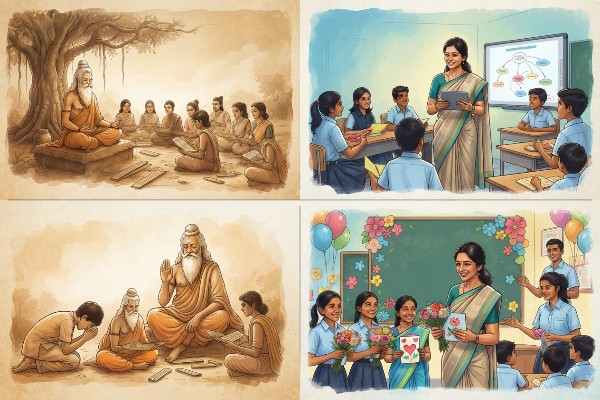
From the traditional Guru-Shishya tradition to modern classrooms, the role of teachers has evolved, but respect, trust, compassion and guidance remain central to education.
Wish you all a very Happy Teachers’ Day.
5th September has arrived, invoking so many fond memories in my heart. Memories of my childhood are the first that surface in my mind. We greeted our beloved teachers with flowers and sought their blessings by respectfully bowing at their feet and, and oh yes, how we longed to be teachers to our junior classes, feeling proud to have been given the opportunity.
Today, I take this opportunity to express my gratitude to my parents who are our first teachers and to all my school and college teachers who made me who I am today. Their encouragement always gave me the confidence to move forward.
Now, the question arises: are we doing something unique by celebrating this day? No, it was always there, albeit in a different form.
From time immemorial “Guru” or teacher has always been a revered figure. Kings and masses alike considered the “Guru” as the embodiment of knowledge and wisdom. Guru or the teacher guided the society as to which direction the nation or the society should move for growth and prosperity. We have innumerable examples where the kings or the rulers sent their royal scion to ‘Gurukul’. i.e. the house of the guru at a very tender age and they returned only after attaining full knowledge regarding practical aspects of life and also spiritual aspects. The most remarkable aspect of “Guru Griha” was that all the students were treated equally and no special treatment was accorded to the students who belonged to the higher strata of the society.
We all know the famous verse “Guru Brahma, Guru Vishnu, Guru Devo Maheshwara” — meaning Guru is even higher than the trinity. Thus the “Guru” was the ultimate guide for everyone. And, of course, special reverence was accorded to the Guru on the full moon day of Guru Purnima, when the Guru was worshipped with deep respect and devotion. Till today, we observe Guru Purnima with respect and faith but the significance has narrowed down only up to our spiritual Guru.
The Gurukul system was prevalent in India till the British came. Slowly the education scenario began to change. The British discouraged traditional education for their own benefit. Since it was difficult to bring people from England to run various offices, they opened public schools, colleges etc. and started to impart English education to the Indians for their own sake, but it also proved to be a blessing in disguise. English gradually became a common mode of communication and opened the doors to modern knowledge in the fields of Science and the Social Sciences.
It helped Indians to set their vision on the new path of development and to be at par with other nations of the world. Not only that, it enabled our leaders at that time to join the discourse on India’s development and put forth their arguments for India’s Independence at the same platform.
Thus, our great national leaders like Gandhiji, Nehruji, Netaji & and so many other known and unknown martyrs, some of whom were themselves educated in England, could pay back the English in their own coin.
The rest is history, India got independence on 15th Aug 1947. Education remained more or less the same as the time of the British with emphasis on English language which was necessary along with other Indian languages.
So, with changing times the education and educator also changed but the Teacher’s always had a revered place in the society.
The concept of “Guru bhakti” or respect to the teachers was again highlighted in today’s “Teachers’ Day” by our great Dr. Sarvepalli Radhakrishnan, the Second President of Independent India. It was his wish that his birthday “the 5th of September” should be celebrated as “Teachers’ Day”, as he was himself a great teacher and philosopher.
Thus, modern India witnessed the emergence of a new national observance “The Teachers’ Day”. Since then Teachers’ Day is observed throughout the country with great enthusiasm. But the question may arise in the minds of many of us as to whether the essence of the day is getting lost. Many factors are responsible for the change of attitude of students as well as teachers. For example, influence of media, mobile apps, the competitive mode of education and so on and so forth. However, this change in attitude in both teachers and the taught arises from lack of understanding.
Community has an important role to play in this regard. Formal education cannot exist in isolation from the rest of society. A lack of interaction between the two is one of the important reasons for a poor image of teachers in the minds of the taught.
Here comes the major role of society and the parents. Respect begets respect. Of course, corporal punishment is a taboo but sometimes disciplining a child is necessary for the good of the child and in turn society at large. If the teachers are not shown respect and trust, it starts a vicious circle. If teachers are not trusted and respected by society then teachers may feel demotivated and cannot give their 100% and the worst sufferers happen to be the students and ultimately the society, as the students are our future generation.
A nation can progress only when its future generation is ready to face all the challenges and knowledgeable. Hence, to get the true essence of “Teachers’ Day” we are to look at the broader perspective. Parents are to teach their children to respect their teachers. Teachers in turn should treat students as their own children, showing love, compassion and guiding them properly.
“আমি তারে শাসন করি বুকেতে বেঁধে, আমি তারে কাঁদাই যে গো আপনি কেঁদে….শাসন করে তারাই সাজে, সোহাগ করে যে।”
Teaching is a creative job, not exactly like other professions. Students will surely show respect if they are treated lovingly. If we treat them as individuals rather than objects they are bound to respect us. The great poet and philosopher Rabindranath Tagore captured this emotion so beautifully when he wrote “আমি তারে শাসন করি বুকেতে বেঁধে, আমি তারে কাঁদাই যে গো আপনি কেঁদে….শাসন করে তারাই সাজে, সোহাগ করে যে।” in his poem বিচার.
After all, students are still innocent. They may get certain unruly behaviour due to outer influences, sometimes unknowingly. Teachers should remember that in any case they are seniors and the major responsibility lies on them. If the students feel that they are understood, and treated sympathetically, the whole issue of discipline will not remain so demanding.
| You may also like : Ranjan Debnath: The Tripura Teacher Transforming Classrooms and Lives |
Because discipline comes from within, and for one on whom it is imposed, it cannot last more than a few minutes. Hence, we can think of patience, understanding and trust as the values we should inculcate among ourselves. This responsibility lies solely on parents and teachers.
If we teach our children to be respectful towards teachers, and provided that teachers also treat students as their own children, each day will feel like “Teachers’ Day” and “Student’s Day” at the same time. Thus, all round efforts from all sections of society can create a congenial atmosphere for education which is key to the development of the nation.
