

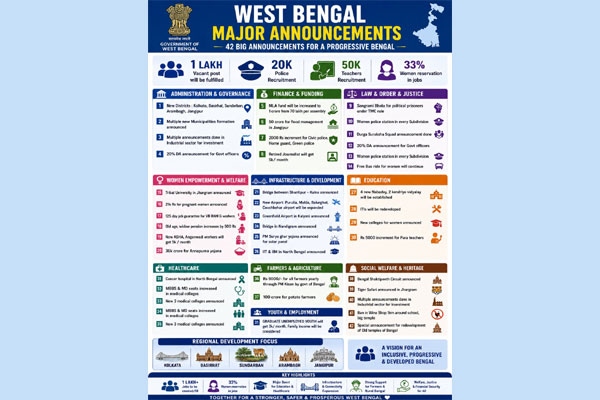
The West Bengal Budget 2026–27 has prioritised social inclusion by focusing on women empowerment, tribal welfare, worker protection and rural development. Presented in Kolkata, the budget introduces major financial support programmes, employment initiatives and welfare measures aimed at improving livelihoods among vulnerable communities across the state.
Quick Glance: Key Takeaways
- ₹36,000 crore allocated for the Annapurna Scheme supporting eligible women with monthly assistance.
- ₹14,000 crore employment mission launched for rural livelihood security.
- Tea garden workers to receive institutional support through a proposed development board.
- Tribal communities targeted through a proposed university and welfare programmes.
Kolkata: The West Bengal Budget 2026–27 has positioned women’s economic empowerment as one of its strongest social policy priorities. The government has introduced multiple initiatives aimed at improving financial independence, education access and household security for women.
A major announcement is the Annapurna Scheme, backed by an allocation of ₹36,000 crore. Under the scheme, eligible women aged between 25 and 60 years will receive monthly financial assistance of ₹3,000.
According to the policy details presented in the state budget, the initiative is designed to strengthen household economic stability while increasing women’s participation in financial decision-making.
Furthermore, the government has announced a one-time educational grant of ₹50,000 for unmarried girls entering undergraduate education. The programme has received an allocation of ₹1,000 crore.
Experts tracking rural development believe such education-linked incentives could influence long-term social indicators by encouraging higher education among young women.
The focus is not limited to direct cash support. The budget also connects women’s welfare with education, livelihood security and social development.
Tribal Welfare and Tea Garden Communities Receive Dedicated Attention
The budget has also highlighted the challenges faced by tribal communities and plantation workers. A significant proposal is the establishment of a Tribal University with an initial allocation of ₹10 crore.
The proposed institution aims to expand educational opportunities for tribal youth and strengthen access to higher learning.
In addition, the government has announced targeted nutrition support for Particularly Vulnerable Tribal Groups (PVTGs) and village-level development programmes.
Specifically, the budget recognises the unique socio-economic conditions of tribal communities requiring focused interventions.
Another major announcement is the proposed Tea Workers Development Board. The board will focus on housing, healthcare, social security and livelihood improvement for tea garden workers, particularly in North Bengal.
Officials confirmed that welfare planning for historically vulnerable worker communities has become a significant component of the budget approach.
The measures indicate a broader strategy of combining income support with institutional development.
Employment and Social Protection Drive for Vulnerable Groups
Employment generation remains another central theme of the budget. The government has introduced the VB-GRAM G (Viksit Bharat–Guarantee for Rozgar and Ajeevika Mission) with a ₹14,000 crore allocation.
The programme aims to provide up to 125 days of employment support to eligible rural households.
Consequently, the initiative is expected to strengthen rural livelihood security and reduce economic pressure that often leads to distress migration.
The budget also proposes expanding protection mechanisms for workers outside traditional employment sectors.
A Welfare Board for Gig and Platform Workers has been proposed to address the growing needs of digital economy workers.
Furthermore, pension support for vulnerable groups has been increased by ₹500 per month. The measure covers senior citizens, widows and persons with disabilities.
The expansion of Maa Aahar Centres and nutrition assistance for pregnant women also reflects the government’s continued focus on social protection.
Rural Housing and Infrastructure Support Strengthen Inclusion Agenda
Housing development remains a major component of the social welfare strategy. The budget has allocated ₹13,000 crore under the Pradhan Mantri Awas Yojana-Gramin (PMAY-G).
The programme aims to support housing construction for nearly 25 lakh beneficiaries.
In addition to improving living conditions, rural housing projects are expected to generate employment opportunities in construction and related sectors.
An internal document reviewed by Enewstime highlights that rural infrastructure investment has been planned alongside welfare expansion.
The budget has also earmarked ₹100 crore for river-based infrastructure development. The funding will support jetties, fisheries infrastructure and rural market connectivity.
Another ₹100 crore has been allocated for sustainable transportation and connectivity projects in the Sundarbans region.
However, analysts suggest that infrastructure spending will require strong monitoring to ensure effective implementation at the grassroots level.
West Bengal Budget 2026-27 Vision Combines Welfare Expansion With Long-Term Challenges
The West Bengal Budget 2026–27 presents a broad social inclusion framework covering women, tribal communities, workers and rural households.
The approach combines direct financial assistance with infrastructure investment and institutional support.
Specifically, the budget attempts to address multiple layers of inequality through targeted programmes.
However, implementation will remain the key factor determining the success of these initiatives.
Experts believe future policy planning may require stronger emphasis on agriculture, rural entrepreneurship, skill development and value-chain expansion.
According to our on-the-ground assessment, effective delivery systems, transparent monitoring and regular evaluation will decide whether welfare allocations translate into sustainable community-level progress.
News Analysis: Author’s Perspective
Social Inclusion Model Applauded, But Needs Strong Execution Beyond Budget Announcements
The West Bengal Budget 2026–27 reflects a clear attempt to place vulnerable communities at the centre of development planning. The emphasis on women, tribal groups, tea garden workers and gig economy workers indicates a wider understanding of changing social and economic realities.
The strongest feature of the budget is its multi-layered approach. It does not rely only on welfare transfers. Instead, it combines employment support, education incentives, housing schemes and institutional mechanisms.
However, the effectiveness of any welfare-oriented budget depends on the quality of implementation. Financial allocations alone cannot guarantee social transformation and all will hope new administration will ensure better implementation.
The proposed tribal university, worker welfare boards and employment programmes will require efficient administration, transparent beneficiary identification and continuous evaluation.
The larger question remains: Can welfare-driven investment create lasting economic mobility?
The answer will depend on whether these schemes generate skills, entrepreneurship opportunities and stronger rural economies alongside immediate assistance.
Overall, the budget provides a significant social protection roadmap, but sustained accountability and execution will determine its real impact on West Bengal’s communities.
(Jayanta Choudhury, Head, Department of Rural Development and Planning, Nagaland University and Founder, Global Forum for Sustainable Rural Development, West Bengal. (jayanatrd@gmail.com))
