

The latest Comptroller and Auditor General of India (CAG) report on the finances for 2024-25 highlights a mixed economic picture for Tripura, taking into account revenue and debt. The state achieved a revenue surplus and maintained low public debt, but rising fiscal deficit and government guarantees raise questions about future financial sustainability.
Quick Glance
- Tripura recorded a revenue surplus despite economic challenges.
- Fiscal deficit reached 3.48% of GSDP, crossing the 3% benchmark.
- Public debt remained low at 17.53% of GSDP.
- State guarantees increased by 25%, creating a future financial risk.
Agartala: The latest CAG report for the financial year 2024-25 has presented a detailed picture of Tripura’s economic condition. The report shows that the state has improved its routine financial management. However, it also highlights emerging concerns linked to borrowing and financial guarantees.
For a small economy like Tripura, maintaining a balance between development spending and financial stability remains a major challenge. The state has successfully controlled daily expenses. At the same time, it has increased borrowing for long-term development projects.
The financial assessment shows two different sides. One side reflects strong budget discipline. The other side signals the need for careful monitoring of future liabilities.
Tripura Achieves Revenue Surplus Despite Fiscal Pressure
One of the biggest achievements mentioned in the CAG assessment is Tripura’s revenue surplus.
A revenue surplus means the government’s regular income is higher than its routine expenses. These expenses include salaries, pensions, and administrative costs.
The 15th Finance Commission encouraged states to maintain zero revenue deficit. The objective was to ensure that governments do not borrow money merely to manage daily operations.
Tripura performed better than expected. It became one of the few states that targeted zero revenue deficit but actually achieved a revenue surplus.
The improvement was supported by the Union Government’s Post-Devolution Revenue Deficit Grant. This assistance helped the state manage regular expenditure without depending heavily on additional borrowing.
Fiscal Deficit Crosses Recommended Limit
While Tripura performed well in managing daily finances, the fiscal deficit situation remains a concern.
Fiscal deficit represents the gap between government income and total expenditure. A higher deficit usually indicates increased borrowing requirements.
According to the CAG-based assessment, the fiscal deficit target fixed under the 15th Finance Commission was 3% of GSDP.
Tripura recorded a fiscal deficit of 3.48% of GSDP in 2024-25.
| Fiscal Indicator | Tripura Status (2024-25) |
|---|---|
| Fiscal Deficit Target | 3% of GSDP |
| Actual Fiscal Deficit | 3.48% of GSDP |
| Increase compared to 2023-24 | More than 25% rise |
Tripura was among several states that crossed the 3% fiscal deficit limit. The increase of more than 25% compared with the previous financial year indicates higher dependence on borrowing.
However, borrowing itself is not always negative. If borrowed funds support infrastructure, roads, education, healthcare, and economic development, they can strengthen future growth.
The key challenge is ensuring that these investments generate enough economic returns.
Tripura Maintains One of India’s Lowest Debt Levels
Despite higher borrowing during the year, Tripura’s overall debt position remains comfortable.
The state has maintained a relatively low public debt ratio compared with many other Indian states.
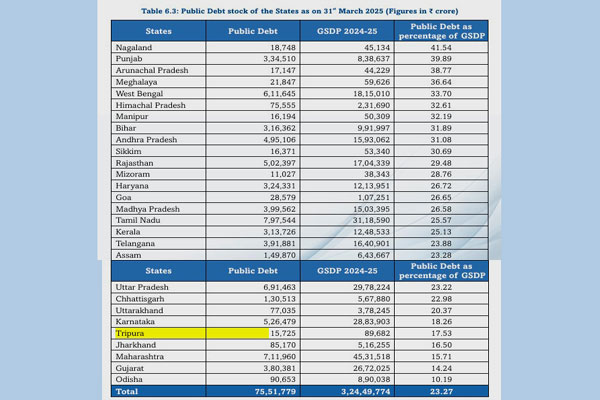
| Financial Metric | Amount |
| Tripura GSDP (2024-25) | ₹89,682 crore |
| Total Public Debt Liability | ₹15,725 crore |
| Public Debt as Percentage of GSDP | 17.53% |
Tripura’s public debt stands at 17.53% of its GSDP. This places the state among the few states in India that have kept debt below the 20% level.
The low debt ratio provides financial flexibility. It also gives the government more space to invest in development activities.
Compared with states where debt has crossed 30% of GSDP, Tripura’s position remains stronger.
Rising State Guarantees Create a Financial Warning
The biggest concern highlighted in the financial assessment is the increase in government guarantees.
State governments often provide guarantees for loans taken by public sector companies and government-backed institutions.
These guarantees do not immediately become government debt. However, they can turn into liabilities if the concerned organisations fail to repay their loans.
Tripura witnessed a significant increase in outstanding guarantees during 2024-25.
| Indicator | Change |
| Increase in State Guarantees | 25% rise compared with previous year |
| Higher increase recorded by | Maharashtra and Uttar Pradesh |
The rise places Tripura among states that have expanded financial backing for institutional borrowing.
Experts often consider guarantees a hidden risk because they may affect future budgets if government-backed entities face financial problems.
Development Push Requires Financial Monitoring
The CAG report reflects a transition phase for Tripura’s economy.
The state has shown strong control over regular expenditure. It has maintained a healthy revenue position. Its public debt remains within a safe range.
At the same time, increased borrowing and rising guarantees require continuous monitoring.
For a developing state in Northeast India, infrastructure investment remains essential. Better roads, connectivity, industries, and public services can accelerate economic growth.
However, financial discipline will remain important. The government needs to ensure that borrowed money creates productive assets and strengthens revenue generation.
News Analysis: Economists’ Lens
The latest Comptroller and Auditor General of India (CAG) assessment of Tripura’s finances presents a classic economic balancing challenge. The state has achieved notable stability in revenue management and debt control. However, rising fiscal deficit and government guarantees indicate that the next phase of growth will require careful financial planning.
From the perspective of economists associated with Enewstime, the key question is not simply whether Tripura is borrowing more. The bigger question is whether these borrowings are creating productive assets that can expand the state’s future income capacity.
Is Tripura’s Revenue Surplus a Strong Economic Indicator?
Yes, the revenue surplus is a significant positive signal.
A state’s revenue account reflects its ability to manage routine expenses through regular income. When a government achieves a surplus, it means operational costs are not forcing it to depend on fresh loans.
For Tripura, this creates a stronger fiscal foundation.
The state has managed salaries, pensions, and administrative expenses while keeping development funds separate from routine expenditure pressures.
Economically, this improves credibility. It also provides confidence to investors and financial institutions.
However, economists also examine the quality of revenue. A surplus supported mainly by external assistance, such as grants from the Union Government, needs long-term planning.
The important question is:
Can Tripura maintain revenue strength even if external financial support changes in the future? Does a 3.48% Fiscal Deficit Create a Serious Concern?
A fiscal deficit is not automatically a negative sign.
For developing economies, borrowing can accelerate growth when it finances infrastructure, connectivity, education, healthcare, and industrial development.
Tripura’s challenge is the speed of deficit expansion.
The state recorded a fiscal deficit of 3.48% of GSDP against the recommended 3% limit. The deficit also increased by more than 25% compared with the previous year.
From an economic viewpoint, this requires closer evaluation.
The critical factor is the return generated from borrowed money.
If borrowing creates highways, logistics networks, tourism facilities, agricultural value chains, and industries, then the debt can support future growth.
But if borrowing mainly supports short-term expenditure, it can create financial pressure.
Is Tripura’s Low Debt Level an Economic Advantage?
Tripura’s public debt position remains one of its strongest economic indicators.
With public debt at 17.53% of GSDP, the state remains among the better-positioned states in India.
This gives Tripura an important advantage.
Lower debt means:
- Reduced interest burden
- Greater flexibility during economic shocks
- More capacity for future investment
For a small northeastern economy, this stability matters.
States with high debt ratios often face difficulties in funding new development programmes because a large part of revenue goes toward repayment obligations.
Tripura currently has more financial space compared with highly indebted states.
Why Are Rising State Guarantees an Economic Risk?
Economists often describe government guarantees as a hidden fiscal risk.
These guarantees may not appear as direct government debt today. However, they can become a liability if state-backed organisations fail to repay loans.
Tripura recorded a 25% increase in outstanding guarantees during 2024-25.
This raises an important economic question:
Are government-backed institutions generating enough income to repay their obligations without affecting the state budget?
If these institutions succeed, guarantees can support development.
If they struggle financially, the burden may eventually shift to taxpayers.
Therefore, economists usually recommend strict monitoring of guaranteed loans.
What Growth Strategy Should Tripura Follow Now?
Tripura’s next economic priority should focus on converting borrowed money into income-generating assets.
The state has several growth opportunities:
- Expanding tourism infrastructure
- Improving road and rail connectivity
- Supporting agriculture-based industries
- Promoting bamboo, rubber, and natural resource-based sectors
- Attracting private investment
A stronger production base will increase state revenue and reduce dependence on external assistance.