

Leading medical specialists meeting in Agartala at the Livercon-9 have warned that a sharp 141 percent surge in liver ailments could soon turn the country into the global liver disease capital. Driven by lifestyle changes, alcohol consumption, and high-risk intravenous drug use, the liver disease crisis in India has emerged as a critical public health emergency.
Quick Glance: Key Data Takeaways
-
Epidemiological Surge: Documented cases of chronic liver conditions have expanded by more than 141 percent nationwide.
-
Primary Catalysts: Doctors point to junk food consumption, obesity, untreated diabetes, alcohol intake, and rising intravenous drug abuse.
-
Northeast Vulnerability: Intravenous drug networks face extreme exposure to highly infectious Hepatitis B and Hepatitis C transmissions.
-
Institutional Scale: Over 250 healthcare professionals mobilized at the Agartala Government Medical College to address these regional vulnerabilities.
Agartala: The alarming expansion of metabolic disorders across Northeast India has fundamentally altered the landscape of preventative medicine. Specialists at the 9th LiverCon highlighted that the correlation between liver damage and pure alcohol consumption is no longer the sole driver of organ failure. Specifically, the widespread adoption of calorie-dense junk food and sedentary habits has triggered a secondary crisis through Non-Alcoholic Fatty Liver Disease (NAFLD). This silent pathology develops gradually, frequently going unnoticed until it advances to irreversible stages.
According to information gathered by Enewstime Desk reporter in Agartala, the state medical observers are particularly anxious about how shifting behavioral patterns among youths intersect with chronic viral hepatitis transmission rates across border corridors.
Diabetes and clinical obesity are acting as aggressive accelerators for chronic tissue scarring. Healthcare planners must immediately recalibrate their community outreach infrastructure because treating advanced complications places an enormous financial burden on public infrastructure.
The Overlap of Substance Abuse and Viral Hepatitis
Beyond metabolic concerns, local clinical teams face a complex battle against blood-borne pathogens. Specifically, regional experts raised serious concerns regarding the high vulnerability of intravenous drug users to acute viral transmissions. Shared injection equipment continues to serve as a primary vector for both Hepatitis B and Hepatitis C across vulnerable communities.
+--------------------------+-------------------------------------------------+
| Risk Factor Profile      | Long-Term Clinical Complication                 |
+--------------------------+-------------------------------------------------+
| Intravenous Drug Abuse   | Rapid Hepatitis B & C Transmission              |
| Metabolic Shift / Junk   | Severe Non-Alcoholic Fatty Liver Disease        |
| Alcohol & Obesity        | Accelerated Liver Cirrhosis & Malignancy        |
+--------------------------+-------------------------------------------------+
These viral strains cause persistent inflammation that quietly degrades organic functions over several decades. If left unchecked, these sub-clinical infections inevitably evolve into severe liver cirrhosis or aggressive liver cancer. Representatives at the conference argued that local health strategies must integrate harm-reduction programs directly with hepatology screening to disrupt this transmission loop before it overwhelms secondary care hospitals.
Replicating the Tripura Community Hepatology Blueprint
Despite these severe warnings, the scientific assembly showcased successful localized intervention frameworks. The Hepatitis Foundation of Tripura received high praise from visiting national delegates for its community-based initiatives. This grassroots model demonstrates that decentralizing specialized diagnostics can drastically improve early intervention metrics.
+-----------------------------------+-----------------------------------+
| Metric Category                   | Recorded Conference Value         |
+-----------------------------------+-----------------------------------+
| National Case Increase Rate       | Exceeding 141 Percent             |
| Local Medical Attendance          | Approximately 250 Physicians      |
| Next Scheduled Session            | June 13 and 14, 2027              |
+-----------------------------------+-----------------------------------+
Moreover, specialists suggested that the future of community medicine relies heavily on integrating digital technologies. Introducing artificial intelligence screening systems at primary health centers could allow rural health workers to identify high-risk individuals long before major symptoms appear. The visiting faculty, including Dr. S.P. Mishra from Moti Lal Nehru Medical College, noted that this unique regional focus makes expanding the event into an international platform a logical next step.
News Analysis: Enewstime Editors Desk’s Perspective
From an administrative and socio-political standpoint, the LiverCon-9 findings indicate that clinical medicine alone cannot solve a crisis deeply rooted in behavioral and social vulnerabilities. A discussion between the experts and Enewstime Editors Desk underscores that addressing the liver disease crisis in India requires moving beyond hospital-centric care and shifting directly toward aggressive community hepatology. By decentralizing liver screenings, blood tests, and viral mapping to localized neighborhoods, health workers can identify high-risk individuals—particularly intravenous drug users—long before they enter the terminal stages of Hepatitis B or C.
To truly end the drug menace, regional administrative bodies must launch sustained, hard-hitting public awareness programs that strip away the social stigma surrounding addiction. These campaigns must explicitly educate vulnerable youth on how rapidly shared needles lead to fatal liver cirrhosis and aggressive liver cancer.
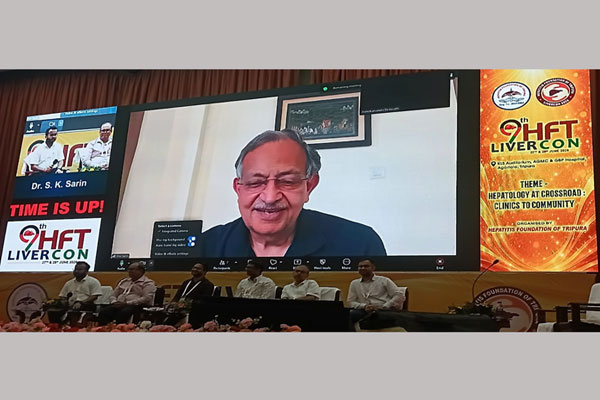
According to Enewstime Editors Desk, integrating the grassroots outreach of the Hepatitis Foundation of Tripura (HFT) with school curricula and local community centers is likely to create a dual-layer defense. Community hepatology provides early detection and medical intervention, while aggressive educational campaigns disrupt the recruitment of new users into illicit drug networks.
For policymakers, the directive from this year’s LiverCon-9 is clear: systemic eradication of the drug menace requires transforming liver health from a solely medical issue into a proactive, community-wide defense strategy.
