

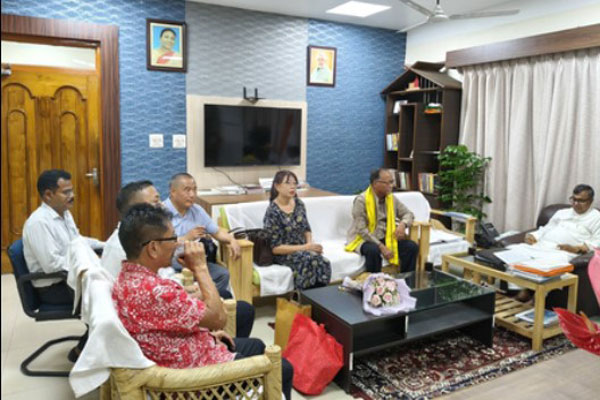
Nagaland and Tripura are expanding renewable energy cooperation after a Nagaland delegation visited Tripura in June 2026 to study clean energy projects. Led by Adviser Picto Shohe, the team reviewed solar, irrigation, and community energy initiatives to promote sustainable development and strengthen Northeast India’s green growth partnership.
Quick Glance
- A 10-member Nagaland renewable energy delegation studied Tripura’s clean energy models.
- The visit focused on PM-KUSUM, solar irrigation, rural electrification and community projects.
- Tripura’s TREDA-developed renewable installations were inspected during the two-day programme.
- Officials discussed policy exchange, financing models and future Northeast collaboration.
Agartala: The renewable energy partnership between Nagaland and Tripura reflects a wider shift in Northeast India’s development approach. States in the region are increasingly exploring collaborative solutions to address energy security, rural development and sustainability challenges.
A 10-member delegation from the Nagaland Department of New and Renewable Energy recently visited Tripura to understand the state’s renewable energy implementation strategies. The delegation was led by Adviser Picto Shohe. The team studied projects developed through the Tripura Renewable Energy Development Agency (TREDA).
Information gathered by Enewstime Desk in Agartala, analysing IANS inputs, reveals that the discussions focused not only on technology but also on administrative models, beneficiary support systems and long-term sustainability.
The visit comes at a time when Northeastern states are attempting to build stronger regional cooperation around renewable energy, reducing dependence on conventional energy sources.
Tripura’s renewable model attracts neighbouring state attention
During the visit, the Nagaland delegation examined several renewable energy installations across Tripura. The projects demonstrated how clean energy solutions can support agriculture, drinking water supply and public infrastructure.
The team inspected:
| Renewable Energy Initiative | Purpose |
|---|---|
| Off-grid solar water pumping systems | Supporting irrigation needs |
| Solarised agricultural pumps | Improving clean energy access for farmers |
| 80-kWp solar PV plant under Virtual Net Metering | Promoting decentralised power generation |
| Community solar water purification plant | Providing clean drinking water solutions |
| Solar high-mast and street lighting systems | Strengthening public infrastructure |
| 500-kWp solar PV plant at Tripura University under RESCO model | Institutional renewable energy adoption |
| Biogas plant at Ramakrishna Mission Complex, Amtali | Promoting alternative energy solutions |
| 100-kW solar plant at Agartala Integrated Check Post | Supporting clean power infrastructure |
Sources told the Enewstime Desk that the delegation appreciated the State government’s approach towards combining renewable energy with social development objectives.
The projects highlighted how clean energy programmes can directly support communities while contributing to environmental goals.
Minister-level talks highlight Northeast cooperation roadmap
During the visit, Adviser Picto Shohe met concerned officials and discussed opportunities for stronger cooperation. The discussions explored knowledge sharing, implementation strategies and future possibilities in renewable energy development.
Minister Nath stated through a Facebook post that the interaction created opportunities to strengthen inter-state cooperation and share successful practices. Consequently, the engagement has been viewed as an example of Northeast states working together towards sustainable development.
After a careful analysis, Enewstime Desk noted that such exchanges are becoming important as states look for region-specific solutions instead of relying only on national-level approaches.
Village-level renewable projects become learning points
The Nagaland delegation also visited Sathdubai Gram Panchayat and Rangacherra Gram Panchayat.
The team interacted with officials and beneficiaries to understand the practical functioning of solar water pumps, solar irrigation systems and the Green Village initiative. These field-level interactions provided insights into how renewable energy projects operate beyond government documents and policy discussions.
In addition, the delegation reviewed the role of financial and technical assistance in ensuring successful implementation.
The visit showed that renewable energy adoption depends not only on infrastructure but also on effective community participation.
Policy discussions focus on financing and future expansion
A review meeting chaired by Abhishek Chandra was held with participation from TREDA Director Debabrata Sukla Das and other officials.
The meeting covered project execution, financing mechanisms, policy frameworks and opportunities for expanded cooperation.
Moreover, the discussions reflected the growing importance of sustainable energy planning in Northeast India.
The delegation included Secretary Linda Solo and Director James Khala.
Tripura University link adds research dimension
The delegation also met Prof. Shyamal Das to explore cooperation in renewable energy awareness, research, skill development and capacity building. The team inspected the university’s solar power facility and studied institutional renewable energy applications.
In addition, the visit to the biogas facility at Ramakrishna Mission highlighted the role of alternative energy solutions. The academic partnership angle could help develop skilled manpower for future clean energy projects across the Northeast.
The Nagaland-Tripura renewable energy engagement indicates a gradual movement towards collective development planning among Northeastern states.
From Enewstime Desk’s viewpoint, the key question is: Can shared renewable energy models become a foundation for stronger regional economic cooperation?
The answer depends on how effectively states convert learning visits into long-term policy partnerships.
Tripura’s experience shows that renewable energy projects can combine infrastructure creation with rural welfare.
