

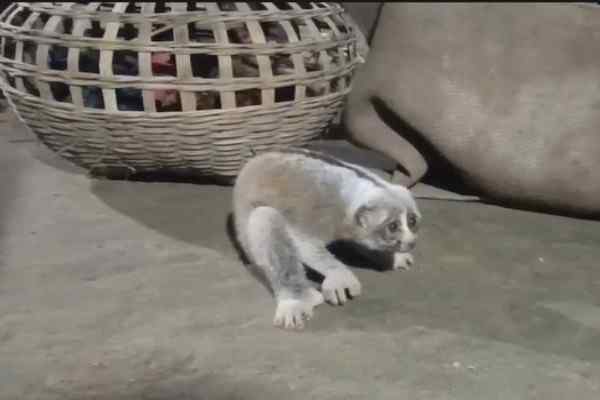
A rare slow loris, locally known as Lojjabati Banor was rescued from the roadside near Baro Bil in Khowai district of Tripura after alert residents safely secured the protected primate and informed the Forest Department. Officials attributed the increasing appearance of wild animals in human settlements to shrinking forests, while conservation concerns over habitat loss gained renewed attention.
Habitat Loss Pushes Wildlife Towards Human Settlements
Agartala: A rare slow loris (shy monkey) strayed and entered Baro Bil area in Khowai. It was rescued on Sunday, unhurt, owing to community awareness and forest department’s timely intervention.
| Read about Man-animal conflicts: Elephants on rampage in rural Tripura |
The nocturnal primate was spotted at around 7 pm slowly crossing the national highway, where it faced the risk of being hit by passing vehicles. A local resident rescued the animal and kept it in a safe place until forest personnel arrived.
| You may also like : Wild Jumbos, Sleepless Nights: Krishnapur Villagers in Tripura Block Road |
Officials later shifted the protected animal to the Khowai Forest Department office for medical examination before its planned release into the wild.
Forest Department Responds Swiftly
Forest Department official Ripon Debnath said the department received information about the animal roughly half an hour before reaching the spot.
“We received information that a slow loris had entered the area. Local people had safely secured it before our team arrived. We rescued the animal and brought it to our office. After completing the necessary medical examination and official procedures, it will be released back into its natural habitat,” Debnath told reporters.
He said the increasing movement of wild animals into human settlements is largely driven by habitat degradation.
“The forests are no longer what they used to be. Continuous clearing of forests is destroying the natural habitat of these animals. As a result, they are entering populated areas. If adequate forest habitat existed, they would not need to venture near people,” he said.
Local Resident Prevents a Tragedy
The rescue was made possible by the timely action of one Barun Kumar Pal, who first spotted the animal while returning from Shingi Chhara.
Pal said he noticed the slow loris crossing the road as a heavy vehicle approached from the opposite direction.
“I immediately turned my vehicle and blocked the road to prevent the animal from being run over. At first, I wasn’t sure what it was. Soon, around 15 to 20 local people gathered, and together we carefully rescued it after it climbed onto a small tree,” he said.
Recognising it as a rare species, Pal decided to hand it over to the Forest Department instead of keeping it.
“I brought it to my hotel and kept it safely until forest officials arrived. I felt it was the right thing to do because it is a protected wild animal,” said Pal, owner of Pratibha Hotel and Restaurant on Baro Bil Highway Road.
The coordinated efforts of local residents and the Forest Department ensured the safe rescue of the endangered primate without any injury.
Slow Loris Rescue Shows Bigger Conservation Challenge
The Khowai incident is the latest in a series of wildlife sightings in populated areas across Tripura especially in Teliamura and Kalyanpur subdivisions under the Khowai District.
In recent years, elephants, monkeys and other wild animals have increasingly strayed into villages and towns, raising concerns over shrinking forest habitats and growing human-wildlife conflict.
While rescue operations prevent immediate harm, conservation experts have repeatedly stressed the need for long-term measures to reduce such encounters.
The Enewstime Perspective: Time for Proactive Governance
The repeated appearance of wild animals in human settlements reflects a deeper ecological challenge rather than isolated incidents.
Creating and protecting wildlife corridors should become a priority so that animals can move safely between forests without crossing highways, rail tracks or entering populated areas. Rescue operations, though essential, should not remain the state’s primary conservation strategy.
After consultation with the wildlife experts, Enewstime Editors Desk understands that at the policy level, habitat preservation also requires stronger safeguards.
Industrial expansion, road projects and other infrastructure developments should undergo rigorous Environmental Impact Assessments (EIA) that specifically examine their impact on wildlife movement and habitat connectivity.
The rare slow loris (Lojjabati Banor) rescue in Khowai also demonstrates the growing awareness among local residents about wildlife conservation. The Forest Department can build on this by introducing community-led conservation programmes, training volunteers in wildlife-friendly rescue protocols and establishing local response networks under expert supervision.
| Also read : Forest Dept Expands Solar Fencing to Stop Elephant Attacks in Tripura |
Rich biodiversity of the State can only be protected through a balanced approach that combines scientific conservation, responsible development and active community participation. The successful rescue of the slow loris serves as both a reminder of the state’s ecological wealth and a warning that safeguarding wildlife requires action long before animals wander into human settlements.
