

As the ‘Destination Tripura Business Conclave 2026’ approaches, the state government is setting an ambitious ₹1 lakh crore investment target. Moving beyond mere pledges, the administration is using the July 9 event to showcase the efficacy of its “SWAAGAT” single-window clearance and deep regulatory reforms, aiming to prove that Tripura is now a premier investment-ready destination.
Key Takeaways:
-
Targeting Growth: The state is aiming for ₹1 lakh crore in new investment proposals during the two-day summit.
-
Proof of Concept: The government highlights a 26% conversion rate from last year, with ₹8,000 crore in projects already in the execution phase.
-
Regulatory Focus: Success hinges on the “SWAAGAT 2.0” platform, designed to simplify land, labor, and power compliance for investors.
-
Global Reach: International delegations from Bangladesh, the Philippines, and Uzbekistan are confirmed, underscoring Tripura’s status as a regional logistics hub.
Agartala: As the countdown to the ‘Destination Tripura Business Conclave 2026’ begins, the state government is positioning the upcoming two-day summit not merely as an investment drive, but as a critical stress test for its revamped industrial framework. With an ambitious target of securing ₹1 lakh crore in investment proposals, the event—scheduled to commence on July 9 at the Hapania International Fair Ground—will serve as the primary litmus test for the state’s aggressive push toward administrative simplification and deregulation.
| Related News: Green Technology and Digital Economy: How Tripura Planning to Move Ahead |
From Policy to Performance: A Credibility Shift
The shift in narrative for this year’s conclave is deliberate. Rather than focusing solely on the volume of Memorandum of Understanding (MoUs) signed, the government is highlighting the “conversion rate” of the previous year’s commitments. Data presented by the Industries and Commerce Department indicates that of the ₹30,000 crore in proposals inked during the 2025 summit, projects valued at approximately ₹8,000 crore have already entered the execution phase.
“The goal is not just to attract interest, but to ensure that the transition from a proposal to a grounded project is frictionless,” said a senior official within the Industries and Commerce Department. “We are utilizing this conclave to demonstrate that Tripura is no longer an administrative hurdle for investors, but a partner in their operational success.”
This emphasis on “grounding” investments is a direct response to past critiques regarding bureaucratic inertia in the Northeast. By showcasing operational units—such as recent data center infrastructure and expanded manufacturing facilities—the government aims to build a track record of reliability.
The “SWAAGAT” Edge
Central to the government’s investor-friendly pitch is the upgraded SWAAGAT 2.0 ecosystem. Designed to consolidate incentives, registrations, and central inspection systems onto a unified digital platform, the portal has become the backbone of the state’s “ease of doing business” strategy.
During the conclave, state officials will host “sector-focused” roundtables where investors can engage directly with departmental heads to navigate the SWAAGAT interface. The government has prioritized reforms in land-use conversion, labor compliance, and power infrastructure, aiming to reduce the lead time for new industrial projects to reach commercial production.
A New Class of Infrastructure
The choice of venue—the Hapania International Fair Ground—is symbolic of this new approach. Moving away from traditional hotel-based meetings to a purpose-built, high-capacity exhibition space indicates the state’s readiness for larger, complex industrial operations.
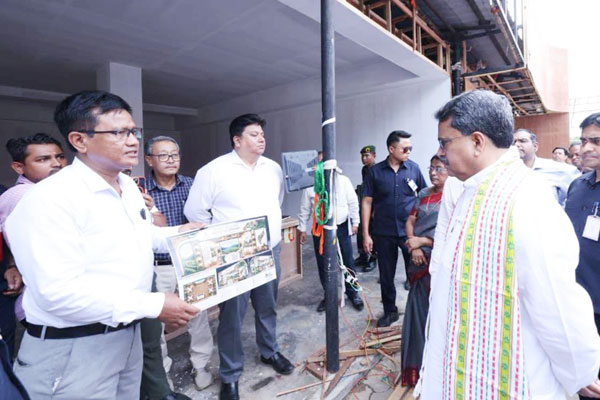
More than 20 dedicated exhibition stalls, representing both state government departments and Central Public Sector Undertakings (CPSUs), will offer real-time insights into the state’s logistics, tea, rubber, and agarwood processing value chains. The presence of international delegations from countries including Bangladesh, the Philippines, and Uzbekistan reflects a growing belief that Tripura’s regulatory environment is now robust enough to support cross-border trade ventures.
Sectoral Priorities and Future-Proofing
The target of ₹1 lakh crore is spread across sectors that are pivotal to the state’s long-term economic vision, known as Lakshya 2047. By aligning with national initiatives like ‘Viksit Bharat,’ Tripura is actively courting investments in:
-
Information Technology & Data Centers: Building on recent successes in attracting telecom infrastructure.
-
Healthcare & Education: Expanding the state’s capacity as a regional service hub.
-
Renewable Energy: Leveraging the region’s natural resources to meet sustainable development goals.
-
Logistics & Connectivity: Capitalizing on the state’s proximity to Bangladesh’s ports and the expanding network of Integrated Check Posts (ICPs).
The Path Ahead
As Union Minister for Development of North Eastern Region (DoNER) Jyotiraditya Scindia arrives to inaugurate the event on July 9, the eyes of the investor community will be on the state’s ability to articulate a clear, predictable, and simplified path to doing business.
For Chief Minister Dr. Manik Saha and his team, the success of the 2026 Conclave will be measured not just by the thousands of crores promised on paper, but by the tangible reduction in the time and effort required to break ground on a new project. As the state moves to position itself as the investment gateway of the Northeast, the July 9 event will serve as a definitive indicator of whether Tripura’s regulatory reforms have truly achieved the scale and speed that the modern market demands. (Sources: The Economic Times & India Today NE)
