

The fatal tunnel collapse at the under-construction NHPC Teesta Stage-VI Hydropower Project in Sikkim has claimed 13 lives, intensifying scrutiny of safety standards at one of the state’s key hydroelectric projects. Rescue teams continue to battle hazardous conditions inside the tunnel as authorities work to recover the remaining trapped workers.
Key Takeaways
- Death toll in the Sikkim tunnel collapse has risen to 13.
- The accident occurred inside the Samardung tunnel of NHPC’s Teesta Stage-VI Hydropower Project.
- Rescue efforts remain suspended intermittently due to mud, water ingress and unstable ground.
- Preliminary autopsy of the first identified victim indicates death due to asphyxia.
- The tragedy has renewed focus on worker safety and risk management at large hydropower projects.
Gangtok/Agartala: The tunnel collapse at NHPC’s Teesta Stage-VI Hydropower Project has emerged as one of Sikkim’s worst industrial disasters in recent years. As rescue teams recovered another body on Wednesday, the official death toll climbed to 13, shifting national attention from the rescue mission to the broader questions surrounding construction safety at the ambitious hydropower project.
The accident occurred inside the Samardung tunnel at Jholungey in Namchi district, where several workers were carrying out construction activities when the collapse trapped them underground. Since then, multiple agencies have been working round the clock to reach those still believed to be inside the tunnel.
Rescue Mission Faces Severe Operational Challenges
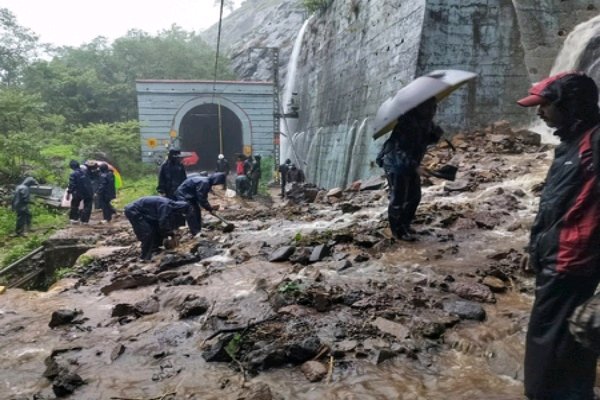
The rescue operation has proved exceptionally difficult because of the dangerous conditions inside the tunnel. Large volumes of mud and water continue to accumulate, making access nearly impossible in several sections.
Officials temporarily suspended rescue activities after engineers assessed that unstable ground conditions posed serious risks to emergency responders. Authorities said operations would resume with full strength only after the tunnel becomes safe enough for personnel to enter.
Despite the setback, teams from the National Disaster Response Force (NDRF), the specialised Asansol Rescue Team and other emergency agencies remain deployed at the site. Heavy machinery and specialised equipment are on standby to resume operations immediately once conditions improve.
Rescue officials described continuous water seepage, thick mud deposits and unstable tunnel surfaces as the biggest obstacles slowing down the search.
Identification of Victims Continues
Authorities have shifted all recovered bodies to different hospitals for identification and post-mortem examinations.
Four bodies have been taken to Sir Thutob Namgyal Memorial Hospital in Gangtok, while the remaining victims have been sent to Namchi District Hospital and Singtam District Hospital.
So far, officials have identified only one victim as 31-year-old Shyam Oraon from Indong Tea Estate in West Bengal’s Jalpaiguri district.
According to Additional Medical Superintendent Dr. Suresh Madan Rasaily of STNM Hospital, the preliminary autopsy found that Oraon died due to asphyxia. Doctors also detected multiple physical injuries, including burn injuries.
Authorities continue efforts to identify the remaining victims before handing over their bodies to family members.
Safety Questions Surround Teesta Stage-VI Project
The tragedy has brought renewed attention to occupational safety measures at major infrastructure projects in mountainous regions.
The Teesta Stage-VI Hydropower Project is one of NHPC’s important hydroelectric developments in Sikkim. Large hydropower projects in the Himalayan region involve extensive underground tunnelling through fragile geological formations, making construction inherently challenging.
Experts have long pointed out that tunnelling projects in the Himalayas face risks from loose rock formations, underground water channels, sudden seepage and unstable slopes. These conditions require continuous geological monitoring, robust engineering safeguards and strict workplace safety protocols.
Although officials have not yet confirmed the exact cause of the collapse, investigators are expected to examine geological conditions, construction practices and compliance with prescribed safety standards.
The findings could influence future safety protocols not only for the Teesta Stage-VI project but also for similar hydropower developments across the Himalayan region.
Authorities Prioritise Worker Safety During Rescue
Officials said the immediate priority remains locating and recovering the remaining trapped workers without exposing rescue personnel to additional danger.
Emergency responders have repeatedly paused and reassessed operations whenever conditions inside the tunnel became unsafe. Authorities emphasised that rescue efforts would continue only after ensuring the safety of personnel entering the affected section.
This cautious approach reflects the difficult balance between conducting an urgent rescue mission and preventing further casualties among emergency workers.
Investigation Likely to Shape Future Infrastructure Safety
The tunnel collapse is expected to trigger a detailed technical investigation into the circumstances that led to the accident. Experts are likely to assess geological surveys, construction methods, structural support systems and emergency preparedness at the site.
The outcome of the investigation may also prompt a broader review of safety mechanisms at ongoing hydropower and tunnel construction projects in Sikkim and other Himalayan states.
For now, the focus remains on completing the rescue operation and identifying all victims. However, the incident has already raised critical questions about construction safety, disaster preparedness and risk management at one of the region’s significant hydropower projects. (With IANS Inputs)
