

The partnership between AIIMS, New Delhi and the Tripura government is emerging as a catalyst for administrative reforms in the health sector, with the state making rapid progress in medical education, hospital governance, faculty development and digital health systems. A recent review meeting highlighted the implementation of key reforms under the 2025 Memorandum of Understanding (MoU), positioning Tripura to build a more efficient, technology-driven and academically stronger public health system.
Institutional Transformation in Tripura Healthcare
Agartala: The collaboration between AIIMS, New Delhi and the Tripura government is moving beyond infrastructure upgrades to reshape the state’s healthcare governance and medical education ecosystem.
During a recent review meeting held through video conference, AIIMS Director Prof. (Dr.) Nikhil Tandon expressed satisfaction over the pace at which Tripura has implemented commitments under the Memorandum of Understanding (MoU) signed between the two institutions. He commended the state government for executing several administrative and institutional reforms within a short period.
Officials said the reforms are intended to modernise healthcare administration, strengthen medical education, improve hospital efficiency and enhance patient services across the state.
The Health and Family Welfare Department said the AIIMS partnership has become an important framework for long-term institutional development rather than merely a technical collaboration.
Administrative Reforms Gather Momentum
One of the major outcomes of the partnership has been the acceleration of governance reforms across the health sector.
The review noted that several administrative measures envisaged under the MoU have already been implemented, while others are progressing according to schedule.
Among the key initiatives is the development of a Health University framework aimed at improving medical education governance in the state. Authorities have initiated reforms relating to institutional staffing, greater financial autonomy and the adoption of IT-enabled administrative systems.
These reforms are expected to streamline decision-making, strengthen accountability and improve coordination among healthcare institutions.
Officials said digitisation of administrative processes will also reduce delays in service delivery while improving transparency across the health department.
Focus on Human Resource Development
The AIIMS collaboration has also placed strong emphasis on strengthening the healthcare workforce.
Recruitment of doctors, faculty members and other healthcare professionals continues through the Health Department and the Tripura Public Service Commission in accordance with existing government rules.
Alongside recruitment, faculty development programmes have been launched in coordination with AIIMS.
Medical teachers and healthcare professionals are undergoing specialised training and skill upgradation to improve clinical expertise and academic standards.
Officials believe continuous professional development will help improve both medical education and patient care in government institutions.
The partnership also seeks to create a sustainable system for capacity building rather than relying on periodic training initiatives.
Medical Education Set for Major Expansion
The review highlighted several initiatives aimed at improving the quality of medical education in Tripura.
Authorities are working on introducing new academic departments while expanding opportunities for specialised medical training.
Service rules governing medical education are also being revised to support academic excellence and attract qualified professionals.
Faculty members are receiving exposure through structured training programmes at AIIMS, New Delhi.
The state government is also preparing the groundwork for introducing advanced postgraduate super-speciality courses, including DM and MCh programmes, subject to completion of the required academic and regulatory processes.
These initiatives are expected to strengthen Tripura’s capacity to train specialist doctors within the state.
Hospital Governance Receives Equal Attention
Institutional reforms are not limited to classrooms and administrative offices.
The AIIMS partnership has also focused on improving hospital management systems and operational efficiency.
Officials said work is underway to strengthen emergency services, expand intensive care facilities and improve operation theatre management.
The government is also introducing advanced medical equipment through the Public-Private Partnership (PPP) model while upgrading supply chain management for medicines and medical consumables.
AIIMS has advised the state to enhance infrastructure and manpower in existing hospital departments to reduce patient waiting time and improve turnaround time for healthcare services.
The review further emphasised strengthening district and peripheral health institutions so that patients can receive quality treatment closer to their homes.
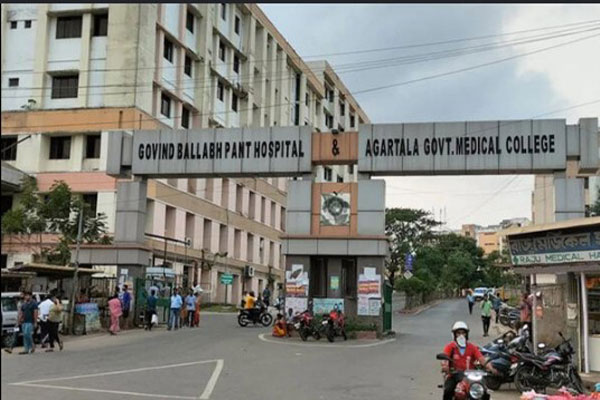
Officials believe this strategy will reduce the overwhelming patient burden at Agartala Government Medical College and GBP Hospital, which currently serves as the state’s principal tertiary care institution.
Digital Healthcare Reforms Continue
Digital governance has emerged as another major pillar of the AIIMS-Tripura partnership.
Officials said telemedicine services have expanded significantly, enabling specialist consultations without requiring patients to travel outside the state.
The AIIMS expert team appreciated the state’s efforts to reduce referrals to hospitals outside Tripura through improved digital healthcare services.
Technology-enabled monitoring systems are also expected to improve hospital administration and healthcare planning in the coming years.
Progress Reviewed Over Multiple Meetings
The latest review builds upon earlier assessments conducted this year.
On January 28, Chief Minister Prof. (Dr.) Manik Saha reviewed the Action Taken Report on the implementation of the MoU signed on October 17, 2025, during a video conference with the then AIIMS Director Prof. (Dr.) M. Srinivas and senior officials.
Another review held on June 23 acknowledged that the state government had already implemented most of the responsibilities assigned under the agreement.
The AIIMS expert team had also praised several citizen-centric initiatives, including telemedicine services and efforts to further reduce infant mortality.
Towards a Sustainable Healthcare Ecosystem
Officials believe the collaboration represents a long-term institutional partnership aimed at creating a self-reliant healthcare system in Tripura.
Rather than focusing solely on physical infrastructure, the partnership seeks to strengthen governance, improve academic quality, develop human resources and modernise healthcare administration.
| Related News: AIIMS Delhi to help transform Tripura Medical College and Hospital into medical hub: CM Saha |
With continued technical guidance from AIIMS and sustained implementation by the state government, Tripura aims to build a healthcare ecosystem capable of delivering better medical education, stronger public hospitals and improved patient care across the state.
The review meeting was attended by Health Secretary Kiran Gitte, Additional Secretary Saju Wahid A, Director of Health Services Dr. Debasri Debbarma, Officer on Special Duty for Health Education Prof. (Dr.) Abhijit Dutta, AGMC and GBP Hospital Principal Prof. (Dr.) Biplab Nath, Medical Superintendent Dr. Bidhan Goswami, AIIMS Director Prof. (Dr.) Nikhil Tandon and other senior officials.
The Health and Family Welfare Department shared the details in an official statement.
