

As digital payments continue to reshape India’s financial landscape, the National Payments Corporation of India (NPCI) has stepped up its awareness campaign against SMS-based financial scam. The organisation has urged users of UPI and other digital payment platforms to remain cautious of deceptive text messages that attempt to steal money or personal information by exploiting fear, urgency and trust.
Quick Glance
- NPCI warns users about rising SMS-based financial fraud.
- Fraudsters impersonate banks, telecom firms and government agencies.
- Fake messages aim to steal OTPs, UPI PINs, passwords or money.
- Users should verify requests only through official channels.
- NPCI urges citizens to report suspicious activity by calling 1930.
- Awareness remains the strongest defence against digital payment scams.
NPCI Intensifies Awareness Drive Against SMS Fraud
Agartala/New Delhi, August 05: India’s digital payment revolution has transformed the way millions of people pay bills, transfer money and conduct everyday transactions. While this shift has made financial services faster and more accessible, it has also created new opportunities for cybercriminals.
Recognising the growing threat, the National Payments Corporation of India (NPCI) has launched a fresh public awareness initiative highlighting the risks posed by fraudulent text messages. The campaign focuses on educating users about how scammers manipulate emotions to gain access to money, banking credentials and digital accounts.
According to NPCI, most modern financial frauds no longer depend on sophisticated hacking techniques. Instead, criminals increasingly rely on social engineering, a method that persuades people to act impulsively through carefully crafted messages that appear genuine.
How SMS Scams Target Digital Payment Users
NPCI explained that SMS scams typically involve fake text messages that impersonate trusted organisations such as banks, government departments, telecom companies, courier services or customer support centres.
These messages are designed to convince recipients that immediate action is required. Some claim that a bank account has been blocked, a KYC update is pending or a payment has failed. Others promise rewards, cashback offers, tax refunds or prize money to lure unsuspecting users.
Because these messages often resemble official communications, many people respond before verifying their authenticity.
The organisation said a fraudulent SMS may ultimately direct users towards activities that compromise their financial security.
Five Common Objectives Behind SMS Fraud
NPCI identified five common actions that cybercriminals attempt to persuade victims to perform.
Fraudsters frequently send links leading to fake websites that closely resemble legitimate banking or government portals. They may also ask victims to call fake customer care numbers where criminals pose as support executives.
Another common tactic involves persuading users to download unknown mobile applications capable of stealing sensitive information.
Scammers also attempt to obtain confidential details such as OTPs, UPI PINs, passwords or debit card credentials. In several cases, victims receive fake SMS alerts claiming money has been credited to their accounts and are subsequently tricked into transferring funds.
Simple Safety Measures Can Prevent Financial Loss
NPCI advised users to remain cautious before responding to any unexpected message.
The organisation recommended reading every SMS carefully instead of reacting immediately. Whenever a request appears unusual, users should verify it directly through the official website, mobile application or customer care service of the concerned organisation.
People should install mobile applications only from trusted app stores and carefully review app permissions before granting access.
NPCI reiterated that OTPs, UPI PINs, passwords and other confidential banking credentials should never be shared with anyone, irrespective of the reason provided.
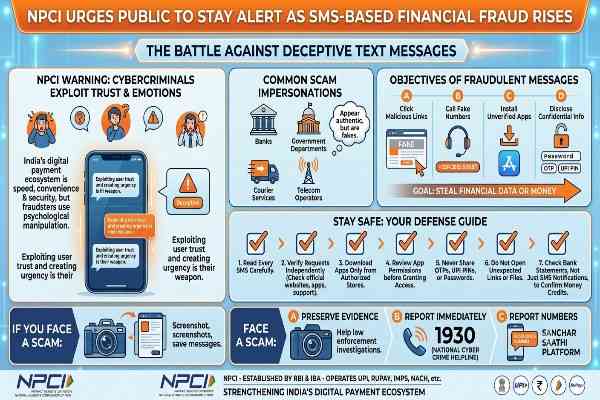
Users have also been advised to avoid clicking unknown links or downloading files received through unsolicited messages. Before believing any notification about money being credited, customers should confirm the transaction through their official bank statement or banking application.
Reporting Fraud Can Help Authorities Act Faster
NPCI encouraged citizens to preserve evidence whenever they receive suspicious SMS messages.
Saving the message, taking screenshots and documenting conversations can significantly assist investigators in tracing fraudulent activities.
The organisation urged users to report cyber fraud immediately by contacting the National Cyber Crime Helpline on 1930. Suspicious mobile numbers can also be reported through the Department of Telecommunications’ Sanchar Saathi portal.
Early reporting increases the chances of limiting financial losses and helps authorities identify emerging fraud patterns.
NPCI Continues to Strengthen India’s Digital Payments Ecosystem
NPCI serves as the umbrella organisation responsible for operating India’s retail payment and settlement systems. Established by the Reserve Bank of India (RBI) and the Indian Banks’ Association (IBA), it has played a pivotal role in building the country’s digital payments infrastructure.
Its flagship platforms—including Unified Payments Interface (UPI), RuPay, Immediate Payment Service (IMPS), National Automated Clearing House (NACH), National Electronic Toll Collection (NETC), Aadhaar Enabled Payment System (AePS) and e-RUPI—have significantly expanded secure digital transactions and improved financial inclusion across India.
As digital payment adoption continues to grow rapidly, NPCI said public awareness remains one of the most effective tools against cybercrime. By recognising warning signs, verifying every request and protecting confidential information, users can greatly reduce the risk of becoming victims of SMS-based financial fraud.
The latest awareness initiative reinforces NPCI’s broader objective of ensuring that India’s digital payment ecosystem remains not only innovative and accessible but also safe and trustworthy for every user.
