

Before the Manikyas: From the Prayaga Prashasti to the Belonia Coin Hoards — Another Ancient History of Tripura Through Copper Plates, Archaeology, Coins, Settlements and Historical Geography
Where should we begin the history of Tripura?
Should we begin with the Rajmala? With the genealogy of the Manikya kings? Or should we go further back to Druhyu, Yayati or some royal figure mentioned in the Puranas?
This has been the usual approach for a long time.
But according to the principles of history, the question needs to be framed somewhat differently.
What do the oldest pieces of evidence found beneath the soil of the territory that we call Tripura today tell us? What do contemporary inscriptions from its surrounding areas tell us? What do the coins tell us? What does settlement archaeology tell us?
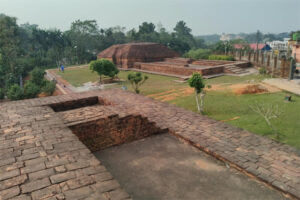
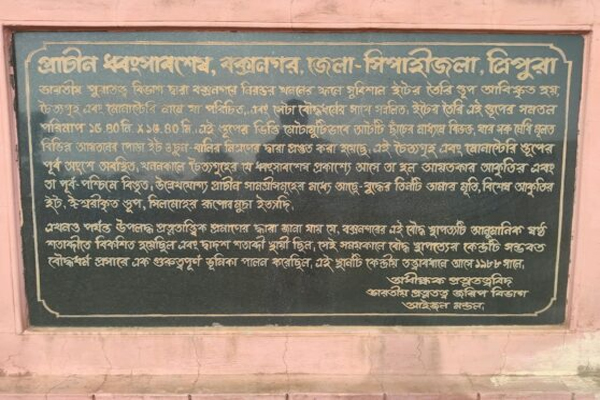
This is where the Rajmala stands alongside the Prayaga Prashasti, Gunaighar Copper Plate, Ashrafpur Plates, Kailan Plate, Lokanatha Record, Paschimbhag Plate, Mehar Plate, Mainamati excavations, Boxanagar, Pilak and the Belonia coin hoards of southern Tripura.
And then the picture begins to change.
The territory that we call Tripura on today’s political map was not necessarily under one kingdom 1,500 years ago. Contemporary evidence proving that the entire territory formed part of a single state during that period has not yet been found.
The geographical landscape of present-day Tripura was also very different in ancient times. Its plains opened towards the areas of present-day Comilla-Mainamati, Noakhali, Feni, Chittagong and the wider southeastern Bengal region. These plains were connected to the broader world of eastern Bengal.
Two large geographical worlds appear to have stood side by side.
On one side were the hills. This was part of the world of Tibeto-Burman-speaking communities of Northeast India. The history of the ancestors of the Tiprasa people belongs within this long population history.
On the other side were the western and southern plains. The ancestors of present-day Bengalis lived there. They also ruled these areas at different times and exercised social, cultural and, of course, religious influence.
Here, I must make one point clear.
The purpose of this article is not to present the history as a victory of one community and a defeat of another.
For me, the subject is much more interesting for several other reasons.
The basic point is that the hill world of present-day Tripura formed part of the Northeast Indian Tibeto-Burman population landscape. It was within this landscape that the history of the ancestors of the Tiprasa people developed.
At the same time, the western and southern plains belonged to the Samatata-Harikela agrarian, commercial and cultural world of southeastern Bengal, where the ancestors of present-day Bengalis lived.
The two worlds remained closely connected at different points of time.
On one side were the hills. On the other were the plains. On one side was the Tibeto-Burman linguistic world. On the other was the eastern Indo-Aryan world.
If we place the geographical map of present-day Tripura before us and examine its history, the picture becomes more complex.
The hill areas of present-day Tripura were indeed the land of the Tiprasa people in ancient times. But the plains — including areas such as Sonamura, Belonia, Kailashahar and Dharmanagar — were, in a broader historical sense, regions influenced by the ancestors of present-day Bengalis.
This is what a scientific interpretation and analysis of history suggests.
But there was no Chinese wall between these two worlds.
People moved. Boats travelled along rivers. Coins moved from one place to another. Religions travelled. Technical knowledge travelled. Artistic traditions travelled. Kings came and went. Boundaries changed. But people remained, and people mixed.
This is the history of Tripura, as it is the history of any other place. This is the history of a frontier.
It is important to remember that the history of kings, or for that matter the history of a particular government, is not the same as the history of people.
Kings or governments draw borders. People marry across those borders.
Kings or governments change capitals. Farmers do not change their fields so easily.
Dynasties disappear. Villages remain.
Political names change. Languages change slowly.
And it is through these slow processes that people are formed.
Did Bengalis Come to Tripura Only After 1947?
The statement that “Bengalis came to Tripura after 1947” contains an element of unquestionable truth.
After Partition, Tripura witnessed an enormous influx of refugees from East Pakistan. The demographic balance changed dramatically.
There is no meaning in denying this history.
But if one goes further and says, “Therefore, there was no historical presence of Bengali-speaking or Bengali-ancestral eastern populations in Tripura before that period,” then the conclusion does not follow from the evidence.
Not only that, such a conclusion would ignore scientifically examined historical evidence.
The Partition migration was a huge demographic wave. But the scale of that wave does not prove that there were no smaller movements over the preceding centuries.
Rather, archaeology and historical geography point towards a different picture.
The presence of Bengalis in Tripura was not a single event. It developed through several layers.
That is why I consider an answer such as “Bengalis came to Tripura in year X” historically inadequate.
I am interested in examining and presenting these different layers.
Broadly, this is what I am trying to explore.
The first layer is ancient and early-medieval interaction across the Samatata-Harikela frontier.
The second layer concerns the movement of cultivators, Brahmins, scribes, artisans and administrative personnel alongside the expansion of the emerging Tripura and Manikya state into the plains.
The third layer centres on settlement around Chakla Roshnabad and the plains revenue system.
The fourth layer involves colonial administrative, commercial and professional migration.
The fifth layer is the Partition and refugee influx.
The final layer was so enormous that it has almost visually erased the earlier layers.
But an event becoming invisible does not mean that it never existed.
(A separate part of my ongoing series will deal with aspects of the third layer.)
Sources Behind This Series
I want to make one point clear at the very beginning of this first part.
The subjects I am writing about, or preparing to write about, have been discussed and written about somewhere before. I am only arranging the available evidence and presenting it according to its sources.
I have read the works of historians and researchers such as R. C. Majumdar, Dr D. C. Sarkar, Nihar Ranjan Roy, Robert S. Wicks, Nicholas Rhodes, J. F. Fleet, Furui Ryosuke, M. Chowdhury, M. Harunur Rashid, Suchandra Ghosh, Sayantani Pal, Projit Kumar Palit and Ratnabali Ray Sengupta.
I have also studied the works of many researchers from Tripura, including Johar Acharya, Mrinal Kanti Ray, Nalini Ranjan Ray Chowdhury, Pannalal Ray, Dipak Bhattacharya, Suchintya Bhattacharya, Nani Gopal Debnath and Lincoln Reang, among others.
Some references have already been directly provided in the article for readers. The books and other works from which I have taken assistance will be listed later in the bibliography.
I have kept the Rajmala outside the framework of this discussion because it does not provide historical or scientific material or information relating to the period that I am trying to examine.
This article primarily depends on the basic scientific sources and materials used in the writing of history.
(The write-up is being translated by the Enewstime Desk. The original post, published in Tripuranet.com, is embedded below)
