

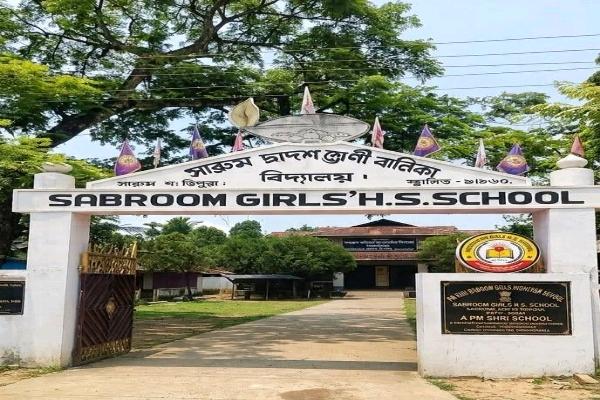
As the news of selection of Ranjan Deb Nath for 2026 National Teachers Award spread, Sabroom PM SHRI Class XII Girls HS+2 School has drawn widespread attention.
Ranjan Deb Nath began his career as an assistant teacher at Maichhara Class XII School in Kamalpur in 1997. He subsequently taught at Nandanagar Class XII School in Agartala in 2003, Pratikrai Class XII School in Dharmanagar in 2012, and Hindi Derozio Academy English Medium School in Agartala in 2014. He joined Sabroom Class XII Girls School in 2021.
Key Takeaways:
- Headmaster Ranjan Debnath has been selected for the 2026 National Teachers Award.
- Sabroom PM SHRI Girls HS+2 School has combined academic excellence with sports and technology-based learning.
- The school has recorded strong board examination results despite having only 17 teachers for around 700 students.
Sabroom School Emerges as an Education Success Story
Established in 1960, Sabroom PM SHRI Class XII Girls School has undergone a major transformation in recent years.
| Earlier report: Ranjan Deb Nath from Tripura Selected for National Teachers Award 2026|
The school has strengthened academic performance while introducing technology-based learning and wider opportunities for students.
The school became part of the PM SHRI initiative on September 7, 2022. The programme seeks to develop schools as model institutions in line with the National Education Policy (NEP) 2020.
The new approach gives students opportunities beyond textbook-based learning. It promotes creativity, critical thinking and problem-solving. Sports, arts, life skills and social values also form part of the learning process.
Strong Academic Performance
The school has produced consistent results in board examinations. It recorded a 100 per cent pass rate in both Madhyamik and Higher Secondary examinations in the 2022-23 and 2023-24 academic years.
In 2024-25, the school maintained a 100 per cent pass rate in Madhyamik. The Higher Secondary pass rate stood at 92 per cent.
The achievement helped the institution earn recognition as the best school in South District during the 2023-24 academic year.
Two students from rural backgrounds, Twitar Tripura and Gopimala Tripura, also received the Chief Minister Annual State Award in 2025 for their academic performance.
Focus on Technology and Modern Learning
The school has introduced several facilities to support modern education. These include smart classrooms, science laboratories, vocational education and live classes through PM e-VIDYA DTH channels.
Students also have access to an Atal Tinkering Lab, skill lab, robotics and virtual reality facilities. The school runs a library club and musical band. Self-defence, yoga and meditation activities are also part of student development.
The initiatives aim to prepare students for a technology-driven world while strengthening practical and life skills.
Students Make Their Mark in Sports
The school has also expanded its focus on sports. Students have represented the institution at national-level competitions in several disciplines.
Sangeeta Das, Pushpa Biswas and Manisha Das participated in national-level table tennis competitions.
Smaranjali Tripura, Urmila Munda and Priyanka Munda participated in national-level kho-kho competitions. The same students also received opportunities to compete in national-level kabaddi.
Dishampori Tripura represented the school at the national level in Under-14 football.
These achievements have given students from rural areas greater exposure to competitive sports.
Around 700 Students, Only 17 Teachers
The scale of the school makes its achievements particularly notable. Around 700 students study from nursery to Class XII. The institution has only 17 teachers.
Despite the limited manpower, teachers continue to manage classroom teaching and co-curricular activities. Their efforts have helped the school maintain academic standards while expanding student participation in sports and other activities.
The school has also improved its infrastructure. A 100-seat tribal hostel has been constructed. The institution also has another hostel for 19 Scheduled Caste girl students.
A kitchen garden and water harvesting system add to the school infrastructure.
Ranjan Debnath Gets National Recognition
Headmaster Ranjan Debnath has been a key figure in the transformation of the school.
He began his teaching career in 1997 as an assistant teacher at Maichhara Class XII School in Kamalpur. He later served at schools in Agartala and Dharmanagar before joining Sabroom Class XII Girls School in 2021.
His approach places strong emphasis on student welfare and modern teaching. He also maintains regular communication with students and parents.
His contribution has now received national recognition. Debnath has been selected for the 2026 National Teachers Award.
The honour is significant for Sabroom and Tripura. It also highlights the role that committed teachers can play in strengthening government schools.
A PM SHRI Model for Rural Education
Sabroom PM SHRI Class XII Girls School represents a broader shift in government education. The institution has combined academic learning with technology, sports, vocational skills and personality development.
The school has also benefited from support provided by social and private organisations. Around nine organisations reportedly recognise meritorious students every year. Such initiatives encourage students to perform better and build confidence.
An online interaction involving three students and Prime Minister Narendra Modi during the “Vikshit Bharat” programme added another notable achievement to the school record.
With its combination of modern infrastructure, dedicated teachers and strong student participation, the Sabroom institution is emerging as an example of how a government school can evolve into a model centre for holistic education. Its progress could offer useful lessons for other rural schools across Tripura and the Northeast.