
Tripura has begun a major shift towards paperless employee administration with the state-level launch of four NextGen Human Resource Management System modules. The initiative seeks to give government employees faster access to service records and financial benefits while making administrative decisions more transparent, traceable and accountable.
Key Takeaways
- Tripura launched four NextGen HRMS modules: e-Service Book, e-Leave, e-Salary and e-Pension.
- The system will digitise employee records and make leave, salary, GPF and pension services accessible online.
- Digital records, e-signatures and automated checks aim to reduce delays, errors and duplicate payments.
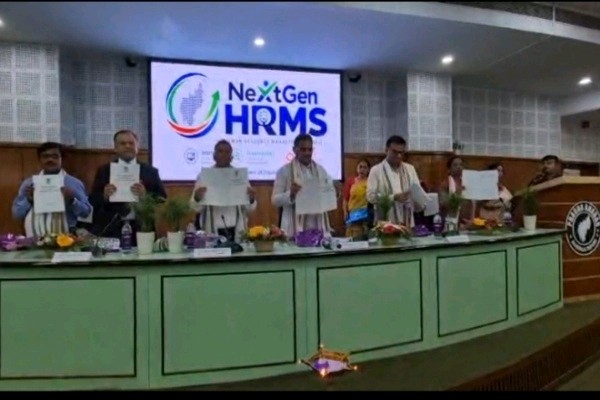
Four new modules under Tripura’s NextGen Human Resource Management System (HRMS) were launched at the state level on Tuesday to modernise employee management and reduce dependence on physical files.
The formal launch took place at 11 am at Hall No. 3 of Pragya Bhavan in Agartala. Finance Minister Pranajit Singha Roy attended the programme as the chief guest and formally inaugurated the modules.
The four services are e-Service Book, e-Leave, e-Salary and e-Pension. Together, they are designed to cover several key stages of a government employee’s service journey, from routine leave and salary matters to retirement and pension processing.
Four Services Move Online
The new platform will allow employees to access important employment-related information from home. This includes leave details, salary information, General Provident Fund (GPF) records, pension-related information and service books.
Employees will also be able to submit claims through the digital platform. These include salary bills, arrear bills, GPF transactions, financial benefits and pension claims.
The system can then forward relevant claims to the Accountant General’s office for processing. This is expected to create a more streamlined workflow and reduce delays caused by physical files moving between offices.
Finance Minister Pranajit Singha Roy said the initiative reflects the government’s focus on good governance. He said technology should reduce the need for employees to repeatedly visit government offices for routine services.
Digital Service Books and Employee Records
The government is working towards a comprehensive digital repository for employee information.
The system will cover recruitment, transfers, promotions, salary fixation, leave and other important service records. These details will remain stored digitally instead of depending mainly on traditional paper-based service books.
The digital repository is also expected to improve record preservation. Officials will be able to retrieve information more easily and track changes made to an employee’s records.
The HRMS has been developed by the Tripura government with support from the National Informatics Centre (NIC). The platform has been operational since March 2026.
Officials said the system is designed to cover the complete service life of an employee, beginning with joining the government service and extending through retirement.
Pension Delays Under Focus
Pension processing remains one of the biggest concerns addressed by the new system.
Officials said prolonged pension delays create serious difficulties for retired employees and their families. In some cases, pension processing has reportedly continued for several months after retirement.
The government wants to reduce such delays through a systematic digital workflow.
Employees approaching retirement have also been advised to complete their documentation well in advance. Officials suggested that retirement-related papers should be checked and completed at least six months before retirement in coordination with the concerned Drawing and Disbursing Officers (DDOs).
The digital system is expected to make it easier to identify missing information and track the progress of pension cases.
E-Signatures to Strengthen Accountability
The HRMS will create a digital trail for approvals, verifications, corrections and other official actions.
Greater use of e-signatures will make each transaction traceable. Any correction or modification to an official record will also remain identifiable.
Officials said this feature will strengthen transparency and accountability. It will also support auditing by creating a reliable record of decisions and transactions.
The digital trail can help identify errors and unexplained changes. It can also strengthen financial controls across the employee management system.
Faster Leave and Salary Services
The e-Leave module will shift leave applications from physical files to an online process.
Employees will be able to submit applications electronically. Concerned authorities will be able to examine and approve them through the same system.
Officials said the move should reduce delays caused by files moving through multiple tables. In the earlier system, employees sometimes had to apply well in advance because approvals could take considerable time.
The e-Salary module will similarly support digital handling of salary-related services and claims.
Automated calculations can also reduce the possibility of errors in financial transactions. Systems can calculate deposits, withdrawals and balances without relying entirely on manual calculations.
Reducing Errors and Duplicate Payments
The government expects digital records to reduce inconsistencies in employee data.
Under manual systems, information can remain scattered across registers, files and separate records. This can create scope for mistakes.
Officials have also cited instances where employees received duplicate payments and discrepancies surfaced much later during scrutiny.
Automated verification can help identify such problems earlier. It can also reduce the possibility of incorrect calculations and excess payments.
The objective is not only faster processing. The government also wants employees to receive their legitimate benefits accurately and on time.
Wider Digital Governance Push
The HRMS forms part of Tripura’s wider push towards digital governance.
The state has already implemented e-Office to accelerate government work and improve access to official information. The government now wants to extend similar digital efficiencies to employee management and financial administration.
Officials said Tripura has examined practices followed in other states while developing its next-generation HRMS.
The initiative also aligns with the broader Digital India approach and the state government’s efforts to build a stronger digital governance framework.
Technology Beyond HR Management
The government’s digital push extends beyond employee services.
Officials discussed the possibility of using technology to monitor vehicles and goods entering and leaving the state. Scanner-based systems could reduce the need for conventional physical checkposts while allowing authorities to collect vehicle and cargo information electronically.
Such systems could record details about vehicles, their owners, entry points and transported materials. A central database could allow authorised departments to access the information.
Officials also linked technology-based monitoring with efforts to prevent illegal activities, including the movement of drugs.
The broader objective is to replace cumbersome manual processes with systems that are faster, more transparent and easier to monitor.
Building a Next-Generation Administration
Senior Finance Department officials, including the department’s secretary, attended the launch programme along with other government officials and personnel associated with NIC.
The government expects the four new HRMS modules to address several long-standing administrative problems.
For employees, the immediate benefit will be easier access to essential services and records. For the administration, the system can create stronger oversight, better record management and improved auditability.
The larger test will be implementation. Employees will need to verify their digital records carefully and ensure that submitted information is accurate.
If implemented effectively, Tripura’s NextGen HRMS could significantly change how the state manages its government workforce. The stated goal is straightforward: make employee services faster, more reliable and transparent while ensuring that government employees receive their legitimate benefits without unnecessary delay.