

Awami League of Bangladesh today challenged the legitimacy of death sentences issued against seven of its leaders and activists over alleged crimes linked to the July 2024 uprising, arguing that the proceedings failed to meet basic legal safeguards.
Key Takeaways:
- The Awami League has rejected the ICT death sentences against seven party leaders and activists.
- The party questioned the legal safeguards in the proceedings conducted in absentia.
- It accused the former interim government of using the tribunal to target political opponents.
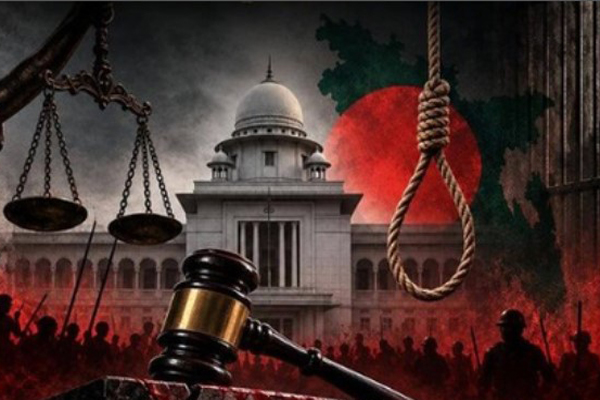
The Bangladesh Awami League has rejected the death sentences handed down to seven of its leaders and activists by the International Crimes Tribunal (ICT). The party called the verdict “one-sided, biased and fabricated”.
The ICT sentenced Awami League General Secretary Obaidul Quader and six other senior leaders of the party and its affiliated organisations to death on Tuesday. The cases relate to alleged “crimes against humanity” during the July 2024 mass uprising, according to local media reports.
The Awami League described the ruling as the latest example of what it called the “weaponisation of judiciary” against political dissenters.
The party also questioned the circumstances in which the tribunal conducted the proceedings. It noted that none of the seven individuals appeared before the tribunal.
Party questions trials in absentia
The Awami League argued that trials in absentia must still provide fundamental legal protections to the accused.
“A fundamental standard of international criminal law is that even in trials conducted in absentia, minimum legal protections — including the right of the accused to choose counsel of their own liking — must be guaranteed. However, these guarantees have been completely ignored in the present tribunal,” the party said.
It alleged that the judicial process moved ahead rapidly without adequate regard for internationally recognised principles of human rights and international criminal law.
The party said the proceedings represented political vengeance rather than the rule of law. It also claimed that the concerns covered more than Tuesday’s ruling.
According to the Awami League, all ICT activities since August 5, 2024, amount to violations of international law and human rights.
Attack on former interim government
The Awami League also targeted the former interim government led by Muhammad Yunus.
The party described the administration as “undemocratic and unconstitutional”. It alleged that the government breached legal and constitutional procedures when it amended the International Crimes Tribunal Act of 1973 through an ordinance.
The Awami League claimed the amendment transformed the legal process into a retaliatory mechanism against its leaders.
It also accused the Yunus government of forming prosecution and judicial panels that included office-bearers and active cadres of Jamaat-e-Islami and the Bangladesh Nationalist Party (BNP).
“To exact political vengeance, the illegal government of Mohammad Yunus constituted the prosecution and judicial panels comprising office-bearers and active cadres of Jamaat-e-Islami and the Bangladesh Nationalist Party (BNP), filing a succession of false and illegal cases against leaders and activists of the Bangladesh Awami League based entirely on falsehood,” the party said.
These allegations represent the Awami League’s stated position on the tribunal process.
Concerns over killings and detentions
The party also warned that the death sentences could deepen what it described as a prolonged cycle of violence.
It claimed that mass killings over the past two years had already caused hundreds of deaths. It further alleged that arbitrary detention had resulted in tens of thousands of people being imprisoned.
The Awami League accused Bangladeshi authorities of continuing an “ongoing killing spree” in custody. It also alleged that authorities had used a “farce trial” as a pretext for other harsh measures linked to violence and deaths during the July-August 2024 demonstrations.
The party said the latest verdict had further weakened democratic rights.
“This latest verdict deals another blow to Bangladesh’s democracy. It reminds citizens and victims of the July-August violence that authorities have taken away their right to seek justice. Meanwhile, people have looted and vandalised the homes and businesses of tens of thousands of activists with complete impunity,” the Awami League said.
Allegations over court violence
The Awami League also raised concerns about developments within the judiciary and court premises.
It alleged that authorities had carried out a broad purge of the judiciary before the trial began. The party further claimed that lawyers faced repeated mob violence and that victims of the alleged campaign faced physical attacks inside court premises.
“The wholesale purge in the judiciary before the start of the trial, the constant mob violence on lawyers and physical attacks on victims of ongoing witch hunt inside court premises are glaring testament to this sham trial,” the party said.
Awami League raises Islamist extremism concern
The party also alleged that the tribunal’s actions had emboldened Islamist extremists in Bangladesh.
It claimed that hundreds of convicted militants, including individuals affiliated with Al Qaeda, had received bail.
The Awami League alleged that these developments had contributed to growing insecurity in the country. It said such actions had already made Bangladesh a “dangerous place on earth”.
The Awami League’s statement came after the ICT’s latest death sentences and focused on the legality of the proceedings, the treatment of its leaders and what the party described as broader political and judicial consequences. (Edited by Enewstime Desk)