

Vishwarang Nalanda, a two-day literary and cultural dialogue discussed how language, literature, Buddhist heritage and shared traditions connect Northeast India with Southeast Asia.
Scholars, academics and cultural experts took part in the discussion held at Nalanda University in Rajgir on October 7–8.
Key Takeaways:
-
Nalanda University hosted a two-day dialogue on linguistic, literary and cultural connections between Northeast India and Southeast Asia on October 7–8.
-
NETRA Foundation scholars highlighted Buddhist philosophy, cultural diplomacy, folklore and the Act East Policy.
-
Speakers called for stronger academic exchanges, cultural cooperation and technology-driven solutions to overcome language barriers.
Historical and cultural connections of the Northeast India with Southeast Asia took centre stage at Vishwarang Nalanda.
Scholars highlighted the region’s role as a bridge between India and Southeast Asia, with discussions covering Buddhist philosophy, indigenous traditions, cultural diplomacy and language preservation.
The event centred on the theme “Northeast India and Southeast Asia: A Dialogue of Language, Literature, Culture and the Arts”.
Nalanda University, Rabindranath Tagore University in Bhopal, the Vishwarang Foundation and Dr. C.V. Raman University organised the programme in collaboration with the Indian Council for Cultural Relations (ICCR).
Scholars Describe Northeast India as a Cultural Bridge
Dr. Rajesh Ranjan, Deputy Director General of ICCR, described Northeast India as a “hinge” connecting India with mainland Southeast Asia.
He stressed that the region serves a wider cultural purpose than merely providing a route between geographical areas.
K. Srinivasan, Secretary of the Ministry of Development of North Eastern Region, also highlighted the relationship between language and culture. He cited Nagamese as a common language in marketplaces and Hindi as a link among diverse tribal communities of Arunachal Pradesh
Their observations reflected the event’s central argument: linguistic traditions and cultural exchanges can strengthen connections between communities across national boundaries.
Nalanda University Emphasises Language and Technology
Prof. Sachin Chaturvedi, Vice-Chancellor of Nalanda University, described the institution as a living centre of knowledge and civilisational values. He outlined three dimensions of its mission: preserving knowledge, applying it to present-day needs and connecting it with future generations.
Chaturvedi observed that English gained prominence as a common medium of communication largely because of the colonial legacy. However, he said modern technology could help communities overcome linguistic barriers.
He announced a partnership with BHASHINI to introduce real-time translation and English subtitles for Hindi lectures. The initiative aims to make academic discussions more accessible to people who speak different languages.
Chaturvedi also highlighted the shared oral traditions and cultural roots of Northeast India and Southeast Asia. He said these connections complement India’s Act East Policy.
Chaturvedi noted that modern political boundaries have divided communities with longstanding cultural ties. He also linked Rabindranath Tagore’s visits to Indonesia with Nalanda University’s new Centre for South-East Asia Studies.
NETRA Foundation Scholar Explores Buddhist Cultural Diplomacy
The NETRA Foundation (North East Training Research and Advocacy Foundation) participated in the event through a team working in education, research, training and policy dialogue across the Northeast.
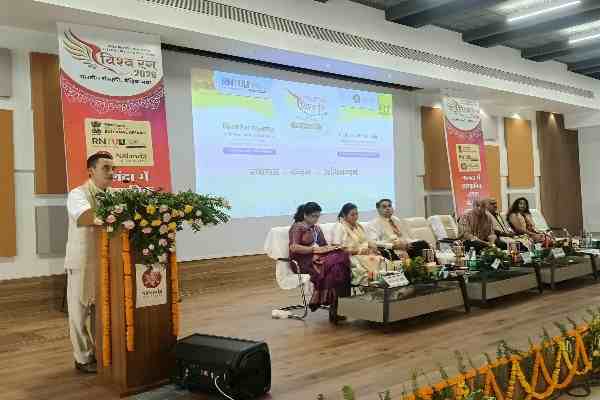
Prof. N. Surjitkumar, Head of the Department of Political Science and Human Rights at Indira Gandhi National Tribal University, delivered a presentation on Buddhist philosophy and cultural diplomacy in South Asia.
He examined the connections among Northeast India, South Asia, Southeast Asia and East Asia before discussing the basic principles of Buddhist philosophy.
Surjit traced spread of Buddhism across South and Southeast Asia through the journeys of monks and merchants, the growth of monasteries, pilgrimage networks and major centres of learning. He highlighted Nalanda and Vikramashila as important institutions in this history.
He also explained how Buddhist traditions evolved as they travelled from India to China, Japan and South Korea.
Another key point concerned Vasudhaiva Kutumbakam, the ancient Sanskrit expression meaning “the world is one family”. Surjit discussed its philosophical connection with Buddhism in the context of India’s G20 presidency in 2023 under Prime Minister Narendra Modi.
Buddhist Heritage and Cultural Exchanges in Focus
Surjit highlighted the proposed “Buddhist Circuit in North East India”, covering Arunachal Pradesh, Sikkim, Assam, Mizoram, Tripura and Manipur.
The initiative seeks to preserve temples and monasteries while promoting tourism across the region. It also aims to support India’s Act East Policy by showcasing the Northeast’s Buddhist heritage.
He called for stronger cultural diplomacy through yoga, Indian cinema and cultural exchanges. He also recommended expanding faculty and scholar exchanges between Indian and Southeast Asian universities.
These measures, he suggested, could strengthen India’s cultural influence and deepen academic relationships across the region.
Sikkim’s Monasteries and Folklore Draw Attention
Ms. Mary Bal, Assistant Professor at Mirik College and a NETRA Foundation member, highlighted the Northeast’s importance in India’s cultural diplomacy. She focused on Sikkim’s role under the Act East Policy, citing the Pemayangtse and Rumtek monasteries as important centres of Buddhist heritage. She also referred to Sikkim’s organic farming model.
Dr. Pooja Basnet, Assistant Professor at Sikkim University, examined Sikkim’s folklore and historical narratives. She explained that folklore helps indigenous communities preserve their identities, maintain cultural traditions and reclaim space for their voices.
Basnet called for more platforms where scholars and representatives from the Northeast could share their experiences and perspectives.
More Than 70 Speakers Join the Dialogue
Vishwarang Nalanda featured more than 70 speakers across its sessions. Five speakers occupied the dais during the inaugural session.
The participants included representatives from Suriname, Sri Lanka and Singapore. Their presence added international perspectives to discussions on language, literature, heritage and cultural relations.
The two-day dialogue brought the Northeast’s cultural connections with Southeast Asia into focus, highlighting the role of academic collaboration, linguistic accessibility and heritage preservation in strengthening regional ties.
