

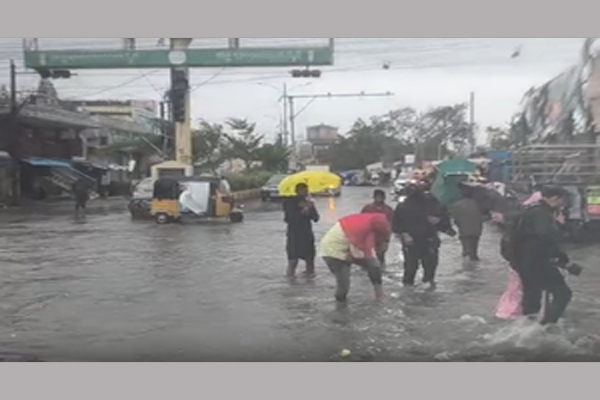
The RTGS Centre, Andhra Pradesh State Disaster Management Authority (APSDMA) and state disaster management officials are coordinating cyclone surveillance and emergency response measures across south coastal Andhra Pradesh following the landfall of Cyclone Murasu on November 3. The efforts aim to track the movement of the storm, keep residents informed and ensure timely reporting of emergencies through Doppler radar monitoring, continuous administrative surveillance and the Mana Mithra helpline.
At A Glance
-
The RTGS Centre and APSDMA are closely monitoring Cyclone Murasu and its movement across south coastal Andhra Pradesh.
-
Doppler Weather Radars at Machilipatnam and Visakhapatnam are tracking the storm as it gradually weakens.
-
Authorities have urged residents to remain alert and report emergencies through the Mana Mithra helpline at 9552300009.
Andhra Pradesh has stepped up its cyclone monitoring and emergency response arrangements after severe cyclonic storm Murasu crossed the south coast early Tuesday. The Real-Time Governance Society (RTGS) Centre and the Andhra Pradesh State Disaster Management Authority (APSDMA) are continuously assessing the situation as the storm moves inland and gradually weakens.
| Read more National News HERE |
Authorities have appealed to residents in affected areas to remain alert. They have also provided a round-the-clock public reporting facility through the Mana Mithra service to help people communicate emergencies and other cyclone-related problems.
The monitoring exercise comes as heavy rainfall and strong winds continue to affect parts of south coastal Andhra Pradesh. The India Meteorological Department (IMD) is tracking the system through Doppler Weather Radars at Machilipatnam and Visakhapatnam.
RTGS and APSDMA Keep Close Watch on Cyclone Situation
The RTGS Centre and APSDMA are maintaining continuous surveillance of the evolving weather situation. Their monitoring efforts are aimed at keeping track of the cyclone’s movement and assessing conditions across the affected areas.
Severe cyclonic storm Murasu crossed the south Andhra Pradesh coast between Nellore and Narasapur between 3.30 a.m. and 5.30 a.m. on Tuesday. The system brought winds of 100-110 kmph, with gusts reaching 120 kmph.
According to the IMD bulletin, the storm was centred over south coastal Andhra Pradesh near Ongole at 5.30 a.m. It was approximately 40 km southwest of Bapatla, 80 km north-northeast of Kavali and 120 km from Machilipatnam.
The weather agency said the system would continue moving in a north-northwestward direction while gradually losing intensity.
The cyclone is expected to weaken into a cyclonic storm by noon on Tuesday. Wind speeds are likely to fall to 80-90 kmph, with gusts reaching 100 kmph.
The system is further expected to weaken into a deep depression by midnight. At that stage, wind speeds may decline to 55-65 kmph, with gusts reaching 75 kmph.
Doppler Radars Track Storm Movement
The IMD is using its Doppler Weather Radar network to continuously monitor the cyclone. Radars located at Machilipatnam and Visakhapatnam are keeping track of the system as it moves across the region.
Radar surveillance provides an important source of information about the storm’s movement and changing intensity. The latest IMD assessment indicates that Murasu is gradually losing strength after crossing the coast.
However, the weakening of the cyclone has not ended the weather threat. Several districts remain under heavy rainfall forecasts, with some areas likely to experience extremely heavy downpours.
The IMD has forecast widespread heavy to very heavy rainfall, with isolated extremely heavy rainfall, in Bapatla, Guntur, Krishna, Palnadu, NTR, Eluru and West Godavari districts on Tuesday.
East Godavari, Polavaram, Kakinada, Konaseema, Prakasam and Markapuram districts are also likely to receive widespread moderate rainfall, with isolated heavy showers.
Mana Mithra Helpline Open for Emergency Reporting
Prakhar Jain, Managing Director of the SDMA and Chief Executive Officer of the RTGS, has urged people to maintain heightened vigilance as the cyclone affects the state.
He said residents could report problems and emergencies at any time through the Mana Mithra service.
People can contact the authorities through the helpline number 9552300009. The facility provides a channel for residents to communicate issues arising from the adverse weather conditions.
The appeal comes amid heavy rainfall across several parts of the south coastal region since November 2.
According to APSDMA rainfall data, Naguluppalapadu in Prakasam district recorded 198.01 mm of rainfall between 8.30 a.m. on Monday and 6 a.m. on Tuesday.
Kothapatnam received 182.25 mm, while Bapatla recorded 128.53 mm. Chirala registered 124.10 mm, followed by Throvagunta in Prakasam district with 116.93 mm.
Ongole Urban received 106.97 mm, while Chilakapadu recorded 104.50 mm during the same period.
Authorities Urge Residents to Remain Vigilant
With the cyclone moving north-northwestwards, continuous monitoring remains a priority for the state authorities. The RTGS Centre and APSDMA are keeping track of developments while the IMD continues its radar-based surveillance.
Although Murasu is forecast to weaken into a deep depression by midnight, heavy rainfall is expected to continue across several districts.
Authorities have therefore urged residents to stay alert and use the Mana Mithra helpline to report problems. Continuous weather surveillance and timely communication remain central to the state’s ongoing response to the cyclone. (Edited by Enewstime Desk)