

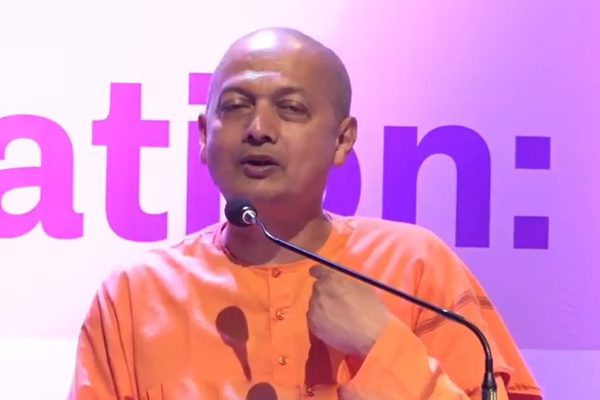
Swami Sarvapriyananda Maharaj has explained how concentration helps individuals attain self-realization beyond the mind and recognise the same consciousness in everyone. Addressing an Agartala gathering on November 25, he linked this realisation to compassion, forgiveness and service as the foundations of a meaningful life.
Speaking at an event organised by URAN at Muktodhara, the Minister-in-Charge of the Vedanta Society of New York urged people to develop sympathy for others and make forgiveness and kindness natural parts of life. He also called for awakening the spirit of service to help those in need.
Swamiji said URAN itself reflects this philosophy of service. He appealed to everyone to make service a way of life, adding that this alone could give life true meaning and establish it on the foundation of truth.
Consciousness Exists Beyond the Body and Mind
A packed auditorium listened attentively as Swamiji explored consciousness through the Bhagavad Gita, the Upanishads and Patanjali’s Yoga Sutras. He connected these ancient philosophical teachings with modern neuroscience and artificial intelligence.
Speaking on the theme ‘Concentration: Our Greatest Power’, he argued that the brain does not produce consciousness. He explained that consciousness exists beyond the body, mind and intellect.
He also referred to an article published in the prestigious journal Nature that examined why artificial intelligence is not conscious and may never become conscious.
Drawing from the 13th chapter of the Bhagavad Gita, titled Kshetra-Kshetrajna Vibhaga Yoga (The Yoga of the Distinction Between the Field and the Knower of the Field), Swamiji explained the distinction between consciousness and the objects of experience.
He described consciousness as the ‘Subject’, while the body, thoughts and emotions remain ‘Objects’. Happiness, sadness and other experiences belong to the realm of objects. Consciousness is the subject that experiences them.
Concentration Offers Freedom from the Mind
Swamiji then connected this understanding of consciousness with the power of concentration. Citing Patanjali’s Yoga Sutras, he explained that a person can discover their true identity when the mind becomes still and reaches a state of concentration.
At that stage, one realises that the self is consciousness beyond the mind. One also understands that the mind does not define one’s true identity.
Explaining the practical benefits, Swamiji said that freedom from the mind does not mean the mind and body stop functioning. They continue their activities, but the individual no longer remains bound by them.
“It gives you freedom from the mind. Freedom from the mind does not mean that the mind and body cease to exist. They are still there, and all their activities continue as before. But I am free from them,” he explained.
He described this as a remarkable experience that makes a person feel lighter and better equipped to manage the mind.
Realising the Same Consciousness in Everyone
Swamiji next explained how this spiritual realisation changes an individual’s relationship with the world.
Referring to the Bhagavad Gita’s verse, “Kshetrajnam chapi mam viddhi sarva-kshetreshu Bharata” — “Know Me also as the Knower of the Field in all fields, O Bharata” — he said the same consciousness exists in every individual.
Once people realise that they are neither the body nor the mind but consciousness itself, they begin to recognise this common identity in others. Consciousness does not exist in different forms. The same consciousness exists in everyone, he explained.
This understanding naturally expands concern for others. Swamiji compared it with the way people respond to their own needs. “When hungry, they seek food; when ill, they need medicine and care and when they feel uncomfortable, they look for relief”, he said.
In the same way, they should respond to the suffering of others.
“If they do not have enough food, I feel compelled to feed them. If they develop a fever, I feel the urge to care for them and nurse them back to health,” he said.
He added that people should also recognise the emotional pain others experience when someone speaks harshly to them, just as they feel hurt by unkind words.
Service Is the Foundation of Humanity
Concluding his address, Swamiji said that the philosophy of service and humanity rests on recognising the essential unity of all beings.
He pointed out that every religion shares a common moral principle: “Treat others as you would have them treat you.”
Although the Bible contains these words, he said, the same principle runs through all religions. People should treat others with the same kindness and consideration they expect for themselves.
He also referred to the Golden Rule displayed on the third floor of the United Nations Headquarters in New York: “Treat others as you would have them treat you.”
Swamiji’s central message was that concentration and self-realisation should not remain confined to personal spiritual experience. They must translate into compassion, forgiveness, kindness and service to humanity.
