

The 18th BRICS Summit has placed global governance reform, stronger representation for the Global South and practical cooperation at the centre of its agenda, with leaders unanimously adopting the New Delhi Declaration 2026 today.
Key Takeaways
- BRICS leaders unanimously adopted the New Delhi Declaration 2026 at the 18th BRICS Summit in New Delhi.
- India proposed reforms to global institutions, a BRICS continuity mechanism and a Seafarers Emergency Support Network.
- BRICS will deepen cooperation in AI, digital infrastructure, quantum technology, energy, health, food security and sustainable development.
The 18th BRICS Summit in New Delhi on Saturday adopted the New Delhi Declaration 2026 unanimously, setting out a broad agenda for institutional reform, economic cooperation, emerging technologies and development.
Prime Minister Narendra Modi said the declaration reflects the confidence of a BRICS that is broader in reach and stronger in purpose. He urged member countries to move beyond commitments and convert their decisions into concrete results.
The declaration was adopted during the summit’s session on Inclusive Global Governance and Strengthening Multilateralism at Bharat Mandapam.
BRICS calls for changes in global institutions
Modi said the changing global order cannot be managed effectively through institutions designed for an earlier era. He called for reforms that improve representation, responsiveness and global rule-making.
The Prime Minister placed the concerns of the Global South at the centre of the reform agenda. He said countries from the Global South often face the strongest impact of global crises while having less influence over major international decisions.
He proposed transforming this “pyramid of privilege” into a “platform of partnership”.
India also proposed 10 joint initiatives on global governance reform. The aim is to develop these proposals into a BRICS reform roadmap by the next summit.
UNSC reform gets fresh push
Modi said reform of the United Nations Security Council can no longer remain an open-ended issue.
He called for negotiations to follow a definite timeline and produce clear outcomes. He also argued that the voting strength, leadership positions and policy priorities of international financial institutions should better reflect present-day economic realities.
Countries that contribute significantly to global economic growth, he said, should have an appropriate role in shaping global economic governance.
The Prime Minister said BRICS supports dialogue, reform, peace and a more representative multilateral system. He also reiterated the grouping’s opposition to terrorism, double standards and threats to international stability.
New mechanism proposed for BRICS continuity
India proposed a BRICS Continuity and Implementation Mechanism to maintain institutional momentum as the group’s chairmanship changes every year.
Under the proposal, the Troika would help monitor and follow up on BRICS initiatives and summit outcomes.
Modi said the grouping must prepare an ambitious agenda for the next 20 years. He added that this process should begin by strengthening BRICS’ own working mechanisms.
The Prime Minister described the 20th anniversary of BRICS as a major milestone. He said the grouping had established a distinct position on the global stage over the past two decades.
Cooperation in AI and emerging technologies
The New Delhi Declaration also looks ahead to emerging areas of cooperation.
Modi said BRICS countries would expand collaboration in artificial intelligence, digital public infrastructure and quantum technologies. Startups, MSMEs, science and research will also remain important areas of joint work.
The grouping will further cooperate on food security, healthcare, energy security, resilient supply chains and sustainable infrastructure.
The Prime Minister also highlighted the importance of strengthening the New Development Bank as part of BRICS’ development-oriented agenda.
He stressed that the Global South should have an equal opportunity to participate in the development of future technologies and in framing the rules governing them.
India proposes support network for seafarers
India also placed a Seafarers Emergency Support Network before the BRICS partners.
The proposed network would connect maritime authorities and diplomatic missions of relevant countries. Its purpose would be to improve assistance for seafarers during emergencies and other difficult situations.
Modi pointed out that seafarers make a major contribution to international trade but can face a lack of institutional support when they encounter serious difficulties.
People-centric approach remains India’s focus
Modi said India’s BRICS chairship has followed a people-centric and humanity-first approach.
He identified resilience, innovation, cooperation and sustainability as India’s key priorities during its chairship.
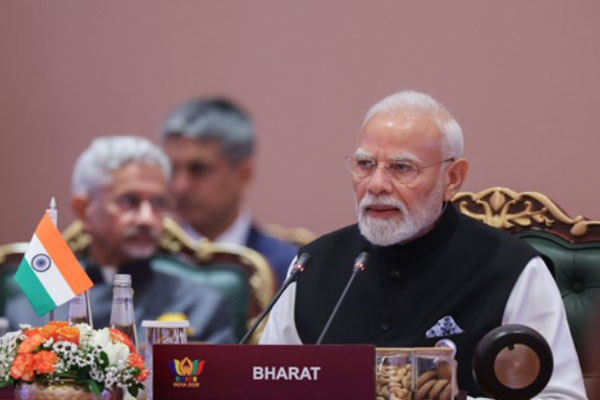
India organised more than 350 meetings as part of its BRICS programme. Delegations were hosted across nearly 30 cities.
The Prime Minister said the objective was to connect BRICS cooperation more directly with people’s development needs.
He also emphasised that BRICS is not directed against any country or group. The grouping, he said, moves forward through mutual respect and consensus while seeking to take all sides along.
BRICS marks 20 years
The summit also marked two decades of BRICS. Leaders released two commemorative postage stamps to mark the anniversary.
In his closing remarks, Modi thanked the participating leaders for their contributions and constructive engagement during India’s chairship.
The Prime Minister said the New Delhi Declaration gives clear direction to the shared resolve of BRICS members. He stressed that the next task is to ensure that those commitments produce tangible outcomes.
The two-day BRICS Summit in New Delhi has brought together leaders of member and partner countries along with outreach invitees. The discussions have focused on strengthening multilateral cooperation while giving greater weight to development, emerging technologies and the voice of the Global South. (with inputs from IANS & newsonair)