

Manipur Chief Minister Yumnam Khemchand Singh highlighted the state’s improving security situation, rehabilitation efforts, peace and development priorities at the NITI Aayog meeting in New Delhi. He credited Central support, discussed IDP resettlement, border management, healthcare, education and youth employment initiatives for building a peaceful and developed Manipur.
Quick Glance
- Manipur CM Yumnam Khemchand Singh discusses peace, rehabilitation and development at NITI Aayog meeting.
- Around 11,000 displaced families have been resettled with Central government assistance.
- Jiribam emerges as a reconciliation model involving Meitei, Kuki, Paite and Hmar communities.
- State seeks support for border security, connectivity, education and youth employment.
Agartala/Imphal: Manipur Chief Minister Yumnam Khemchand Singh presented the state’s peace, rehabilitation and development roadmap at the NITI Aayog meeting held in New Delhi. He said the state has witnessed improvement in the overall situation due to coordinated efforts by the Central and state governments.
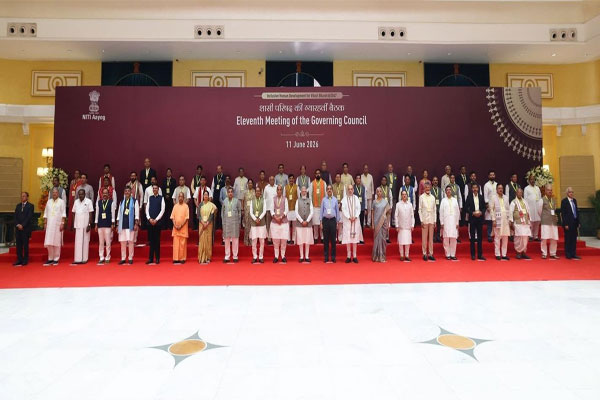
The meeting was chaired by Prime Minister Narendra Modi, who is also the Chairman of NITI Aayog. The theme of the discussion was “Inclusive Human Development for Viksit Bharat @ 2047.” The session focused on strengthening the future growth path of states and the country.
Singh expressed gratitude to Prime Minister Narendra Modi for continued support towards Manipur’s development. He also appreciated the role of Union Home Minister Amit Shah in improving the law and order situation through focused interventions.
Rehabilitation of Displaced Families Remains Key Priority
The Chief Minister highlighted the ongoing rehabilitation work for people displaced due to ethnic violence in Manipur. He said the government is implementing the Resettlement and Rehabilitation Package in phases with support from the Central government.
According to Singh, around 11,000 families have already returned to stable conditions. The state government is continuing efforts to rehabilitate the remaining displaced families.
The Chief Minister also thanked the Central government for approving additional houses under the Pradhan Mantri Awas Yojana-Gramin (PMAY-G) for 2026-27.
| Initiative | Details |
|---|---|
| Resettled displaced families | Around 11,000 families |
| Additional PMAY-G houses approved | 5,000 houses |
| Completed border fencing | 50 km |
| Additional border fencing work started | 80 km |
| Free medical treatments provided | Over 1.4 lakh |
| Healthcare support value | More than Rs 181 crore |
| Higher education Gross Enrolment Ratio | 35.5% |
| National average GER | 28.4% |
Jiribam Model Emerges as Symbol of Community Reconciliation
Singh said his government, formed on February 4, 2026, is working not only to restore peace but also to rebuild trust among communities.
He shared details of his visits to relief camps in Jiribam and Imphal. He also travelled through Kangpokpi to reach Senapati district and met representatives from Naga and Kuki communities during his visit to Ukhrul.
The Chief Minister said Jiribam has become an example of peaceful cooperation. He pointed out that people from Meitei, Kuki, Paite and Hmar communities came together and shared a meal peacefully.
Singh informed NITI Aayog that displaced families from Jiribam have started returning to their original homes. He expressed hope that the Jiribam reconciliation model can expand across other districts of Manipur.
Border Security and Anti-Smuggling Measures
The Chief Minister raised concerns related to challenges from instability in Myanmar. He stressed the importance of stronger border monitoring and coordinated action against illegal activities.
He said improved surveillance is necessary to control drug trafficking, arms smuggling and human trafficking along the India-Myanmar border.
Singh informed the meeting that the Ministry of Home Affairs has completed 50 kilometres of border fencing. Work on another 80 kilometres has started to improve security arrangements.
Healthcare & Education Sectors Show Progress
Highlighting healthcare achievements, Singh said Manipur has provided more than 1.4 lakh free treatments under Ayushman Bharat and the Chief Minister’s Hakshelgi Tengbang scheme.
He added that the state currently records the lowest infant mortality rate in India.
In higher education, Singh said Manipur’s Gross Enrolment Ratio has crossed the national average. The state has achieved a 35.5 per cent GER compared with the national figure of 28.4 per cent.
The government is also focusing on faculty recruitment and aligning universities with the National Credit Framework and National Education Policy (NEP) 2020 reforms.
Singh requested inclusion of Manipur in the national Research and Innovation Parks and Mega Educational Hubs initiative. He proposed a regional centre connecting universities, NIT, IIIT and local industries.
Youth Employment and Skill Development Focus
The Chief Minister highlighted skill development programmes aimed at improving employment opportunities for Manipuri youths.
He said many youths trained in Japanese language skills are now working in healthcare and hospitality sectors in Japan through collaboration between the Skill Development Department and NSDC.
He added that youths have also received overseas employment opportunities in Dubai, Abu Dhabi, Portugal and the United States through DDU-GKY.
Singh requested Central support to modernise Industrial Training Institutes (ITIs) and Polytechnics through an industry-linked hub-and-spoke model.
Connectivity and Act East Policy Push
The Chief Minister sought faster development of infrastructure projects under the Act East Policy.
He requested support for highways, railway expansion and border trade infrastructure at Moreh. According to Singh, stronger connectivity will help Manipur strengthen its position as India’s gateway to East Asia.
He also requested expansion of the Aspirational Districts and Aspirational Blocks programmes to cover more areas of the state.
News Analysis: Manipur’s Development Strategy Moves Beyond Conflict
The statements made by Chief Minister Yumnam Khemchand Singh at the NITI Aayog meeting reflect a multi-layered approach towards Manipur’s recovery. The focus is not limited to restoring law and order. It also includes rehabilitation, economic revival, education, healthcare and employment.
The government’s emphasis on Jiribam as a reconciliation model indicates an attempt to rebuild social confidence among communities affected by conflict. At the same time, border management remains a major concern because of challenges linked with the India-Myanmar frontier.
Manipur’s development strategy now combines peace-building with infrastructure expansion. Requests related to railways, highways, border trade and skill development show the state’s effort to strengthen its role under the Act East Policy.
The success of this approach will depend on sustained rehabilitation, community cooperation and effective implementation of development programmes across hill and valley regions.
