

Medziphema Campus of the Nagaland University organised a Rural Talk Series recently. The event brought together academics, researchers and students. The participants explored how community involvement, indigenous practices and traditional institutions can strengthen forest governance and environmental sustainability in Nagaland and the wider Northeast.
Key Takeaways
-
Nagaland University’s Rural Talk Series examined the role of local communities in forest governance, natural resource conservation and sustainable rural development.
-
TISS experts Dr. Geetanjoy Sahu and Dr. Abhinandan Saikia discussed customary laws, the Forest Rights Act, environmental governance and climate change.
-
The sessions highlighted indigenous knowledge, traditional land ownership, women’s participation and the socio-economic and ecological significance of jhum cultivation.
Medziphema Campus explored the role of indigenous communities in protecting natural resources during a Rural Talk Series on October 15, 2026.
The programme brought together experts from the Tata Institute of Social Sciences (TISS) to discuss forest governance, customary laws, environmental sustainability and climate change.
The Department of Rural Development and Planning, under the School of Social Sciences, organised the event under the theme “Community-led Natural Resource Management.”
The discussions focused on community participation in natural resource governance, particularly in Scheduled Areas and the northeastern region.
Community Participation at the Centre of Rural Development
The Rural Talk Series seeks to promote academic dialogue, knowledge exchange and interdisciplinary engagement on contemporary rural development challenges.
It also provides students, research scholars and faculty members with opportunities to explore emerging ideas and practical approaches to sustainable development.
The programme highlighted the importance of local institutions, participatory decision-making and traditional knowledge in managing forests and other natural resources.
Speakers also examined how community-led initiatives can strengthen environmental governance while supporting rural livelihoods.
Dr. Deepa Thangjam, Assistant Professor in the Department of Rural Development and Planning, delivered the welcome address.
She welcomed the resource persons, faculty members and students and emphasised the relevance of the discussions to academic research and rural development.
Dr. Thangjam encouraged participants to consider how community-led approaches could support development in Nagaland and the wider Northeast.
She noted the particular importance of natural resource management in Nagaland, where traditional community institutions maintain close relationships with the surrounding environment.
Dr. Jayanta Choudhury, Professor and Head of the department, delivered the introductory remarks.
He stressed the importance of community-led initiatives in natural resource management and highlighted the contribution of indigenous practices to resource conservation in Nagaland.
TISS Professor Examines Forest Governance and Customary Laws
Dr. Geetanjoy Sahu, Professor and Dean of the School of Habitat Studies at TISS, Mumbai, delivered the first technical session on “Forest Resource Governance in the Scheduled Areas.”
He traced the evolution of forest governance from the pre-colonial period through the post-independence era to the present day.
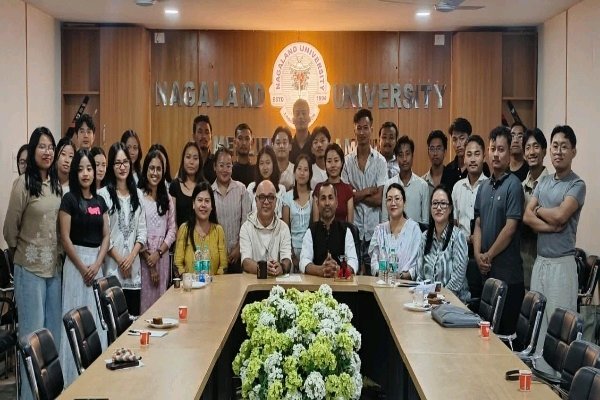
His presentation examined the institutional challenges surrounding forest management and the relationship between national policies and customary practices.
Dr. Sahu discussed the National Forest Policy, 1988, which promotes forest conservation in India. He explained that customary laws continue to play a significant role in governing forest resources across different parts of the Northeast.
He also highlighted Article 371A of the Constitution, which provides special protection for Nagaland’s customary laws and practices.
These constitutional safeguards remain important when considering the relationship between indigenous institutions and central legislation affecting local communities.
The speaker described customary laws as important frameworks for inclusive, sustainable and gender-sensitive natural resource management.
Dr. Sahu also examined the Forest Rights Act (FRA), 2006, focusing on its relationship with customary practices, traditional land ownership systems and community-based forest governance.
He emphasised the need to understand the region’s distinct socio-cultural context when addressing forest rights. He also stressed the importance of protecting indigenous communities’ traditional rights and practices while considering the provisions of the Act.
Environmental Governance and Climate Change
Dr. Abhinandan Saikia, Assistant Professor at the School of Social Sciences and Humanities, TISS, Guwahati, delivered the second technical session on “Environmental Governance: Role of Community.”
His presentation explored how community participation and collective action can support environmental protection and sustainable resource management.
He discussed changing climatic conditions and resource conservation. Besides the speaker focused on the roles of women and local communities in environmental governance.
Dr. Saikia highlighted the transdisciplinary nature of climate change research and explained the importance of Environmental Impact Assessment in addressing environmental challenges.
He also examined jhum cultivation as a way of life rather than merely an agricultural practice.
His discussion highlighted the close links between the cultivation system, community livelihoods, cultural traditions and local ecological conditions.
Dr. Saikia emphasised the socio-economic and ecological dimensions of jhum cultivation.
His presentation encouraged participants to consider the broader significance of traditional practices when examining sustainable resource management and rural development.
Students and Faculty Participate in Interactive Discussion
The technical sessions concluded with an interactive question-and-answer round.
Faculty members and students actively participated, raised questions, exchanged views and sought clarification on different aspects of natural resource management and environmental governance.
The discussion provided participants with an opportunity to engage directly with the speakers. Also, they could explore the practical implications of community participation, indigenous knowledge and environmental sustainability.
Dr. Merensangla Longkumer, Assistant Prof in the Department of RD and Planning at Nagaland University, delivered the vote of thanks, bringing the programme to a close.
