

Spain’s 1-0 extra-time victory over Argentina in the FIFA World Cup 2026 final should have been remembered solely for footballing excellence. Instead, post-match violence, controversial disciplinary decisions and disputed FIFA rulings throughout the tournament shifted global attention from the champions to a series of incidents that sparked widespread debate.
Three Key Takeaways
- Spain lifted its second FIFA World Cup title after defeating Argentina 1-0 in extra time, but the final ended in heated confrontations between players.
- Several controversial disciplinary decisions, including the cases involving Miguel Almiron and Folarin Balogun, generated debate throughout the tournament.
- Former players, football officials and governing bodies criticised both on-field conduct and FIFA’s handling of disciplinary matters.
Agartala: The 2026 FIFA World Cup will be remembered for much more than Spain’s return to the pinnacle of international football. While the month-long tournament showcased elite competition, emerging stars and memorable performances, its closing chapter became dominated by controversy after ugly scenes unfolded immediately following the final whistle in the championship match.
Spain secured its second FIFA World Cup title with a hard-fought 1-0 victory over Argentina after extra time. However, instead of celebrations taking centre stage, the attention quickly shifted to confrontations between players, reigniting discussions about discipline, sportsmanship and FIFA’s management of controversial incidents during the tournament.
Spain’s Title Celebration Marred by Heated Confrontations
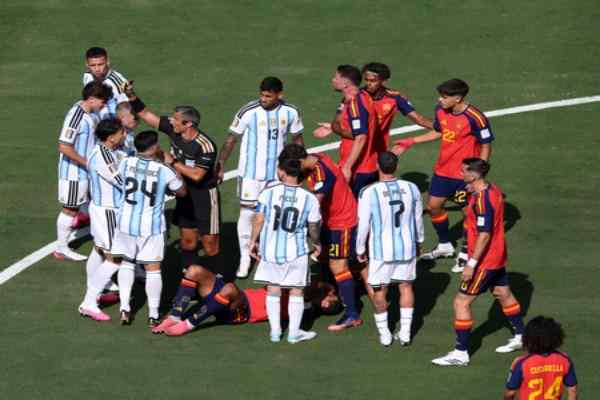
The final at New York ended on a sour note as emotions boiled over seconds after the referee signalled the end of the match. Players from Spain and Argentina became involved in a series of physical altercations that transformed the trophy presentation into one of the tournament’s biggest talking points.
Argentina midfielder Leandro Paredes appeared to grab Spain defender Eric Garcia by the throat during one confrontation before head coach Lionel Scaloni stepped in to calm the situation.
Television footage also appeared to show Argentina defender Nahuel Molina striking a Spanish player in the stomach during the melee. In another flashpoint, Paredes was seen bringing Spain midfielder Gavi to the ground before shoving him in the face and seemingly kicking a boot in the youngster’s direction.
Spain captain Rodri was also caught up in the chaos after Molina appeared to throw a punch at him, prompting an immediate and angry response from the Spanish midfielder.
Although security personnel and coaching staff eventually restored order, the clashes overshadowed what should have been Spain’s crowning moment after a successful campaign.
Football Pundits Condemn the Conduct
The incidents drew swift criticism from former players and television analysts covering the final.
Former England captain Alan Shearer, speaking during the BBC’s post-match coverage, strongly criticised Argentina’s behaviour.
He said there was no justification for players throwing punches after the final whistle, adding that while defeat is painful, teams must know how to lose with dignity. Shearer also remarked that similar reactions had been seen from Argentina on previous occasions and described the post-match scenes as unacceptable.
The criticism extended beyond the physical confrontations.
According to TalkSPORT, former England international Stuart Pearce claimed Argentina’s players deliberately turned their backs while Spain prepared to lift the World Cup trophy during the medal ceremony.
The incident reportedly occurred as Spain celebrated its victory in the presence of US President Donald Trump, adding another layer of controversy to an already dramatic evening.
Controversies Extended Beyond the Final
The dramatic ending reflected a tournament that had witnessed several contentious moments long before the championship match.
One of FIFA’s newly introduced regulations became a major talking point during the group stage when Paraguay’s Miguel Almiron became the first footballer to be sent off for covering his mouth while confronting an opponent on the field.
The incident, involving Türkiye defender Mert Muldur, automatically earned Almiron a one-match suspension. FIFA ruled that the punishment could not be appealed, forcing the Paraguayan midfielder to miss his country’s final group-stage fixture against Australia.
The decision immediately sparked debate over the practical application of FIFA’s new disciplinary measures and whether the punishment was proportionate.
Balogun Decision Triggered Global Debate
Another controversy emerged during the knockout rounds involving United States striker Folarin Balogun.
Balogun was initially dismissed after stepping on an opponent’s ankle during the USA’s Round of 32 victory over Bosnia-Herzegovina. The red card automatically ruled him out of the next match under FIFA regulations.
However, the situation changed dramatically when FIFA’s disciplinary committee provisionally lifted the suspension, fined the forward 40,000 U.S. dollars, and cleared him to face Belgium.
Belgium’s football federation formally challenged the ruling, arguing that the reversal undermined the tournament’s disciplinary process.
Despite the protest, FIFA’s appeals committee dismissed Belgium’s objection less than eight hours before kickoff.
The decision drew unusually strong criticism from UEFA, which labelled FIFA’s action as “unprecedented, incomprehensible and unjustifiable,” adding that the governing body had “crossed a red line.”
Balogun later admitted he had anticipated that overturning his suspension would inevitably generate significant controversy.
A Tournament of Football Excellence and Fierce Debate
Despite the controversies, the 2026 FIFA World Cup delivered high-quality football across North America, with Spain ultimately emerging as world champions after a disciplined and resilient campaign.
Yet the tournament will likely be remembered as much for its disciplinary disputes as for its footballing achievements. New FIFA regulations, contentious appeals, high-profile suspensions and the explosive scenes following the final combined to create one of the most debated editions of the World Cup in recent history.
For FIFA, the events may also prompt renewed discussions about player conduct, consistency in disciplinary decisions and the effectiveness of newly introduced regulations before the next global tournament.
As Spain celebrates its long-awaited return to world football’s summit, the controversies surrounding the 2026 World Cup are likely to remain part of the tournament’s enduring legacy. (With inputs from IANS)
FAQs (for Advanced GK Studies, prepared by Enewstime Editors’ Desk)
1. Why did the FIFA World Cup 2026 final become controversial?
The final became controversial after violent confrontations erupted between Spain and Argentina players immediately after the final whistle, overshadowing Spain’s 1-0 extra-time victory.
2. Which FIFA rule led to Paraguay’s Miguel Almiron receiving a historic red card?
Almiron became the first player sent off under FIFA’s new regulation prohibiting players from covering their mouths during on-field confrontations.
3. Why did UEFA criticise FIFA over Folarin Balogun’s suspension?
UEFA objected after FIFA provisionally lifted Balogun’s automatic suspension before the Belgium match, calling the decision “unprecedented, incomprehensible and unjustifiable” because it believed the disciplinary process had been inconsistently applied.
