

Tripura emerged as India’s leading state in capital asset creation spending during FY 2024-25, according to the latest CAG report. However, the State also faced major fiscal challenges, including low tax revenue generation, heavy dependence on Central grants, growing pension liabilities, and significant expenditure misclassification.
Quick Glance
- Tripura spent the highest share of its budget on capital asset creation among all States.
- The State received Rs 3,788 crore as Revenue Deficit Grant, the fourth-highest in India.
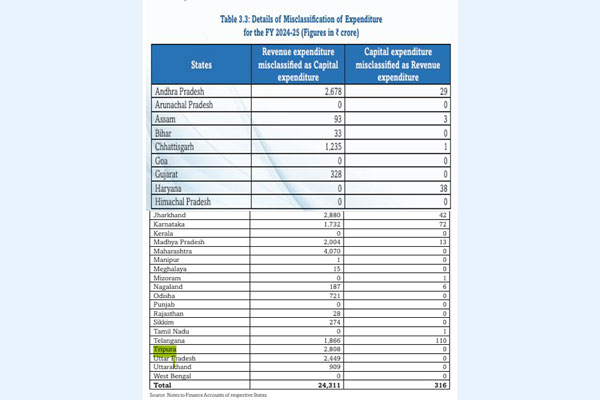
- CAG flagged Rs 2,808 crore expenditure misclassification, the third-highest nationally.
- State Own Tax Revenue accounted for only 16.8% of Tripura’s total revenue receipts.
Agartala: The latest Comptroller and Auditor General (CAG) Report on State Finances 2024-25 has presented a mixed assessment of Tripura’s fiscal position.
On one hand, the State demonstrated strong commitment to infrastructure development and prudent debt management. On the other hand, it remained heavily dependent on external financial support and struggled to expand its own revenue base.
The report analysed audited financial data of all 28 States over the past decade. It highlighted both achievements and structural weaknesses in Tripura’s public finances.
Economic experts believe the findings carry important lessons for policymakers as the State seeks sustainable growth.
Tripura Among States with Lowest Own Tax Revenue
One of the report’s key findings concerns Tripura’s limited revenue-generating capacity.
During FY 2024-25, the State collected Rs 3,545 crore as State Own Tax Revenue (SOTR). This represented only 16.80 per cent of total revenue receipts amounting to Rs 21,104 crore.
The figure places Tripura among the States with the weakest tax bases in India.
Tripura Revenue Profile
| Indicator | Amount |
|---|---|
| Total Revenue Receipts | Rs 21,104 crore |
| State Own Tax Revenue (SOTR) | Rs 3,545 crore |
| SOTR Share in Revenue Receipts | 16.80% |
| Revenue Deficit Grant | Rs 3,788 crore |
The report noted that Tripura’s annual SOTR growth improved from 8.95 per cent in the pre-GST era to 12.37 per cent in the post-GST period.
However, SGST growth averaged only 10.27 per cent. This made Tripura one of only six States where GST growth failed to outpace overall tax revenue growth.
Economists view this as a sign that economic expansion and tax buoyancy remain limited.
Heavy Dependence on Revenue Deficit Grants Continues
The report reveals that Tripura remains one of India’s largest beneficiaries of Revenue Deficit Grants.
During 2024-25, the State received Rs 3,788 crore from the Finance Commission. This accounted for 15.45 per cent of all Revenue Deficit Grants distributed across the country.
Only Himachal Pradesh, Uttarakhand and Nagaland received higher allocations.
According to economists, such grants play a critical role in maintaining government services. However, they also highlight structural dependence on Central support.
“Tripura’s fiscal system still relies heavily on external transfers. Long-term sustainability will depend on expanding economic activity and strengthening the State’s own revenue streams,” public finance experts observed.
CAG Flags Rs 2,808 Crore Expenditure Misclassification
One of the most serious observations in the report relates to accounting practices.
The CAG found that expenditure worth Rs 2,808 crore, which should have been classified as revenue expenditure, was booked under capital expenditure.
This was the third-highest such instance in India after Maharashtra and Jharkhand.
Major Fiscal Indicators
| Indicator | Status |
| Expenditure Misclassification | Rs 2,808 crore |
| National Rank | 3rd Highest |
| Internal Debt Growth (2015-25) | 113% |
| Capital Asset Creation Spending | 11.51% of Total Expenditure |
Experts warn that such classification can distort fiscal indicators.
When revenue expenditure is shown as capital expenditure, revenue deficits may appear smaller while capital spending appears larger. This can create a misleading picture of fiscal health.
Financial transparency, economists argue, remains essential for maintaining investor confidence and policy credibility.
Tripura Leads India in Capital Asset Creation
Despite fiscal concerns, the report identifies a major achievement for Tripura.
The State allocated 11.51 per cent of its total expenditure towards Grants-in-Aid for Creation of Capital Assets. This is the highest share recorded by any State in India.
Jharkhand ranked second with 8.87 per cent, while Bihar stood at 6.14 per cent.
The expenditure includes infrastructure projects, public facilities and viability gap funding for developmental initiatives.
Economists consider this a positive sign.
“Capital spending creates long-term productive assets. If executed effectively, such investments can improve connectivity, attract industries and eventually expand the State’s tax base,” experts noted.
The finding suggests that Tripura is prioritising long-term development despite fiscal constraints.
Debt Growth Remains Relatively Moderate
The report also offers encouraging insights into debt management.
Between 2015-16 and 2024-25, Tripura’s internal debt increased by 113 per cent. This was among the lowest growth rates recorded nationwide.
Several Northeastern States and larger Indian States witnessed significantly higher debt accumulation during the same period.
The report suggests that the State has adopted a relatively cautious borrowing strategy.
Lower debt growth can reduce future repayment burdens and create fiscal flexibility during economic downturns.
Salary and Pension Bills Continue to Rise
At the same time, committed expenditure remains a major challenge.
Tripura was among 13 States where salary expenditure exceeded 20 per cent of total spending during FY 2024-25.
The State also ranked among eleven States where pension expenditure accounted for 10 to 15 per cent of total expenditure.
Economists caution that rising salary and pension liabilities can limit the government’s ability to invest in development sectors.
These obligations consume a significant share of public resources and reduce fiscal flexibility.
Low Subsidy Burden Provides Relief
Unlike many larger States, Tripura continues to maintain a low subsidy burden.
The report places Tripura among ten States where subsidies accounted for less than two per cent of total expenditure.
Most subsidies are directed towards transport services, food distribution and welfare programmes.
The relatively low subsidy requirement helps contain expenditure growth and provides some fiscal breathing space.
Fiscal Sustainability Hinges on Revenue Growth
The CAG report ultimately presents a story of fiscal contrasts.
Tripura leads India in capital asset creation and has managed debt growth effectively. However, low tax revenue generation, growing pension liabilities, dependence on Central grants and accounting concerns remain significant challenges.
Economists describe the State’s situation as a fiscal paradox.
Tripura is investing aggressively in future growth while still relying heavily on external financial support. The success of this strategy will depend on whether infrastructure investments generate economic activity, attract private investment and broaden the tax base.
As the State advances its development agenda, improving revenue mobilisation may become the most important fiscal priority for policymakers.
