

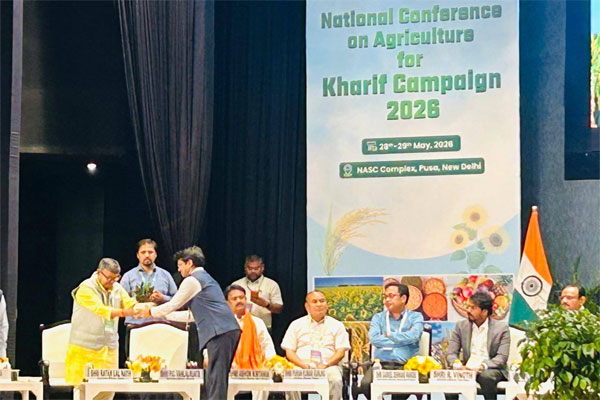
Tripura Agriculture and Farmers’ Welfare Minister Ratan Lal Nath has appealed to the Central Government for enhanced financial and policy support to strengthen the state’s agriculture sector. He placed a series of proposals before Union Agriculture Minister Shivraj Singh Chouhan during the National Conference on Agriculture for Kharif Campaign 2026 held in New Delhi. The proposals focus on food security, hybrid paddy expansion, organic farming, crop insurance reforms, fertilizer support, and technological advancement in agriculture.
Quick Glance
- Tripura sought central support to expand hybrid paddy cultivation and improve food security.
- The state requested wider coverage of organic farming schemes across the Northeast.
- The government proposed crop insurance reforms to compensate flood-affected farmers.
- Additional financial support was sought for oil palm cultivation and potato farming initiatives.
Agartala: Ratan Lal Nath highlighted the importance of paddy cultivation in Tripura’s agricultural economy while addressing the event. He said rice remains the state’s primary crop and occupies nearly 49 percent of the total gross cropped area.
The minister informed the gathering that Tripura plans to bring around 50,000 hectares under hybrid paddy cultivation during the 2025-26 financial year. To facilitate the expansion, the state government has already allocated Rs 10 crore in its budget.
He urged the Union Agriculture Ministry to extend support through the PM-RKVY scheme. According to Nath, expanding hybrid paddy cultivation will improve food grain production and strengthen long-term food security in the state.
Organic Farming Emerges as a Success Story
The minister also showcased Tripura’s progress in organic agriculture. He noted that the Mission Organic Value Chain Development for North Eastern Region (MOVCD-NER) has delivered encouraging results.
Organic farming now covers approximately 26,600 hectares across the state. In addition, nearly 26,800 farmers have adopted organic cultivation practices.
Nath emphasized that around 96 percent of Tripura’s farmers belong to the small and marginal category. Therefore, he requested the Centre to expand the scheme’s coverage and ensure broader implementation across the Northeastern region.
Demand for Better Fertilizer Support
The availability of fertilizers remains another major concern for the state. Nath called for uninterrupted urea supply to support agricultural activities throughout the year.
He pointed out that oil palm cultivation is expanding rapidly in Tripura. Since oil palm plantations require significant chemical inputs, he requested additional financial assistance to help farmers purchase fertilizers and other essential inputs.
The minister argued that such support would reduce the burden of rising cultivation costs and improve productivity.
Crop Insurance Reforms Sought for Flood-Affected Farmers
During his address, Nath highlighted the achievements of the Pradhan Mantri Fasal Bima Yojana (PMFBY) in Tripura.
According to him, more than 15 lakh farmers have received crop insurance coverage under the scheme during the past eight years. However, he noted that farmers cultivating paddy in low-lying areas continue to suffer heavy losses due to recurrent floods caused by intense rainfall.
He argued that the current insurance framework does not adequately address such situations. Consequently, he urged the Centre to classify flooding under the category of “local natural calamity” within PMFBY guidelines.
If accepted, the proposal would allow affected farmers to receive compensation for crop losses caused by localized flooding events.
Higher Assistance Proposed for Oil Palm Bio-Fencing
The minister also sought increased financial support for bio-fencing in oil palm plantations.
At present, farmers receive Rs 4,000 as assistance for bio-fencing. Nath proposed increasing the amount to Rs 8,000. He said the enhancement would help farmers better protect their plantations and improve plantation management.
Potato Farming Innovation Produces Encouraging Results
Tripura has also recorded progress in potato cultivation through the adoption of innovative technologies.
Nath informed the conference that the state has introduced the Apical Rooted Cuttings (ARC) technique in recent years. The initiative has significantly boosted potato production.
According to the minister, potato output has increased nearly three times due to the adoption of this scientific cultivation method. The results demonstrate the effectiveness of technology-driven agricultural practices in improving productivity.
Continued Technical Support Requested
Referring to the state’s collaboration with the International Potato Center (CIP), Lima, Peru, Nath stressed the importance of continued technical and consultancy support.
He expressed concern over the discontinuation of the RKVY-DPR scheme during the current year. The minister urged the Centre to restore the consultancy fee component so that farmers can continue benefiting from expert guidance and technological support.
National Conference Focuses on Kharif Preparedness
The National Conference on Agriculture for Kharif Campaign 2026 brought together agriculture ministers from 19 states. Senior officials from the Ministry of Agriculture and Farmers’ Welfare and other central departments also attended.
Agriculture Secretary Atish Chandra participated in the deliberations. Discussions focused on strategies to improve agricultural production, strengthen farmer welfare programmes, and prepare states for the upcoming Kharif season.
Key Agriculture Data Presented by Tripura
| Indicator | Details |
|---|---|
| Paddy Share in Gross Cropped Area | 49% |
| Hybrid Paddy Target (2025-26) | 50,000 hectares |
| State Budget Allocation for Hybrid Paddy | Rs 10 crore |
| Area Under Organic Farming | 26,600 hectares |
| Farmers Adopting Organic Cultivation | 26,800 |
| Small and Marginal Farmers | 96% |
| Farmers Covered under PMFBY | 15 lakh+ |
| Existing Bio-Fencing Assistance | Rs 4,000 |
| Proposed Bio-Fencing Assistance | Rs 8,000 |
| Increase in Potato Production via ARC Method | Nearly 3 times |
News Analysis
Tripura’s proposals reveal a strategic effort to modernize agriculture while addressing region-specific challenges. The state is simultaneously pursuing higher productivity through hybrid paddy cultivation and sustainability through organic farming. This dual approach reflects an attempt to balance food security with environmental concerns.
The demand to include flooding under PMFBY guidelines highlights a significant issue for Northeastern states where heavy rainfall frequently damages crops. If approved, the proposal could improve financial protection for thousands of vulnerable farmers.
Similarly, requests for fertilizer support, oil palm assistance, and continued potato cultivation consultancy indicate that Tripura is focusing on both diversification and modernization of agriculture. The proposals also underline the state’s dependence on targeted central support to accelerate agricultural transformation and improve rural livelihoods.
