

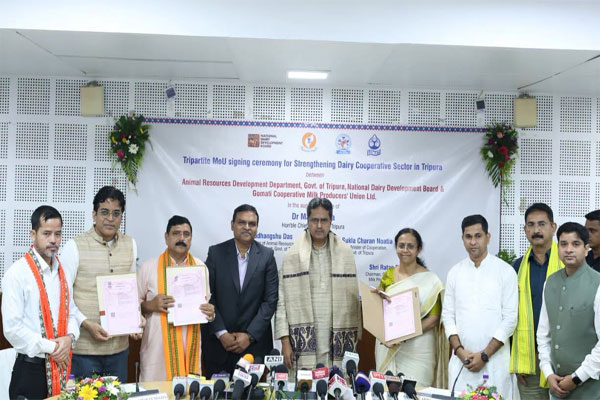
Tripura has launched a new dairy development initiative as the state government signed an MoU with the National Dairy Development Board and Gomati Cooperative Milk Producers’ Union Limited at the Secretariat to improve milk production, strengthen cooperatives, and create better economic opportunities for livestock rearers.
Quick Glance: Key Takeaways
- Tripura signed a dairy development MoU involving the government, NDDB, and Gomati Cooperative Milk Producers’ Union Limited.
- The agreement will support a Comprehensive Cooperative Dairy Development Plan (CCDDP).
- The initiative focuses on increasing livestock rearer income and rural economic growth.
- The project aligns with the national “White Revolution 2.0” vision.
Agartala: Tripura’s dairy sector has received a fresh development roadmap with the signing of a strategic agreement aimed at transforming livestock rearers into stronger economic participants.
According to our on-the-ground report in Agartala, the MoU signing ceremony at Conference Hall No. 2 of the Secretariat marked a significant policy move towards expanding cooperative dairy production across the state.
The agreement was signed between the Animal Resources Development Department, Government of Tripura, the National Dairy Development Board (NDDB), and the Gomati Cooperative Milk Producers’ Union Limited.
Furthermore, the partnership will focus on preparing and implementing a Comprehensive Cooperative Dairy Development Plan (CCDDP). The plan is designed to support milk production growth while creating sustainable livelihood opportunities for rural communities.
The initiative follows the broader national objective of achieving the goals of “White Revolution 2.0”, which aims to strengthen dairy-based economic activities.
Dairy Sector Seen as New Source of Rural Financial Security
Chief Minister Prof. (Dr.) Manik Saha highlighted the importance of dairy development while addressing the gathering at the MoU ceremony.
He said Tripura has the potential to emerge as a recognised dairy-producing state by adopting successful models from across India.
The Chief Minister pointed to Gujarat’s dairy sector as an example of cooperative-led growth. He expressed confidence that Tripura could develop a similar movement with wider participation from farmers and livestock rearers.
According to officials, the government’s focus is not limited to increasing milk production. It also aims to improve the financial and social position of people engaged in livestock rearing.
Speaking exclusively to Enewstime Desk, officials confirmed that cooperative expansion remains a key strategy for connecting rural producers with organised markets.
The dairy ecosystem can provide additional income opportunities for small livestock rearers. Consequently, it may contribute to strengthening the rural economy.
Cooperative Model Expected to Expand Market Opportunities
Animal Resources Development, Fisheries, and Scheduled Caste Welfare Minister Sudhangshu Das described the MoU as an important milestone for Tripura.
He stated that the agreement would help create a foundation for sustainable dairy development.
Furthermore, he highlighted that milk production in the state has been showing gradual improvement and that additional measures are being taken to accelerate growth.
The cooperative structure is expected to play a major role in improving production systems. It can also help producers access better support services, market networks, and technical guidance.
According to concerned officials, the development plan will focus on strengthening cooperative-based dairy activities and improving the overall dairy value chain.
The expected benefits include:
| Sector | Expected Impact |
|---|---|
| Milk Production | Expansion of dairy output |
| Livestock Rearers | Improved livelihood opportunities |
| Cooperatives | Stronger rural producer networks |
| Rural Economy | Increased income generation |
Government Links Dairy Growth With “Viksit Bharat” Vision
Cooperation Minister Shuklacharan Noatia said cooperative institutions have witnessed positive changes under the current government.
He emphasised that cooperatives must become more connected with ordinary citizens.
Furthermore, he stated that a stronger cooperative sector would support the larger vision of building a “Viksit Bharat.”
The government believes dairy cooperatives can become a bridge between rural producers and economic growth.
Specifically, better cooperative infrastructure can help reduce challenges faced by livestock rearers.
These challenges include limited market access, production-related issues, and difficulties in obtaining organised support.
The partnership with NDDB is expected to bring institutional expertise into Tripura’s dairy sector.
NDDB Partnership May Strengthen Tripura’s Dairy Future
The presence of NDDB leadership added importance to the agreement.
NDDB Chairman Dr. Meenesh Shah and Gomati Cooperative Milk Producers’ Union Limited Chairman Ratan Ghosh discussed initiatives related to dairy expansion, cooperative production, market development, and welfare of livestock rearers.
The MoU brings together government support, technical expertise, and cooperative participation.
Furthermore, it creates a structured approach for long-term dairy growth.
The event was attended by senior officials, including Tapas Roy, Secretary of the Cooperation Department, Dr. Neeraj Kumar Chanchal, Director of Animal Resources Development Department, representatives of NDDB, and members of the cooperative union’s Board of Directors.
