

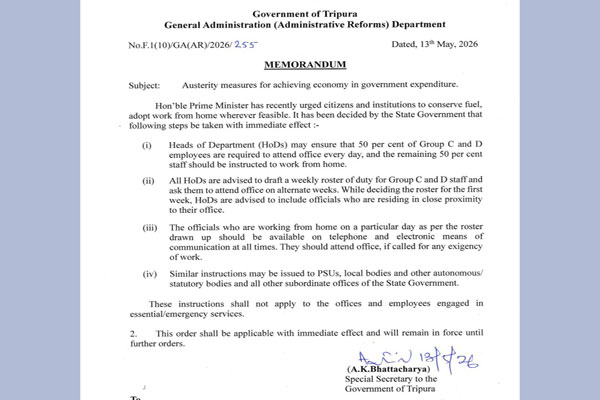
The Tripura government has issued a work-from-home order for Group C and Group D employees in state offices following Prime Minister Narendra Modi’s appeal to conserve fuel. The order took effect immediately and excludes emergency service departments.
Quick Glance
- Tripura government directs 50% attendance for Group C and D staff in offices
- Remaining employees will work from home on a rotational basis
- Weekly rosters will prioritize employees living near offices
- Emergency and essential service departments remain exempt from the order
Tripura Govt Announces Austerity Measures to Cut Fuel Consumption
Agartala: The Tripura government on Wednesday rolled out a new administrative directive aimed at reducing fuel consumption and cutting government expenditure. The move came after Prime Minister Narendra Modi urged citizens and institutions across the country to adopt fuel-saving measures and promote work-from-home practices wherever possible.
The order was issued by the General Administration (Administrative Reforms) Department. It directed all Heads of Departments (HoDs) to ensure that only half of the Group C and Group D employees attend office physically each day.
The remaining employees will perform their duties remotely from home.
Officials said the measure has come into force with immediate effect from May 13, 2026. The directive will remain operational until further government instructions.
Weekly Duty Rosters Made Mandatory
Under the new system, every department must prepare a weekly duty roster for Group C and Group D employees. Staff members will attend office on alternate weeks.
The government also instructed department heads to prioritize employees residing near office premises while preparing the first week’s roster. Officials believe this step will help reduce fuel use and travel expenses significantly.
The memorandum further clarified that employees working from home must remain accessible at all times through mobile phones and digital communication platforms.
If any urgent official work arises, the employees must report to office immediately.
The decision reflects the administration’s attempt to balance operational efficiency with expenditure control during a period of rising fuel concerns.
Govt Extends Directive to PSUs and Autonomous Bodies
The state government has not limited the order to secretariat offices alone. It also asked Public Sector Undertakings (PSUs), local bodies, autonomous institutions, statutory organizations, and subordinate offices to issue similar instructions.
This wider implementation could affect thousands of employees across Tripura’s administrative network.
However, the government clearly exempted emergency and essential service departments from the directive. Hospitals, emergency response services, and critical operational departments will continue normal attendance to ensure uninterrupted public service delivery.
Officials stated that essential sectors cannot afford disruptions because they directly affect public welfare and emergency management.
Fuel Conservation Becomes Administrative Priority
The latest order signals Tripura government’s alignment with the Centre’s broader fuel conservation campaign.
Prime Minister Narendra Modi recently emphasized the need for responsible fuel use amid global economic uncertainties and rising energy costs. Several states have started exploring remote working arrangements and cost-cutting mechanisms in response.
Tripura’s decision marks one of the most structured approaches among northeastern states in implementing a rotational office attendance system for lower-tier government employees.
Administrative experts believe the initiative may also reduce traffic congestion in Agartala and nearby urban areas if implemented effectively.
Key Features of the Government Order
| Measure | Details |
|---|---|
| Office Attendance | 50% Group C and D employees |
| Work From Home | Remaining 50% employees |
| Roster System | Weekly rotational duty |
| Priority Basis | Employees residing near offices |
| Communication Rule | Employees must remain reachable |
| Emergency Services | Exempt from directive |
| Effective Date | May 13, 2026 |
News Analysis
The Tripura government’s latest directive highlights a shift toward administrative flexibility and resource conservation. Although the order primarily focuses on fuel savings, it also reflects growing acceptance of hybrid work culture within government systems.
The policy may help reduce transportation expenses for employees and lower operational costs for departments. At the same time, successful implementation will depend on efficient communication and strict monitoring mechanisms.
The exemption granted to emergency services indicates that the government aims to maintain essential public operations without disruption.
The order may also serve as a test case for future digital governance practices in Tripura. If the rotational system works smoothly, authorities could consider expanding flexible work arrangements in selected sectors even after the current austerity phase ends.
At the political level, the decision reinforces the state government’s attempt to align closely with the Centre’s administrative and economic priorities.
People Also Ask
Why did the Tripura government introduce work-from-home rules?
The government introduced the system to conserve fuel and reduce administrative expenditure following Prime Minister Narendra Modi’s appeal for austerity measures.
Which employees will work from home in Tripura government offices?
Group C and Group D employees will work on a rotational basis, with 50 percent attending office physically and the rest working remotely.
Are emergency departments included in the new Tripura order?
No. Essential and emergency service departments remain outside the scope of the directive.
