

Community organisations can play a major role in building stronger neighbourhoods. In Agartala, Aurobindo Club has used social service initiatives to connect people with community needs. Its activities range from blood donation and clothing distribution to programmes that recognise the contribution of senior citizens.
Key Takeaways
- Aurobindo Club in Agartala has expanded its community activities beyond social gatherings.
- The club has organised blood donation and clothing distribution programmes for people in need.
- Its senior citizen felicitation initiative highlights the role of local organisations in strengthening community bonds.
Agartala August 19: The Aurobindo Club at Kasharipatty in Agartala, Tripura has emerged as a local platform for community-oriented activities.
The organisation regularly undertakes initiatives aimed at supporting people and encouraging social participation. Its programmes include blood donation drives and clothing distribution activities.
These efforts reflect a wider role for community clubs in urban areas. Such organisations can respond to local needs while also creating opportunities for residents to work together.
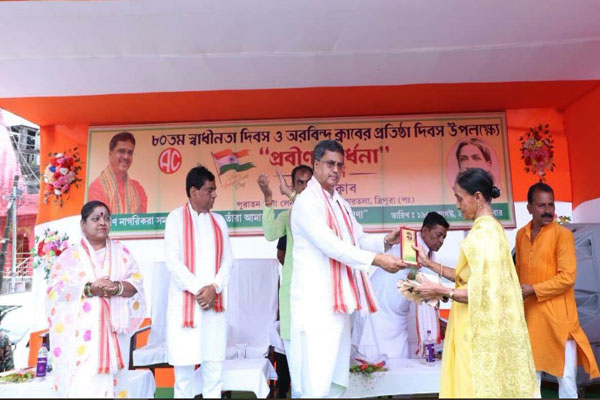
The club recently added another dimension to its social activities by organising a felicitation programme for senior citizens.
The programme was held as part of the celebrations marking the 80th Independence Day of India and the foundation day of the Aurobindo Club.
Senior Citizens Get Community Recognition
The felicitation programme placed senior citizens at the centre of the community event.
Chief Minister Prof. Dr Manik Saha attended the programme and praised the initiative. He described elderly people as important sources of experience, tradition and values.
The Chief Minister said the contribution of senior citizens should receive greater recognition in society.
He also stressed that respect for elderly people should begin at home. Families, according to him, have an important role in ensuring that senior citizens remain connected with younger generations.
The message also highlighted the importance of intergenerational relationships. Senior citizens can pass knowledge, memories and cultural traditions to younger members of society.
Community Clubs Can Drive Social Change
The Aurobindo Club initiative also points to the potential of local organisations in addressing social concerns.
Community clubs often have direct links with residents. This gives them an opportunity to identify local needs and mobilise people quickly.
Blood donation programmes are one example. Such initiatives can encourage healthy citizens to contribute to emergency healthcare needs.
Clothing distribution is another form of community support. It can provide assistance to economically vulnerable families while encouraging people to share resources.
Recognition of senior citizens adds a social and cultural dimension to these activities.
Together, such programmes can create stronger community networks.
Call for More Organisations to Follow
Dr Saha urged other social organisations in Tripura to take inspiration from such initiatives.
He said programmes that recognise and support senior citizens can send a positive message across society.
The Chief Minister also called for social responsibility to become part of everyday life. He said people should make efforts to contribute to society and stand beside others when they need support.
This approach places community service beyond occasional events. It encourages individuals and organisations to make social welfare a continuing activity.
Preserving Values Through Community Participation
The programme also highlighted the connection between community service and cultural values.
India has a long tradition of community participation and collective responsibility. Local organisations can help keep this tradition relevant by involving different generations in social activities.
Senior citizens can play an important role in this process. Their life experiences can provide younger people with perspectives on social values, traditions and community relationships.
At the same time, younger generations can contribute through volunteer work and new forms of community engagement.
A Local Model With Wider Potential
The Aurobindo Club programme demonstrates how a neighbourhood organisation can combine social service with community recognition.
Its activities provide different ways for residents to participate. Blood donation supports healthcare needs. Clothing distribution addresses immediate social concerns. Senior citizen programmes promote dignity and inclusion.
The broader message is that community welfare does not depend only on government programmes.
Local organisations, voluntary groups and citizens can also contribute significantly. When such efforts continue regularly, they can strengthen social connections at the neighbourhood level.
For Agartala, initiatives such as those undertaken by Aurobindo Club offer a practical example of community participation. They show how local clubs can move beyond recreational activities and become active partners in social welfare.
The participation of senior citizens also adds an important dimension to the clubs work. It reinforces the idea that every generation has a role in building a more connected and supportive society.
