

Tripura Unit of the All India Kisan Sabha (AIKS) cited farmers’ grievances as a major political issue in the State and accused the BJP-led Government of neglecting the farmers. AIKS leaders alleged that gaps in agricultural support are putting rural livelihoods under pressure. The organisation has demanded stronger government intervention in irrigation, farm inputs, flood relief, rubber cultivation and support for Jhum cultivators.
Key Takeaways:
- AIKS alleges inadequate support for irrigation, farm inputs, flood-hit farmers and rubber growers in Tripura.
- The farmers’ body raises concerns over Jhum cultivation, dairy farming and vegetable production.
- AIKS plans to strengthen its grassroots network and intensify mobilisation over farmers’ demands.
AIKS Flags Growing Farm Distress
The All India Kisan Sabha (AIKS) has accused the Tripura government of failing to adequately address the problems confronting farmers across the state.
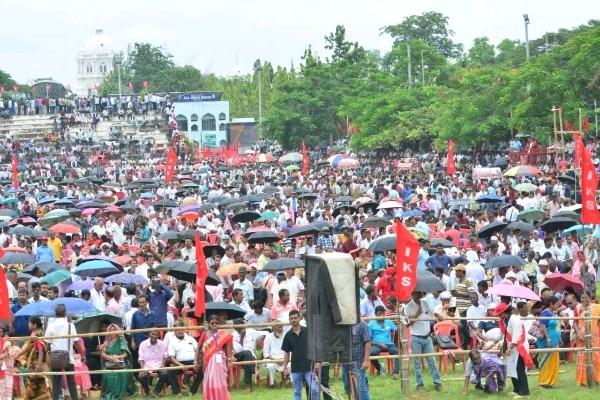
The allegations were raised during the organisation’s 22nd state conference in Agartala. A large public meeting followed the conference at Swami Vivekananda Maidan, also known as Astabal Maidan.
AIKS leaders said farmers continue to face difficulties despite agriculture remaining a key source of livelihood in rural Tripura. They pointed to problems involving irrigation, agricultural inputs, crop losses and inadequate assistance after natural disasters.
The organisation claimed that several irrigation projects across the state have become dysfunctional. It also alleged that government warehouses have faced shortages of essential supplies, including quality seeds.
According to AIKS leaders, these gaps have made it harder for farmers to maintain production and protect their incomes.
Flood Losses and Farm Inputs Under Focus
Flood-related damage was another major concern raised at the gathering.
AIKS alleged that many farmers affected by severe flooding did not receive adequate assistance. The organisation said crop and livelihood losses have added to the financial pressure on rural households.
Shortages of fertilisers and other agricultural inputs also featured in the discussions. AIKS leaders argued that timely availability of such materials remains critical for farmers, particularly during key cultivation periods.
The organisation said government agencies must respond faster to farmers’ demands and ensure that essential inputs reach cultivators without disruption.
Rubber Growers Seek Greater Support
Rubber cultivation also came under discussion at the conference.
AIKS leaders claimed that more than two lakh people in Tripura depend on rubber cultivation. They alleged that the state lacks a comprehensive strategy to expand the sector and protect growers from production-related challenges.
Pest attacks on rubber plantations were highlighted as a serious concern. According to the organisation, affected growers did not receive sufficient government assistance.
AIKS leaders said rubber producers’ organisations and the Rubber Board had provided support to affected farmers when government assistance was allegedly inadequate.
They argued that the rubber sector needs stronger institutional backing because of its importance to the state’s rural economy.
Jhum Cultivators Face Alleged Support Gap
The organisation also highlighted the condition of Jhum cultivators.
AIKS claimed that around 40,000 hectares of tribal land are associated with shifting cultivation in Tripura. Leaders alleged that Jhum farmers previously received various forms of assistance from the state government and the Tripura Tribal Areas Autonomous District Council.
They claimed that such support has declined sharply.
The organisation demanded greater attention to Jhum cultivation and the economic needs of communities dependent on it.
Dairy farmers and vegetable growers were also identified as groups requiring stronger policy support. AIKS leaders said these sectors can contribute significantly to rural incomes if farmers receive adequate infrastructure, inputs and market assistance.
AIKS Links Farm Issues to Wider Rural Crisis
The farmers’ organisation said its workers continued to raise agricultural issues before government departments during the past several years.
AIKS leaders also recalled their activities during the COVID-19 period. They claimed that workers remained connected with farmers and continued to press their demands despite organisational challenges.
The organisation said its membership had declined after the 2018 Assembly elections because many members allegedly faced difficulties in working openly. However, it claimed that membership has increased every year since 2019.
AIKS currently claims around 1.6 lakh members in Tripura. The Ganamukti Parishad, according to the organisation, has nearly one lakh members.
Roads and Rural Infrastructure Add to Concerns
The conference also brought infrastructure issues into the wider discussion on rural distress.
AIKS leaders criticised the condition of roads across Tripura. Their concerns covered major highways as well as roads connecting villages and agricultural areas.
CPI(M) state secretary and Leader of Opposition Jitendra Chaudhury separately criticised the condition of important routes linking Agartala with northern Tripura.
He cited routes through Teliamura as well as Khowai, Kamalpur and Kailashahar while questioning the quality of road connectivity.
The opposition leader also alleged that gaps remain in public services despite government claims of large-scale recruitment and outsourcing.
AIKS Plans Wider Farmers’ Mobilisation
The conference was held after a gap of around five and a half years. The previous AIKS state conference took place in December 2020.
Senior AIKS and CPI(M) leaders attended the latest conference. They included Jitendra Chaudhury, Pabitra Kar and AIKS central leadership member Hannan Mollah.
Delegates from different districts and subdivisions discussed agriculture, farmers’ interests and the organisation’s future programmes.
AIKS leaders said they intend to strengthen the organisation at the grassroots level. They also want to expand campaigns around farmers’ demands.
The organisation referred to the nationwide ‘jail bharo’ mobilisation on August 10, claiming that farmers, workers, students, youth and women participated in large numbers in Tripura.
AIKS described that mobilisation as a sign of broader resistance against the BJP-led government.
The latest conference has therefore placed farmers’ livelihood concerns at the centre of the opposition’s wider political campaign. With Village Committee elections approaching, the organisation’s push to consolidate farmers and rural workers could add a fresh dimension to Tripura’s political contest.
