

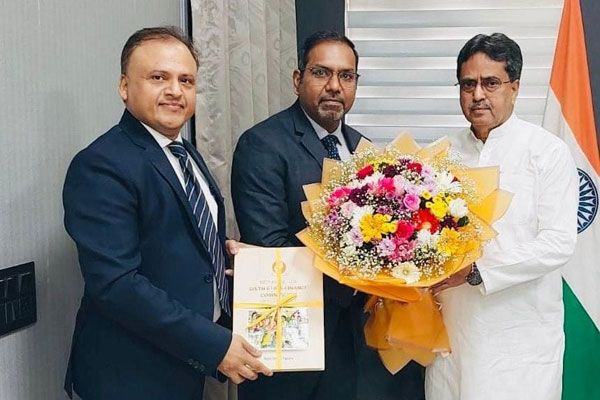
The submission of the Sixth State Finance Commission (SFC) report to Chief Minister Prof. (Dr) Manik Saha marks an important step for the Tripura Government. But what exactly is the State Finance Commission (SFC) , and why should ordinary citizens care? The answer lies in how villages, municipalities and local bodies receive funds to provide essential public services.
Key Takeaways
- The Sixth State Finance Commission has submitted its report to the Tripura government.
- The Commission recommends how funds should be shared among local bodies.
- Its recommendations cover Panchayats, Urban Local Bodies and the TTAADC.
- Cabinet approval is required before implementation.
- The recommendations are expected to guide local funding from 2026-27 to 2030-31.
Agartala: The State Finance Commission (SFC) is a constitutional body. Every state government constitutes it periodically under Articles 243(I) and 243(Y) of the Constitution of India.
Its primary responsibility is to review the financial health of local governments. It also recommends how financial resources should be distributed among Panchayati Raj Institutions (PRIs), Urban Local Bodies (ULBs) and, in Tripura’s case, the Tripura Tribal Areas Autonomous District Council (TTAADC).
Simply put, the Commission decides the principles that can help local governments receive adequate financial support to deliver public services efficiently.
Why Was the Sixth State Finance Commission Formed?
The Government of Tripura constituted the Sixth State Finance Commission on January 7, 2025.
The Commission was headed by Abhishek Singh, IAS, with Dr. Pallab Kanti Ghosal as Member and Dr. Akinchan Sarkar, IAS, as Member Secretary.
Its mandate went beyond reviewing finances. It examined whether local institutions have enough resources to meet growing development needs. It also explored ways to improve governance, accountability and service delivery.
Why Does the Commission Matter to Ordinary Citizens?
Many people assume the Commission deals only with government accounts. In reality, its recommendations affect everyday life.
Local governments are responsible for several essential civic services. These include:
- Village roads and internal streets
- Drinking water supply
- Sanitation and waste management
- Street lighting
- Local markets
- Community assets
- Rural development works
- Municipal services
When local bodies receive adequate and predictable funding, they can plan projects better. They can also complete development works more efficiently.
Better financial planning often leads to better public services.
How Are Funds Shared?
One of the Commission’s biggest responsibilities is to recommend how the State Government should distribute financial resources.
The recommendations cover three major institutions:
- Panchayati Raj Institutions in rural areas
- Urban Local Bodies such as Municipal Corporations and Municipal Councils
- Tripura Tribal Areas Autonomous District Council (TTAADC)
The Commission studies several factors before making recommendations. These may include population, geographical conditions, development needs, existing infrastructure and financial capacity.
Its objective is to ensure a fair and balanced distribution of public funds.
What Happens After the Report Submission?
Submitting the report does not mean the recommendations become effective immediately.
The report will first go before the Tripura Council of Ministers.
The Cabinet will examine each recommendation carefully.
After approval, different government departments will prepare implementation plans.
Officials have indicated that the recommendations may remain in force during the period 2026-27 to 2030-31.
How Can Better Funding Improve Governance?
Experts believe stronger fiscal decentralisation creates stronger local governments.
When Panchayats and municipalities receive timely financial support, they can:
- Execute development projects faster.
- Improve transparency.
- Strengthen financial discipline.
- Reduce dependence on emergency grants.
- Respond more effectively to local needs.
This also allows elected local representatives to prepare development plans based on local priorities instead of waiting for ad hoc funding.
Why Fiscal Decentralisation Is Important
Fiscal decentralisation means giving local governments greater financial authority and predictable funding.
Instead of concentrating financial decisions at the state level, resources are distributed closer to the people.
This approach often improves governance because local authorities understand local problems better.
For a geographically diverse state like Tripura, where development needs vary across districts, decentralised funding can support more balanced growth.
What CM Dr Manik Saha Said
Chief Minister Prof. (Dr) Manik Saha appreciated the Commission for conducting extensive consultations with government departments, local self-government institutions and subject experts.
He said the State Government would examine the recommendations carefully before taking appropriate decisions.
The Chief Minister also reiterated the government’s commitment to strengthening local self-governance and promoting balanced development across Tripura.
What Citizens Can Expect Next
The submission of the Sixth State Finance Commission report represents the beginning of a new policy phase rather than its conclusion.
The recommendations now await Cabinet approval. Once accepted, they could shape the financial framework of Panchayats, Urban Local Bodies and the TTAADC for the next five years.
For citizens, the impact may eventually be visible through stronger civic infrastructure, improved municipal services, better rural development and more accountable local governance.
While the full recommendations are yet to enter the public domain, the report has already laid the foundation for Tripura’s next phase of fiscal decentralisation. If implemented effectively, it could strengthen grassroots democracy and improve the delivery of public services across the state.
