

Integrated farming in Tripura is emerging as a sustainable solution for small and marginal farmers seeking stable incomes and the success of Unakoti farmer Jyotsna Nama demonstrates how scientific training and institutional support for integrated farming can transform rural livelihoods.
Quick Takeaways
- Integrated farming is gaining popularity among small farmers in Tripura.
- Diversified agriculture helps reduce income risks and improves productivity.
- Jyotsna Nama earns around ₹2.5 lakh annually from four kani of land.
- NABARD’s LEDP training and Growing Seed supported the integrated farming model.
- Experts say the approach can strengthen sustainable agriculture across Tripura.
Agartala: Integrated farming is emerging as a sustainable livelihood model for small and marginal farmers in Tripura. The approach combines agriculture, livestock, fisheries and horticulture on the same piece of land.
It helps farmers diversify income, reduce risks and make better use of limited resources. The recent success of a woman farmer from Unakoti district has highlighted the growing potential of this farming system in the state.
Small landholdings find new opportunities
Most farmers in Tripura cultivate small and fragmented landholdings. Depending on a single crop often leaves them vulnerable to erratic weather, market fluctuations and rising production costs. Agricultural experts increasingly recommend integrated farming as a practical solution to these challenges.
The model combines multiple farm activities. Poultry, dairy, goat rearing, fishery, vegetable cultivation and paddy farming complement each other. Farm waste from one activity becomes an input for another. This reduces production costs while improving overall productivity.
The system also creates year-round income opportunities instead of relying on a single harvest season.
Jyotsna Nama demonstrates integrated farming success
The potential of this approach has become evident through the achievements of Jyotsna Nama, a progressive farmer from Satnala village under Dasda block in Unakoti district.
Nama joined the Deo Valley Farmers Producer Company Ltd. in April 2024. She later received intensive training under the Livelihood and Enterprise Development Programme (LEDP) on livestock, implemented by Growing Seed with support from NABARD.
The training introduced her to scientific farming practices, livestock management and market-oriented production. Technical mentoring helped her develop an integrated farming model across four kani of land.
Her farm now combines poultry, goat rearing, dairy, fishery, vegetable cultivation and paddy farming under a single production system.
Diversification improves farm income
The integrated model has significantly improved Nama’s earnings. According to programme officials, she now generates a net annual income of nearly ₹2.5 lakh.
Instead of depending on one crop, she earns from several agricultural activities throughout the year. Income from livestock supports crop cultivation, while fishery and vegetable production provide additional revenue.
This diversification has reduced financial risks and strengthened household income. It has also made better use of available land and natural resources.
Agriculture experts say such models offer greater resilience against crop failures and changing market conditions.
Institutional support strengthens rural livelihoods
The success story also underlines the importance of institutional support in modern agriculture.
The Livelihood and Enterprise Development Programme focuses on building entrepreneurial skills among rural households. Besides technical training, participants receive mentoring, scientific guidance and assistance in accessing markets.
Officials associated with the programme believe these interventions help farmers shift from subsistence agriculture to commercially viable farming enterprises.
Membership in Farmers Producer Companies also enables cultivators to access better marketing opportunities, collective procurement and technical services.
Recognition reflects wider potential
Nama’s achievement received formal recognition on July 15, 2026, when NABARD’s Tripura Regional Office felicitated her during celebrations marking the International Year of the Woman Farmer and NABARD’s 45th Foundation Day.
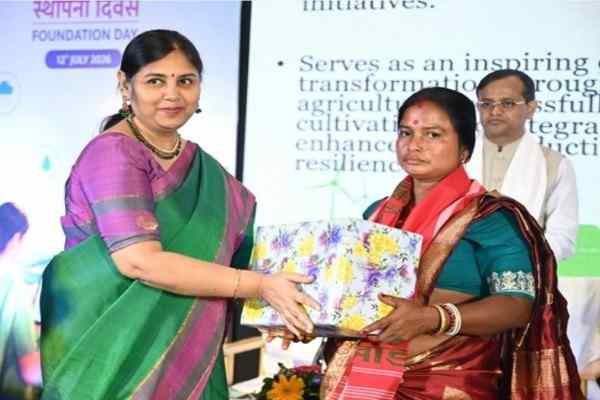
The honour recognised her contribution to agriculture and rural development. However, agricultural stakeholders view the recognition as more than an individual achievement. They see it as evidence that integrated farming can become a scalable livelihood model across Tripura.
Growing Seed, the implementing agency, welcomed the recognition and credited NABARD’s continued support for strengthening rural livelihoods through skill development, scientific farming practices and improved market access.
Scope for wider adoption in Tripura
Agriculture remains the primary source of livelihood for a large section of Tripura’s rural population. With shrinking landholdings and increasing climate uncertainties, experts believe integrated farming offers an effective pathway towards sustainable agriculture.
The model promotes efficient resource utilisation, generates multiple income streams and encourages year-round farm activity. It also creates opportunities for women farmers and rural entrepreneurs to build financially viable agricultural enterprises.
The success of Jyotsna Nama demonstrates how scientific training, institutional support and diversified farming can transform a small farm into a profitable venture. As more farmers look for resilient and sustainable livelihood options, integrated farming is steadily emerging as one of the most promising agricultural models for Tripura’s rural economy.
