

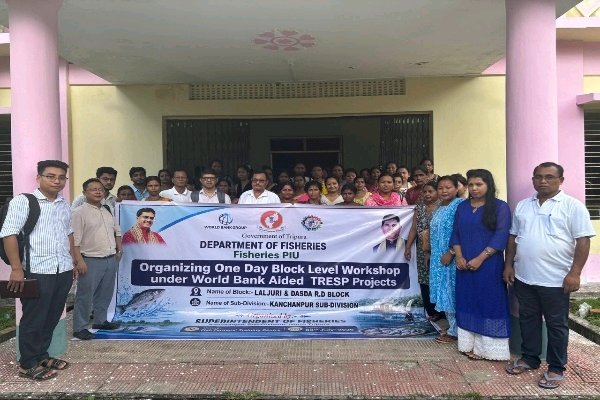
The Tripura Rural Economic Growth and Service Delivery Project (TRESP) has intensified its efforts to strengthen fisheries-based livelihoods in North Tripura. The TRESP held a workshop to equip Matsya Sakhi women with technical knowledge and community leadership skills. A block-level workshop at Kanchanpur highlighted the growing role of trained women facilitators in improving fisheries services, beneficiary support, and sustainable rural development.
Kanchanpur: Strengthening the skills of grassroots women workers has emerged as a key strategy under the TRESP to improve fisheries-based livelihoods across North Tripura.
In line with this objective, the District Project Management Unit (DPMU), North Tripura, in collaboration with the Department of Fisheries, organised a one-day block-level fisheries workshop at Kanchanpur Sub-Division to build the technical and leadership capacity of Matsya Sakhis.
The initiative reflects TRESP’s broader vision of creating a strong community-based support system capable of assisting fish farmers, promoting sustainable aquaculture, and ensuring effective implementation of livelihood programmes at the village level.
Women at the Centre of Fisheries Development
The workshop brought together 36 Matsya Sakhis representing 24 Village Committees from Laljuri and Dasda Rural Development Blocks.
| Related News: Dasda BPMU in North Tripura Declared Best Performing Unit Under TRESP |
These trained women function as community-level facilitators, serving as a bridge between government departments, project teams and fish farming households.
TRESP is strengthening the knowledge and practical skills of Matsya Sakhis. The project aims to improve access to fisheries services. It also seeks to provide beneficiaries with timely technical guidance and institutional support.
Officials said Matsya Sakhi women now play a bigger role in supporting fisheries development. They help reach remote villages where regular extension services often remain limited.
Their presence enables better communication with beneficiaries and helps ensure that development programmes are implemented more efficiently.
Focus on Practical Capacity Building
Unlike conventional awareness programmes, the workshop concentrated on enhancing the operational capabilities of Matsya Sakhis through structured technical sessions.
Participants received detailed orientation on their responsibilities, fisheries livelihood interventions under TRESP, beneficiary facilitation, community mobilisation techniques, stakeholder engagement and village-level monitoring of fisheries activities.
|Related News: TRESP Livestock Growth in Mandwai: Scopes & Challenges Reviewed |
The sessions focused on practical ways to identify local challenges. Trainers explained how Matsya Sakhis can support fish farmers during project implementation. They also highlighted the importance of maintaining field records and submitting reports on time.
Organisers believe the training will strengthen the knowledge of community facilitators. They expect the programme to improve the planning and implementation of fisheries development initiatives across North Tripura.
Collaboration Key to Successful Implementation
The programme also highlighted the importance of convergence between different implementing agencies.
Experts stressed that closer coordination between the Department of Fisheries, TRESP teams and village-level institutions would improve the quality of service delivery and accelerate the achievement of project objectives.
Regular field visits, prompt reporting and continuous technical support were identified as essential elements for ensuring that fisheries interventions generate lasting benefits for rural households.
Interactive discussions allowed participants to exchange experiences from their respective villages, identify operational bottlenecks and discuss practical solutions for improving implementation on the ground.
Senior Officials Attend Workshop
The workshop was inaugurated by Shri Animesh Chakma, SF, Kanchanpur.
Among those present were Dr. Samar Roy, Nodal Officer for TRESP Fisheries, Shri B. Hijam, Fishery Specialist, and Ms. Songhita Paul, District Manager (Fishery), DPMU North.
Officials from the Department of Fisheries, district and block-level TRESP teams, along with Technical Support Agency (TSA) personnel, also attended the programme, reflecting a coordinated approach to fisheries development.
Their participation underscored the emphasis being placed on strengthening institutional support alongside community capacity building.
Building Sustainable Rural Livelihoods
Fisheries continue to provide an important source of income for many rural families in Tripura, particularly in areas where agriculture alone may not generate adequate earnings throughout the year.
TRESP seeks to strengthen these livelihood opportunities by combining technical assistance, institutional support and community participation. The development of trained grassroots cadres such as Matsya Sakhis forms an integral part of this strategy.
As trusted community representatives, Matsya Sakhis help mobilise beneficiaries, facilitate awareness about government schemes, encourage adoption of improved fish farming practices and support the monitoring of ongoing projects.
Their involvement also enables quicker identification of field-level issues, allowing implementing agencies to respond more effectively.
Strengthening the Foundation for Future Growth
The Kanchanpur workshop marks another step towards creating a stronger grassroots fisheries support network in North Tripura. Rather than functioning as a standalone training programme, it forms part of a larger effort to build local capacity that can sustain fisheries development over the long term.
Officials expect the enhanced knowledge and coordination developed through the workshop to improve project implementation across villages while increasing the effectiveness of fisheries-based livelihood interventions.
With greater investment in community capacity building, TRESP is working to create a model in which trained local women become catalysts for rural economic growth, improved service delivery and sustainable fisheries development. As these grassroots facilitators strengthen their technical expertise and leadership skills, they are expected to play an increasingly significant role in supporting fish farming communities and advancing inclusive rural development across North Tripura.
