

The Northeast is emerging as a potential growth centre for India space sector, with technology, geospatial applications and innovation expected to address regional challenges while opening new commercial opportunities for startups and young entrepreneurs.
Key Takeaways:
- Northeast India can evolve from a user of space technology into a developer and commercial hub for space-enabled solutions.
- Governor Indra Sena Reddy Nallu highlighted Tripura Digital Forest Rights Act Atlas as a major regional space technology application.
- The Northeast India Space Workshop 2026 focused on innovation, public services, disaster management, agriculture and youth opportunities.
The Northeast could soon take a larger role in India space technology ecosystem. The region is moving beyond the traditional role of using space-based services. It now has the potential to develop applications, serve as a testing ground and create commercially viable space-enabled solutions.
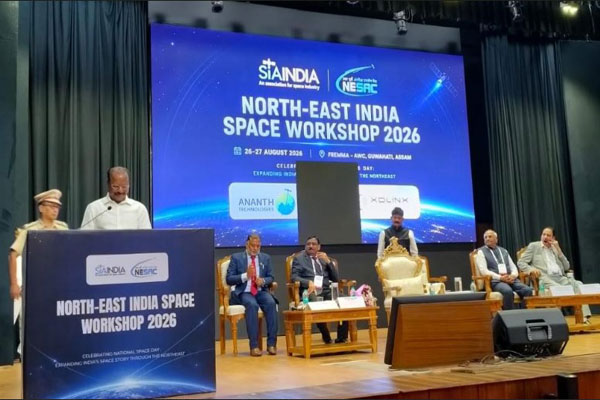
Governor Indra Sena Reddy Nallu highlighted this opportunity while participating in the Northeast India Space Workshop 2026 in Guwahati on Thursday. The event focused on the theme, “Leveraging Space Technology: Regional Transformation to Global Reach.”
The Space Industry Association of India (SIA-India) organised the workshop with the North Eastern Space Applications Centre (NESAC).
Space Technology Can Drive Regional Transformation
Governor Nallu said the Northeast has distinct geographical and developmental conditions. These factors create strong opportunities for wider use of space technology.
He pointed to several sectors that can benefit from advanced space applications. These include public services, connectivity, agriculture, disaster management and sustainable development.
According to the Governor, the Northeast is reaching an important stage in its technology journey. Scientific capabilities and technological innovation can work together to develop solutions suited to local challenges.
He said these solutions should remain scalable and sustainable. They should also create measurable and long-term benefits for communities across the region.
Tripura Highlights Digital Forest Rights Atlas
The Governor placed particular emphasis on a major technology initiative from Tripura.
He highlighted the launch of the Northeast first Digital Forest Rights Act (FRA) Atlas. The Tripura Space Applications Centre (TSAC) supported the initiative as the technology and knowledge partner.
The Governor described the atlas as more than a technological achievement. He said it reflects an effort to protect the rights and interests of tribal communities through scientific planning and technology-driven governance.
The Digital FRA Atlas can also strengthen the implementation of the Forest Rights Act. Geospatial and space-based technologies can provide authorities with better information for planning and monitoring.
Such tools can improve transparency in the process. They can also support greater efficiency and help officials make informed decisions.
Northeast Eyes New Space Opportunities
The workshop formed part of National Space Day celebrations. It aimed to strengthen the contribution of Northeast India to the rapidly expanding New Space ecosystem.
The event brought together government officials, policymakers, industry representatives, academics, startups and international partners.
Participants examined how space technology can support socio-economic development across the region. They also discussed ways to improve public service delivery through space-based applications.
Innovation and entrepreneurship emerged as important areas of discussion. The expanding space ecosystem could create new opportunities for startups and young professionals across the Northeast.
The discussions also explored the potential of space technology to address challenges linked to the region geography and infrastructure.
Agriculture, Disaster Management Among Key Areas
Space-based applications can play a growing role in sectors that directly affect people across the Northeast.
In agriculture, satellite-based information can support crop monitoring and improve planning. Geospatial tools can also help authorities assess land and natural resources.
Disaster management remains another major area of potential use. Satellite imagery and other space technologies can support monitoring, assessment and response during natural disasters.
Connectivity and public service delivery can also benefit from improved technology. These applications could help bridge geographical barriers faced by remote communities.
Experts Discuss Regional Space Ecosystem
The programme began with a welcome address by Dr. Subba Rao Pavuluri, President of SIA-India.
Pallav Kumar Jha, Secretary, Science and Technology, Government of Assam, delivered a special address. Dr. Srinivas Rao, Secretary, Ministry of Earth Sciences, also addressed the gathering.
The programme concluded with a vote of thanks from Anil Prakash, Director General of SIA-India.
The workshop underlined the growing scope for Northeast India in the national space sector. It also highlighted how regional institutions such as TSAC and NESAC can connect space technology with local development needs.
With increasing attention on innovation and the New Space economy, the Northeast could gradually shift from being primarily a consumer of space services to becoming a contributor to space technology development and commercial applications.
