

A total of 13 students from Tripura presented innovative science projects addressing everyday challenges at the 12th National Level Exhibition and Project Competition under INSPIRE-MANAK in New Delhi on October 12 and 13, 2026, with their ideas focusing on drainage management, labourers’ welfare, rural energy efficiency, accessible mobility, cleaning safety and women’s protection.
Key Takeaways
- 13 students from Tripura presented projects at the national INSPIRE-MANAK exhibition in New Delhi on October 12–13, 2026.
- Their innovations address drainage overflow, labourers’ physical strain, rural fuel consumption, mobility challenges and cleaning safety.
- A smart women’s safety system combines an emergency-alert shoe, a wristband and a safety clip to support faster responses during emergencies.
School students from Tripura showcased six practical innovations at the national-level INSPIRE-MANAK 2026 competition in New Delhi. Their projects combine scientific thinking, affordable materials and technology to address problems affecting communities and households. The ideas include a solar-powered drainage system, a multipurpose carrier for labourers, an electricity-free water-heating solution, a smart shoe for visually impaired people, a dust-cleaning device and a wearable women’s safety system. Here is a look at six projects.
Innovations Address Everyday Challenges
The projects demonstrate how school students are applying science and technology to practical problems. They cover environmental management, occupational safety, rural energy use, accessible mobility and personal protection.
1. Solar-Powered System to Tackle Drainage Problems
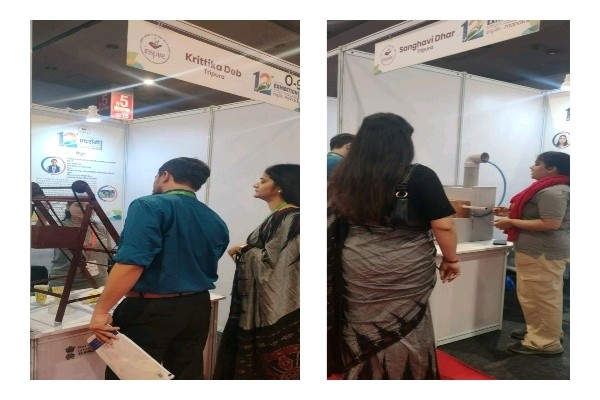
Class VII student Kritika Deb of Hariananda English Medium Higher Secondary School in Gomati district developed a solar-powered automatic drainage cleaning system. Bidisha Majumder guided the project.
Kritika identified drainage overflow during heavy rainfall as a major problem. Power cuts can worsen waterlogging and flooding, while stagnant water creates unhygienic conditions.
Her system automatically monitors water levels and controls drainage gates. It detects blockages and issues warnings when the drainage system faces a risk of overflow.
The design combines solar power, Internet of Things (IoT)-based remote monitoring, self-cleaning filters and a waterproof structure. These features aim to improve drainage efficiency and reduce the risks associated with urban flooding.
2. Multipurpose Load Carrier for Labourers
Awrdeep Dey, a Class VII student of Udaipur English Medium Higher Secondary School in Gomati district, designed a multipurpose load carrier. Sukanta Saha guided the project.
The student observed that labourers often carry heavy loads on their heads and backs. This practice can cause fatigue, back pain and long-term musculoskeletal injuries.
He developed a lightweight carrier using durable PVC pipes. Workers can use it as a backpack, a head-load carrier or a rolling trolley, depending on their needs.
The device includes cushioned supports, adjustable straps, ergonomic handles, waist pockets for tools and an integrated light for nighttime use. Its design distributes weight more evenly across the body to reduce strain on the spine, shoulders and neck.
The carrier can handle approximately 20–30 kg. Its affordable construction and simple assembly also make it suitable for local manufacturing.
3. Multipurpose Geyser Offers a Rural Energy Solution
Class VIII student Sanghavi Dhar of Netaji Vidyapith English Medium Higher Secondary School in Unakoti district developed a multipurpose geyser. Tanumoy Lodh guided the project.
The student noted that rural households often burn firewood separately for cooking and heating water. This practice increases fuel consumption and smoke emissions.
The proposed system uses a metal water tank fitted with pipes and placed on a traditional chulha. It heats water while the household cooks food, allowing both tasks to use the same fire.
The system also collects steam and condenses it into distilled water. This could provide an additional source of income while reducing the need for separate fuel consumption.
The electricity-free design seeks to improve household energy efficiency and reduce pollution in rural areas.
4. Smart Shoe Helps Visually Impaired People Navigate Safely
Zinnia Biswas, a Class IX student of Shishu Bihar Higher Secondary School in West Tripura district, developed a smart shoe for visually impaired people. Nabanita Chakraborty guided the project.
The device uses a microcontroller, ultrasonic sensors, a vibrator, a buzzer and a control switch. The sensors detect nearby obstacles, uneven surfaces and potholes.
The shoe alerts the wearer through vibrations and audio signals. The alerts become more intense as obstacles approach.
The innovation aims to support independent movement and improve safety while walking or crossing roads.
5. Low-Cost Device Makes Ceiling Cleaning Safer
Raktima Dhar, a Class IX student of Netaji Vidyapith English Medium Higher Secondary School in Unakoti district, developed a low-cost multipurpose dust cleaner under the guidance of Tanumoy Lodh.
The device addresses a common cleaning problem: dust and spider webs often fall onto people’s faces when they clean ceilings. This can cause discomfort, coughing and allergic reactions.
Raktima attached an inverted umbrella beneath a ceiling-cleaning stick. The umbrella collects falling dust and cobwebs before they reach the user’s face.
The design can also provide protection from sunlight or rain during outdoor cleaning. Its simple construction aims to make cleaning safer and more comfortable.
6. Smart Women Safety System Combines Three Wearables
Jannat Begam, a Class IX student of Hariananda English Medium Higher Secondary School in Gomati district, developed a smart women’s safety system. Bidisha Majumder guided the project.
The system combines three wearable devices: a smart shoe, a smart wristband and a smart safety clip.
The shoe uses pressure sensors to trigger an SOS alert and share the user’s live location when it detects sudden force. The wristband features a one-touch emergency button and vibration alerts.
The safety clip contains a concealed camera and microphone intended to collect evidence discreetly. The project also incorporates AI-enabled technology, cloud connectivity and multiple communication channels to support real-time alerts and faster emergency responses.
Tripura Students Focus on Practical Innovation
The projects presented in the competition address distinct challenges but share a common objective: finding practical solutions to everyday problems.
From solar-powered drainage management to wearable safety devices, the students have explored ways to combine technology, affordability and usability. Their work also highlights the potential of school-level scientific innovation to address local needs.
Editorial note: The above mentioned projects were presented at the 12th National Level Exhibition and Project Competition under INSPIRE-MANAK in New Delhi on October 12–13, 2026.
