

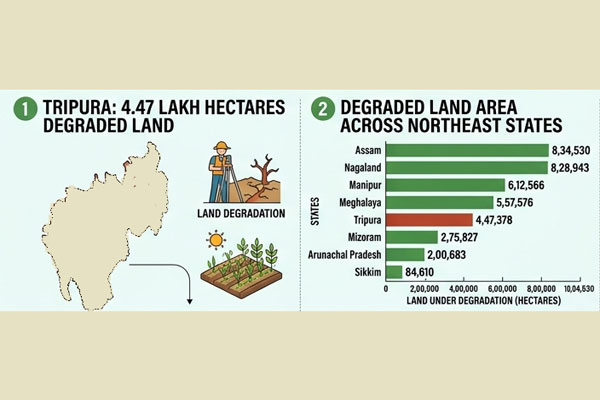
Tripura has 4,47,378 hectares under land degradation, according to data cited by Agriculture Minister of State Ramnath Thakur in Rajya Sabha, with Assam, Nagaland and Manipur reporting larger areas under degradation across the Northeast.
Editorial note: The report deliberately avoids saying that 4.47 lakh hectares of agricultural land are degraded. The government data refers to total land under degradation, while the Central government explicitly stated that it has not assessed the agricultural land affected or the resulting crop-yield losses.
Agartala, August 8: Tripura has 4,47,378 hectares of land under degradation, according to the Desertification and Land Degradation Atlas of India 2021. The data has put the spotlight on the scale of land degradation across the Northeast.
The information was given by Minister of State for Agriculture and Farmers Welfare Ramnath Thakur in a written reply in the Rajya Sabha on August 7, 2026.
The government data shows that Assam has the largest degraded land area among the Northeastern states. Nagaland and Manipur also report more degraded land than Tripura.
However, the Union government said it has not conducted a separate assessment of agricultural land affected by degradation or its specific impact on crop productivity.
Land Under Degradation in Tripura
Tripura’s reported degraded land covers 4,47,378 hectares.
The figure comes from the 2021 atlas published by the Space Applications Centre of the Indian Space Research Organisation.
The atlas assessed desertification and land degradation across India based on the 2018-19 status.
The figure does not mean that the entire degraded area is agricultural land. It also does not quantify crop losses caused by degradation.
That distinction is important because the government has not undertaken a separate assessment linking degraded agricultural land with yield losses.
Assam Has Largest Degraded Area in Northeast
Assam recorded the highest area under land degradation among the Northeastern states at 8,34,530 hectares.
Nagaland followed closely with 8,28,943 hectares. Manipur reported 6,12,566 hectares, while Meghalaya had 5,57,576 hectares.
Tripura ranked next with 4,47,378 hectares.
Mizoram reported 2,75,827 hectares. Arunachal Pradesh had 2,00,683 hectares. Sikkim recorded the lowest figure among the Northeast states listed, at 84,610 hectares.
| Northeast state | Land under degradation |
|---|---|
| Assam | 8,34,530 hectares |
| Nagaland | 8,28,943 hectares |
| Manipur | 6,12,566 hectares |
| Meghalaya | 5,57,576 hectares |
| Tripura | 4,47,378 hectares |
| Mizoram | 2,75,827 hectares |
| Arunachal Pradesh | 2,00,683 hectares |
| Sikkim | 84,610 hectares |
Government Has No Separate Yield-Loss Assessment
The Union government has acknowledged the challenge but said it has not assessed agricultural yield losses caused specifically by land degradation.
This means the available figures show the extent of degraded land, rather than the economic or agricultural losses resulting from it.
The distinction matters for states such as Tripura, where agriculture and horticulture support a large rural population.
A separate agricultural assessment could identify areas where soil degradation directly affects farm productivity.
ICAR Promotes Soil Restoration
The Indian Council of Agricultural Research has developed several location-specific technologies for soil restoration and sustainable land management.
These include contour cultivation, intercropping, crop rotation, conservation agriculture, mulching and green manuring.
ICAR also promotes reduced tillage and agroforestry.
For water conservation, the recommended measures include contour bunds, staggered trenches, check dams, farm ponds and community ponds.
The approach aims to improve soil fertility, conserve moisture and increase the efficiency of agricultural inputs.
Climate-Resilient Farming Gets Focus
The government is also implementing the National Innovations in Climate Resilient Agriculture (NICRA) project.
NICRA studies climate impacts on agriculture and conducts district-level risk assessments.
The programme covers 651 districts.
The government has identified 310 districts as vulnerable to climate change. Of these, 201 fall under the high-vulnerability category and 109 under the very-high-vulnerability category.
District Agriculture Contingency Plans have been prepared for all 651 districts.
These plans recommend location-specific crops, varieties and farming practices to help farmers deal with extreme weather and climate variability.
Northeast Can Benefit From Location-Specific Practices
Climate-resilient practices are particularly relevant to the Northeast’s diverse agricultural landscapes.
The region includes flood-prone plains, hilly terrain and rain-dependent farming areas.
The government is promoting techniques such as the System of Rice Intensification, direct-seeded rice, aerobic rice and in-situ crop residue management.
The programme also supports village-level seed banks and community nurseries in selected climate-resilient villages.
Soil Health and Water Conservation Schemes
Several national schemes also target soil health and agricultural resilience.
The Per Drop More Crop scheme promotes drip and sprinkler irrigation.
The Rainfed Area Development scheme supports integrated farming systems.
The Soil Health and Fertility scheme promotes balanced nutrient management.
The government is also encouraging organic and natural farming.
Agroforestry, horticulture and bamboo development form part of the broader strategy to improve climate resilience.
Crop insurance schemes provide additional protection against losses from natural calamities and climate-related risks.
Land Restoration Remains a Policy Priority
The government is also using watershed development programmes to restore degraded and rainfed land.
Measures include soil and moisture conservation, rainwater harvesting, drainage-line treatment, ridge-area treatment and pasture development.
These interventions can improve water security while strengthening farmers’ ability to withstand climate-related shocks.
Nationally, agricultural production has continued to grow despite land and climate pressures.
Foodgrain production rose from 252.03 million tonnes in 2014-15 to 357.73 million tonnes in 2024-25.
Horticulture production increased from 280.98 million tonnes to 370.73 million tonnes during the same period.
For Tripura and other Northeast states, the latest land degradation figures highlight the need for continued investment in soil restoration, water conservation and climate-resilient agriculture.(With PIB inputs)
