

Former Tripura Power Minister Manik Dey defended the CPIM-led government’s pilot implementation of smart meters and questioned the growing role of private agencies in the present expansion, seeking clarity on accountability, billing and consumer protection.
Quick Glance
- Manik Dey defended the earlier CPIM-led government’s pilot smart-meter rollout.
- He said 40,000–50,000 meters were installed under the pilot phase.
- Dey linked the rollout to power-system improvement projects backed by the World Bank and Central Government.
- He questioned accountability when private agencies supply, install and maintain smart meters.
- He also raised concerns over higher bills, unpaid dues and the future role of the power corporation.
- On alleged irregularities during the earlier rollout, Dey said he had no information and referred to the CAG’s observations.
Agartala, August 12: Former Tripura Power Minister Manik Dey has defended the CPIM-led government’s decision to introduce smart meters on a pilot basis. He also questioned the present expansion of smart metering through private agencies.
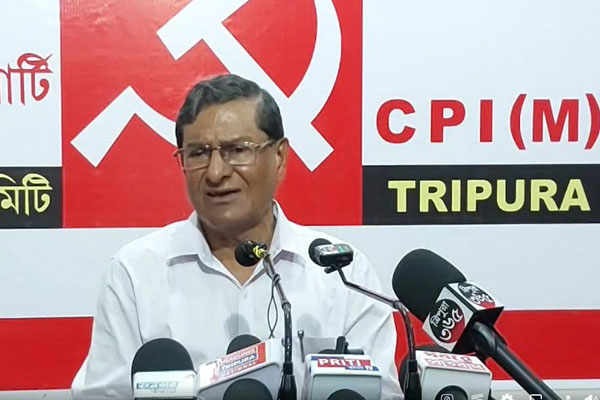
Dey spoke at a press meeting in Agartala on Wednesday. He said the smart-meter debate needs to be seen in the wider context of power-sector reforms undertaken by the earlier government.
He also responded to reports of alleged irregularities in the smart-meter rollout during the Left Front government. Dey said such observations came from the Comptroller and Auditor General (CAG). However, he said he had no information about the alleged irregularities.
Why the earlier government introduced smart meters
Dey said the CPIM-led government introduced smart meters as part of broader system-improvement efforts.
The main focus was to reduce transmission and distribution losses. The government also wanted to cut technical losses. Improving the quality and reliability of power supply was another objective.
According to Dey, several power-sector improvement projects received support from the World Bank and the Central Government.
The installation of smart meters in selected areas formed part of the conditions attached to some of these projects, he said.
Dey said the then government initially questioned the need for smart meters. It had concerns about replacing existing meters with new ones and then installing another category of meters.
However, discussions with the agencies concerned changed the position.
After considering the project conditions, the government decided to introduce smart meters on a pilot basis.
40,000-50,000 meters installed in pilot phase
Dey said around 40,000 to 50,000 smart meters were installed during the pilot phase.
An agency selected through a tender supplied the meters. The power corporation supervised the installation, he said.
Dey said he was not aware of any major complaints or widespread consumer dissatisfaction during that period.
He also stressed that the earlier rollout covered only a limited section of consumers.
However, he said the present system is different. Private agencies now play a growing role in supplying, installing and maintaining smart meters.
This, according to Dey, raises an important question about accountability.
Who will be responsible for faulty smart meters?
Dey asked who will take responsibility if a smart meter develops a fault.
He also referred to complaints about unusually high bills after smart-meter installation.
If a meter generates an incorrect bill or needs replacement, he asked whether the responsibility will lie with the power corporation, the government or the private agency.
Dey said the Left Front government followed a different approach.
During that period, the power corporation took direct responsibility for meters. Its engineers and employees inspected meters when consumers reported problems.
They also repaired or replaced faulty meters when necessary, he said.
Dey questioned whether the present system offers the same level of accountability.
He asked whether the government has issued a written assurance on meter replacement and maintenance if a private company exits the market or its contract ends.
He also sought clarity on whether any formal order or notification covers such situations.
Consumer complaints over higher bills
Dey also referred to complaints from consumers who claim that smart meters generate higher electricity bills.
He said many consumers report a significant difference between their old and new bills despite similar patterns of electricity use.
Dey said the government must address such complaints with clear explanations.
He stressed that the CPIM is not opposed to technology or modernisation.
However, he said technology should not become a reason to impose an additional burden on consumers.
He called for accurate meter readings, transparent billing and a clear grievance-redressal mechanism.
Dey questions private role in power sector
Dey expressed concern over what he described as a move to reduce the role of the power corporation and expand private participation in electricity services.
He warned that greater dependence on private companies could reduce the government’s direct control over the sector.
He also feared that consumers could eventually bear the financial burden.
“Electricity is not a luxury,” was the thrust of his argument. It is a basic necessity, he said.
Dey argued that the power sector should serve the public interest rather than operate primarily as a profit-making activity.
He called for stronger action to reduce technical and commercial losses.
The authorities should recover outstanding electricity bills and take steps to stop power theft, he said.
He also urged the government to make better use of the experience and skills of power corporation employees.
Unpaid power bills remain a concern
Dey also highlighted outstanding electricity dues.
He claimed that large amounts remain unpaid by government and semi-government institutions, banks, Central and state government departments and various public-sector organisations.
He alleged that the authorities have not taken adequate steps to recover these dues.
According to Dey, technical losses and commercial losses contribute to the financial problems of the power sector.
He argued that better management of these losses could reduce pressure to increase electricity tariffs.
Repeated tariff hikes, he said, cannot offer a permanent solution.
Government must address ground-level concerns
Dey also questioned the government’s claims about development and public welfare.
He said people should assess what the government has achieved in recent years and how much benefit has reached them.
However, he said ordinary people continue to face several problems in their daily lives.
Dey urged the government to engage more closely with consumers.
It should understand their problems and take steps to provide relief, he said.
He also warned against excessive dependence on private agencies for essential public services.
According to Dey, government institutions should instead be strengthened.
He said public institutions remain accountable to the people and the government. Private companies, he argued, do not have the same level of direct public accountability.
Dey said adequate financial support can make government institutions more efficient.
For him, the smart-meter debate ultimately involves a broader political and policy choice: whether essential power services should remain firmly under public accountability or move further towards private participation.
