

Two government schools in Tripura have exposed glaring flaws in teacher deployment. A school in Jampuijala has six teachers for just six students, while another in Nalchar is managing nearly 100 students with only one teacher, highlighting the urgent need for rationalisation in the state’s education system.
Key Takeaways:
- Jampuijala government school has six teachers but only six enrolled students.
- Rangamatiya North High School in Nalchar serves nearly 100 students with a single teacher.
- The contrasting cases have renewed calls for teacher rationalisation and better resource planning in Tripura.
Agartala, August 06: Two government schools in Tripura have exposed a striking imbalance in teacher deployment and student enrolment. In Jampuijala, a primary school with just six students has six teachers. In contrast, a school in Nalchar is struggling to educate nearly 100 students with only one teacher.
The contrasting situations have reignited concerns over teacher rationalisation, shrinking enrolment in government schools and the need for better manpower planning in the state’s education system.
Two Schools, Two Opposite Challenges
The two schools represent opposite ends of the same problem.
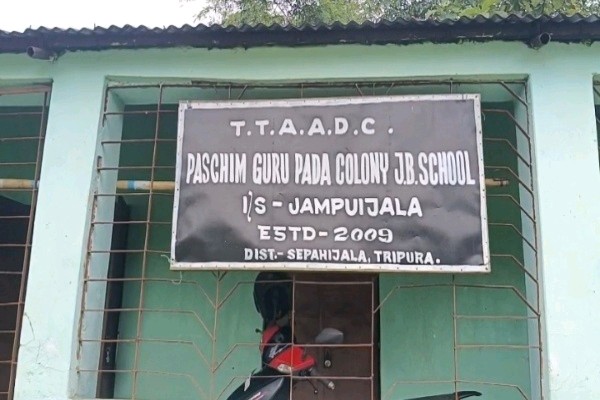
West Gurupada Colony JB School in Jampuijala has sufficient teaching staff but very few students. Rangamatiya North High School in Nalchar has a large student population but a severe shortage of teachers.
Both cases raise questions about whether teachers are being deployed where they are needed most.
Jampuijala School Has Six Teachers but Only Six Students
West Gurupada Colony JB School, located at Longmahati under the TTAADC area in Jampuijala Sub-division, currently has only six enrolled students. The school has six teachers.
Teachers said student attendance has become increasingly irregular. On several days, only one student attends classes. Sometimes, no student comes to school at all.
One teacher said he joined the school in 2011 when around 25 students studied there. Over the years, enrolment has steadily declined.
At present, the school has one student in Class I. There are no students in Classes II and III. The remaining students study in Classes IV and V.
Despite the low enrolment, the school continues to maintain its academic schedule with its existing staff.
Parents Shift Towards Private English-Medium Schools
Teachers and local residents believe the decline in enrolment is largely due to changing parental preferences.
A private English-medium school is located next to the government school, while another private institution stands about 200 metres away. Most parents now prefer to admit their children to these schools instead of the Bengali-medium government institution.
Teachers said the government school provides basic educational facilities and adequate infrastructure. However, parents increasingly associate English-medium education with better opportunities for their children.
“The attraction towards English-medium schools has increased significantly,” a teacher said, adding that the decision ultimately depends on the parents.
Teachers Allege Inaction by Authorities
Teachers said they have repeatedly informed the concerned authorities about the situation.
They alleged that complaints were submitted several times to the office of the Inspector of Schools (IS), Jampuijala. However, they claimed no effective intervention has taken place.
When journalists visited the school, five teachers were present but only one student had attended classes that day.
The teachers said such low attendance has become a common occurrence.
Nalchar School Faces the Opposite Problem
While Jampuijala struggles with declining enrolment, Rangamatiya North High School in the Nalchar Assembly constituency faces a completely different challenge.
The school has nearly 100 students but only one teacher.
The institution initially offered classes from Class I to Class V. Around three months ago, a Nursery section was introduced. The school now provides education from Nursery to Class VIII, covering eight different levels.
Despite this expansion, no additional teachers have been appointed.
The lone teacher is responsible for teaching multiple classes and managing the school’s daily academic activities.
Nursery Added, But No Teacher or Aya Appointed
The introduction of the Nursery section has created additional challenges.
Local residents said the school also requires an aya to look after Nursery children. However, neither a Nursery teacher nor an aya has been appointed.
According to residents, the sole teacher has repeatedly approached the Inspector of Schools’ office seeking additional staff. Members of the local school committee have also raised the issue several times.
They alleged that officials assured them that teachers would be posted soon, but no appointments have been made so far.
A local representative questioned how a school with nearly 100 students could function with only one teacher.
“We fail to understand how the authorities expect one teacher to manage an entire school. They should know the minimum number of teachers required to run a school properly,” he said.
Residents Demand Immediate Staff Appointments
Residents have demanded immediate deployment of additional teachers and support staff.
They urged the School Education Department to appoint teachers without further delay and post an aya for the Nursery section to ensure proper care and learning for young children.
According to them, the shortage has continued for four to five years despite repeated representations.
Why the Two Cases Matter: Enewstime Desk Perspective
The two schools expose a deeper administrative challenge rather than isolated incidents.
One school has enough teachers but almost no students. The other has students but not enough teachers to provide effective classroom instruction.
Education experts have long advocated periodic teacher rationalisation based on actual enrolment, classroom requirements and demographic changes. The contrasting situations in Jampuijala and Nalchar suggest that teacher deployment has not kept pace with changing ground realities.
A balanced redistribution of teaching staff, coupled with efforts to improve enrolment in government schools, could help address both problems simultaneously. Unless staffing patterns are regularly reviewed, such disparities may continue to affect learning outcomes and the efficient use of public resources across Tripura’s government school system.
