

Tripura University (TU) has set research, innovation, employability and institutional collaboration as its core priorities for the fifth decade, backed by a proposed ₹1,589-crore development plan and five new partnership initiatives.
Key Takeaways
- Tripura University has proposed a ₹1,589-crore development plan focused on infrastructure, research and academic growth.
- The university has proposed five MoUs to expand academic, research, industry and skill-development partnerships.
- Research, innovation, employability and community engagement will shape the university’s priorities in its fifth decade.
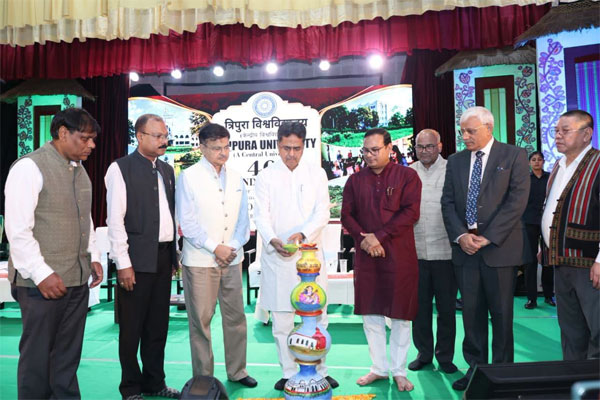
Tripura University (TU) marked its 40th Foundation Day on Friday by outlining a development roadmap centred on research, innovation, employment-oriented education and stronger institutional partnerships.
The university also proposed an investment plan of around ₹1,589 crore for infrastructure, research and academic development. The initiative aims to strengthen the institution’s capabilities as it works towards its ambition of becoming a globally recognised university.
Chief Minister Professor Manik Saha attended the Foundation Day celebrations as chief guest. He stressed the role of education, research and innovation in Tripura’s development and called for greater opportunities for young people.
₹1,589-crore plan at the centre of growth strategy
Vice-Chancellor Professor Debabrata Das said the university had entered its fifth decade with a focus that goes beyond conventional academic expansion.
He said the institution wants to strengthen the links between higher education, research, industry and employment. The proposed development projects will focus on infrastructure and research capabilities while creating a stronger base for the university’s next phase.
Professor Das also sought greater support from the state government. He said sustained institutional backing would help the university pursue its objective of developing into a world-class institution.
The university’s development strategy extends beyond buildings and physical infrastructure. It seeks to connect research, innovation, skill development and employment within a wider academic ecosystem.
Five MoUs to expand academic and industry links
Tripura University proposed five memoranda of understanding as part of its Foundation Day initiatives.
Two proposed agreements involve academic and research collaboration with Assam University and Devi Ahilya Vishwavidyalaya, Indore.
The other three proposals focus on industry-academia engagement. They involve the North East Financial Inclusion Trust (NEFIT), associated with the Bandhan Group and based in Agartala; the Institute of Cost Accountants of India, a statutory body established under the Cost Accountants Act, 1959; and the Pahle India Foundation, an FCRA-certified not-for-profit policy think tank established in 2013.
The proposed partnerships could support joint academic programmes, research, skill development and institutional exchanges.
The university expects the industry-linked arrangements to strengthen the connection between classroom education and employment opportunities. The academic partnerships could also create avenues for joint research, academic exchanges and other collaborative programmes, subject to the final agreements.
Bandhan Group chairman Chandra Shekhar Ghosh announced ₹10 crore in financial assistance for the university’s development. He also assured support for future projects.
Research output remains a key priority
Research formed another major part of the university’s Foundation Day agenda.
Professor Das said Tripura University had published nearly 1,500 research papers during the past five years. That works out to around 300 papers a year.
He also highlighted 75 international-standard research papers and 25 patents as part of the university’s research activities.
The university presented these figures as evidence of its expanding research base. It now aims to widen its academic footprint while creating more opportunities for innovation and collaboration.
The institution also wants researchers to find greater scope to apply their work beyond the traditional academic setting.
Employment-focused education and industry engagement
Tripura University has placed employability alongside research and innovation in its future agenda.
Professor Das said the university wants to strengthen the interface between higher education, research, industry and employment.
The proposed partnerships with NEFIT, the Institute of Cost Accountants of India and the Pahle India Foundation are expected to broaden the university’s network beyond conventional academic institutions.
The objective is to create opportunities for students and researchers to engage with organisations outside the university environment.
However, the impact of these partnerships will depend on how the proposed agreements are implemented and what programmes eventually emerge from them.
Six villages selected for community initiatives
The university also plans to extend its academic and research activities beyond the campus.
Professor Das said six villages had been selected for initiatives aimed at addressing local needs.
The programme seeks to connect university knowledge and research with community concerns. It also reflects the institution’s effort to give research and academic expertise a stronger social application.
Along with the proposed partnerships, the village initiative forms part of the university’s broader effort to expand its role across Tripura.
Foundation Day marks four decades of growth
Tripura University was established on October 2, 1987. The Foundation Day programme began with Vice-Chancellor Professor Debabrata Das hoisting the university flag at the Pandit Deendayal Upadhyaya Academic Building.
Teachers, officials, employees and students attended the celebrations. The university also presented awards to teachers, employees and students.
Higher Education Minister Kishor Barman said the completion of 40 years represented more than a numerical milestone. He said the anniversary reflected the contributions of generations of students, teachers and researchers and provided an opportunity to assess past achievements and identify future priorities.
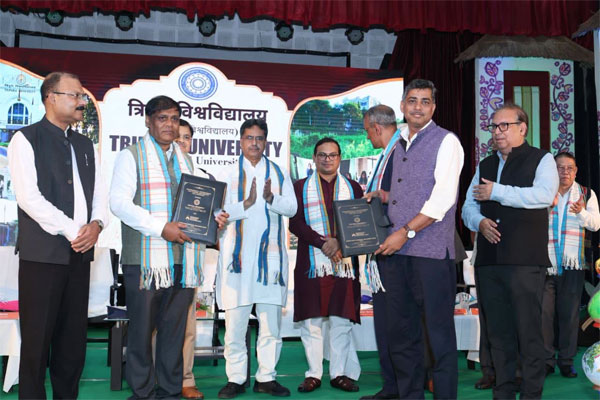
The programme brought together representatives from the university, government, higher education institutions and industry.
Among those present were university Chancellor Ahmed Javed, Assam University, Silchar, Vice-Chancellor Professor Rajiv Mohan Pant, Devi Ahilya Vishwavidyalaya, Indore, Vice-Chancellor Professor Rakesh Singhvi, Higher Education Minister Kishor Barman and Bandhan Group chairman Chandra Shekhar Ghosh.
From Tripura University, Vice-Chancellor Professor Debabrata Das, Registrar Professor Dr Samir Kumar Sil and Dean Professor Sukhendu Debbarma attended the programme.
Earlier, the university organised a programme at City Centre in Agartala to mark Gandhi Jayanti and its Foundation Day. Participants paid tribute to Mahatma Gandhi and recalled his principles of truth, non-violence, peace and service.
Focus shifts to the next decade
The Foundation Day celebrations placed greater emphasis on the university’s future direction than simply marking four decades of its journey.
Research, innovation, employment-oriented education, institutional collaboration and community engagement now form the central pillars of its agenda.
The ₹1,589-crore development plan, proposed five MoUs, research output, patents and ₹10-crore financial assistance announced by the Bandhan Group chairman represent the main components of the university’s development roadmap.
The next challenge will be implementation. Tripura University’s stated ambition of becoming a globally recognised institution will require sustained research, stronger academic outcomes, meaningful industry engagement and opportunities that deliver tangible benefits to students.
As the university enters its fifth decade, its progress will depend on how effectively these priorities translate into functioning programmes, new research, industry-linked opportunities and wider student outcomes.
