

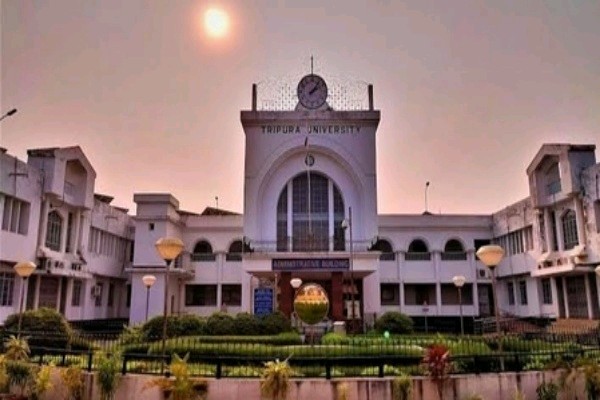
With the appointment process complete, Tripura University is likely to focus on enhancing academic quality, institutional transparency, research expansion and holistic student development. Informed sources told the Enewstime Desk that the next phase of growth of the university is likely to be reform-based agenda prioritizing academic excellence.
Agartala: The appointment of Dr. Debabrata Das as the 11th Vice-Chancellor of Tripura University has opened a new discussion within the state’s higher education ecosystem—not merely about a change in leadership but about the direction the Central University may take over the coming years.
With the Vice-Chancellor’s office remaining without a regular incumbent for nearly a year, the focus has now shifted from administrative continuity to institutional transformation. Dr. Das’s initial remarks suggest that he intends to place academics at the centre of the university’s development strategy while strengthening governance, research and student support systems.
Instead of presenting campus placements as the ultimate measure of success, the newly appointed Vice-Chancellor has argued that quality education should remain the university’s primary mission. According to him, better employment opportunities naturally follow when students receive strong academic training, practical skills and holistic development throughout their university journey.
His comments signal a broader educational philosophy that aligns with the objectives of the National Education Policy (NEP), which encourages multidisciplinary learning, skill development, innovation and critical thinking rather than focusing exclusively on job-oriented outcomes.
Academic quality likely to receive immediate attention
Dr. Das has indicated that improving teaching standards will be among his first priorities after assuming office. Academic observers believe this could involve strengthening classroom practices, encouraging faculty development and creating a more student-centric learning environment.
Tripura University occupies a unique position in the state’s higher education landscape. Besides functioning as a Central University, it serves as the affiliating university for 68 colleges and educational institutions across Tripura. Any improvement in its academic ecosystem therefore has the potential to influence higher education standards beyond the university campus itself.
Education experts point out that enhancing academic quality will require coordinated efforts involving faculty members, researchers, students and affiliated colleges. The new administration is expected to work towards creating stronger academic linkages across these institutions.
Governance reforms expected
Another area highlighted by Dr. Das is transparent and accountable governance.
Efficient administration has become increasingly important for universities as they handle expanding academic programmes, research funding, digital services and regulatory compliance. By emphasising transparency, the incoming Vice-Chancellor has indicated that institutional decision-making and administrative processes will receive significant attention.
Observers say improvements in governance often translate into faster academic decisions, better utilisation of resources, smoother student services and improved coordination among departments.
Research and innovation remain major priorities
The timing of Dr. Das’s appointment is significant because Tripura University is attempting to strengthen its research profile while expanding collaborations with institutions across India and abroad.
Higher education institutions are increasingly evaluated not only by teaching standards but also by research output, innovation, patents, publications and industry partnerships.
Academic circles expect the university’s new leadership to encourage interdisciplinary research, improve access to research funding and create opportunities for collaboration with national research organisations and international universities.
Such initiatives could enhance the university’s academic reputation while creating better opportunities for both faculty members and research scholars.
NEP implementation enters a crucial phase
Implementation of the National Education Policy is another important area likely to receive renewed momentum under the new Vice-Chancellor.
Universities across the country are restructuring curricula, introducing multidisciplinary education, expanding skill-based courses and adopting flexible academic frameworks in line with NEP recommendations.
Tripura University has already initiated several reforms in this direction. The arrival of a regular Vice-Chancellor may provide greater administrative stability for carrying these initiatives forward over the next few years.
A personal connection with Tripura
Even before assuming office, Dr. Das has spoken about his long association with Tripura.
He has also shared his intention to begin his tenure by offering prayers at the revered Tripureswari Temple, reflecting both his personal connection with the state and the symbolic importance he attaches to the beginning of his new responsibilities.
This gesture has attracted attention within academic circles, where many see it as an expression of respect for the state’s cultural heritage before embarking on a significant institutional role.
Leadership after a prolonged vacancy
The appointment also ends an extended period during which the university functioned under officiating leadership following the completion of former Vice-Chancellor Prof. G. P. Prasain’s tenure in August 2025.
During this transition, senior professor Dr. Shyamal Das discharged the responsibilities of officiating Vice-Chancellor, ensuring administrative continuity until a regular appointment was made.
With a full-time Vice-Chancellor now in place, university stakeholders expect faster policy decisions and greater continuity in long-term planning.
Expectations from the academic community
Faculty members, researchers and students are expected to closely watch the new administration’s initial decisions, particularly those concerning academic reforms, faculty recruitment, research infrastructure, digital governance and student welfare.
Dr. Das brings administrative experience from his previous role as Adviser to the Higher Education Department of the Assam Government. That experience is expected to help the university navigate policy implementation, institutional development and coordination with government agencies.
As Tripura University approaches two decades as a Central University, expectations extend beyond maintaining academic standards. Stakeholders increasingly expect the institution to emerge as a stronger centre for research, innovation, interdisciplinary education and regional academic leadership.
The coming months will therefore be viewed as an important period for setting priorities. While the appointment has formally concluded the search for a new Vice-Chancellor, the larger challenge now lies in translating the stated vision into measurable academic and institutional outcomes that benefit students, faculty and the wider higher education ecosystem in Tripura.
