

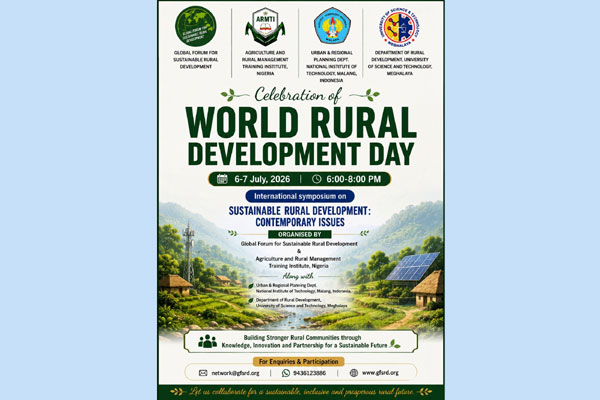
Agartala: More than 480 policymakers, researchers, academicians and development professionals from 17 countries gathered for a two-day international symposium to deliberate on the future of sustainable rural development. Organised to mark the United Nations World Rural Development Day, the event highlighted the urgent need for climate-resilient agriculture, digital inclusion, stronger local governance and greater investment in rural infrastructure to achieve the Sustainable Development Goals (SDGs).
The Global Forum for Sustainable Rural Development (GFSRD) organised the symposium in collaboration with the Agriculture and Rural Management Training Institute (ARMTI), Nigeria. The programme, titled “Sustainable Rural Development: Contemporary Issues,” was held on July 6 and 7 through an international virtual platform that enabled experts from Asia, Africa and other regions to exchange ideas and policy recommendations.
The event also received support from the Urban and Regional Planning Department of the National Institute of Technology (NIT), Malang, Indonesia, and the Department of Rural Development, University of Science and Technology Meghalaya, underlining growing international cooperation in the rural development sector.
Symposium focuses on challenges facing rural communities
The organisers said the observance of United Nations World Rural Development Day offered an opportunity to examine the realities confronting rural populations worldwide.
Although rural regions remain central to global food production, environmental conservation and cultural preservation, millions of people continue to struggle with poverty, unemployment, climate-related disasters, inadequate healthcare, poor educational facilities, digital exclusion and weak infrastructure.
The symposium sought to identify practical and scalable solutions by bringing together experts representing governments, universities, development organisations and civil society institutions.
The sessions were hosted by Prof. Jayanta Choudhury, Founder and Secretary General of GFSRD.
He was joined by Tapas Ranjan Chakraborty, Senior Programme Manager of BRAC Bangladesh and Co-Founder of GFSRD; Mohammed Abubakar, Head of GFSRD-Africa; and Dr. Maria Christina Endarwati, Head of GFSRD-Asia. Together they highlighted the importance of stronger international collaboration to achieve sustainable rural transformation.
Experts outline roadmap for sustainable development
Delivering the inaugural address, Dr. Olufemi A. Oladunni*, Chief Executive Officer of ARMTI, Nigeria, said rural communities continue to sustain global food security despite facing severe climate risks and economic hardship.
He recommended expanding value-chain development, promoting climate-smart agriculture, encouraging renewable energy adoption, supporting youth entrepreneurship and women’s economic participation, strengthening cooperatives and improving digital agriculture through international cooperation.
Former National Institute of Rural Development and Panchayati Raj (NIRDPR) official Prof. Rajiv Ranjan Prasad stressed that sustainable rural development must combine poverty reduction with better infrastructure, quality education, accessible healthcare and agricultural advancement.
He also proposed the creation of a globally adaptable “Rurality Index” that could help governments accurately assess rural conditions and frame evidence-based policies. According to him, public investment should be complemented by corporate and philanthropic funding to accelerate rural transformation.
Former Union Secretary Meenakshi Datta Ghosh, IAS (Retd.), emphasised that both first-mile and last-mile connectivity remain fundamental to rural progress.
She advocated GIS-based planning, biotechnology-driven development, efficient transport systems and universal access to essential services including healthcare, education, electricity, drinking water and digital infrastructure.
International speakers present diverse development models
Experts from India, Bangladesh, Nigeria, Sri Lanka, Indonesia and several other countries shared successful case studies and innovative approaches to rural development.
Dr. Kumudini Mishra from the Government of Odisha highlighted how secure land ownership strengthens the social and economic status of rural women. She called for legal land documentation, women’s resource centres and improved access to government welfare programmes.
Dr. Pravin P. Ghunnar of WeSchool, Mumbai, explained how Farmer Producer Organisations (FPOs) improve farmers’ market access, strengthen bargaining power and reduce transaction costs. He also stressed professional management, better governance and digital integration.
Representing Sri Lanka, Varathagowry Vasudevan advocated community-driven planning, resilient local economies, disability-inclusive employment and disaster-sensitive governance while emphasising equal participation of both men and women in empowerment initiatives.
Dr. Sonia Sharma from Lovely Professional University argued that rural women entrepreneurs require mentoring, digital connectivity, financial literacy and easier market access to become engines of economic growth.
Healthcare emerged as another major theme during the symposium.
Dr. Sudhir Joshi, District Ayurved Officer from Gujarat, proposed integrating telemedicine, artificial intelligence, improved sanitation and rural healthcare infrastructure into development planning.
Meanwhile, Prof. Abhishek Das demonstrated how Information and Communication Technology (ICT), Artificial Intelligence, Internet of Things (IoT), blockchain, GIS and community-owned digital hubs could bridge the rural digital divide and create self-sustaining digital ecosystems.
Indonesia’s Dr. Agustina Nurul Hidayati introduced the concept of “Future Villages,” which combines indigenous knowledge, climate resilience, digital innovation and green economic practices.
Other speakers highlighted subjects ranging from biodiversity conservation and eco-tourism to smart villages, child development, seaweed cultivation, blue economy opportunities, soil microbiology and participatory local governance.
Comprehensive policy recommendations emerge
The symposium concluded with a detailed policy framework aimed at strengthening sustainable rural development globally.
Participants recommended greater investment in rural roads, drinking water, sanitation, electricity and broadband connectivity. They also urged governments to expand climate-smart agriculture, renewable energy adoption and digital inclusion through AI, IoT, GIS and telemedicine.
The recommendations further called for stronger land rights for women, youth entrepreneurship, skill development, support for cooperatives and Farmer Producer Organisations, improved healthcare and nutrition services, biodiversity conservation, eco-tourism promotion and diversified rural livelihoods.
Delegates also stressed the importance of evidence-based policymaking, resilient disaster management systems, improved rural financing and stronger public-private-academic partnerships.
South-South cooperation highlighted as key to future growth
During the valedictory session, Dr. Helen Sekar underscored the importance of investing in child protection and holistic development to prepare future rural leaders.
Delivering the concluding address, Dr. Shiladitya Chatterjee, IAS (Retd.), former Director in the Prime Minister’s Office and President of GFSRD, observed that national development cannot become sustainable without transforming rural communities.
He called for stronger grassroots institutions, better digital connectivity, improved education and healthcare services, increased public-private investment and greater community participation in policymaking.
Global collaboration seen as essential for achieving SDGs
The organisers said the symposium demonstrated the growing value of South-South cooperation in addressing complex rural development challenges.
By bringing together experts from Asia and Africa, the programme promoted collaborative research, policy dialogue and institutional networking. Participants expressed confidence that the recommendations emerging from the discussions would help shape future rural development strategies and contribute to achieving the United Nations’ 2030 Sustainable Development Agenda.
The event concluded with a collective message that resilient rural economies remain indispensable for ensuring food security, environmental sustainability, inclusive economic growth and long-term social justice across the world.
Other Speakers:
Dr. Abigail Iyilade, Assistant Director, ARMTI, Nigeria advocated evidence-based, context-specific rural development interventions rather than standardized approaches. She emphasized situational analysis, indigenous knowledge, conflict resolution, cooperative development, climate-smart innovations, transparent learning from project failures, and partnerships for holistic rural wellbeing.
Dr. Satya Prakash Mehra, GFSRD – Global Head, Network and Partnership, emphasized biodiversity conservation, ecosystem restoration, indigenous ecological knowledge, rural tourism, agro-tourism, and community reserves. Protecting ecosystems, he argued, directly supports sustainable livelihoods, climate resilience, and rural prosperity.
Dr. Yasir Ashraf, Assistant Professor, Department of Sociology, VET Institute of Arts & Science, proposed health-centred Smart Villages where healthcare becomes the foundation of development. Clean water, sanitation, nutrition, primary healthcare, community participation, Gram Panchayat planning, and preventive healthcare should be integrated into local development planning.
Dr. K. Ramesh Kumar, Assistant Professor. Department of Economics and Rural Development. Alagappa University, Tamil Nadu, India and State Director, GFSRD- Tamil Nadu presented seaweed cultivation as an emerging blue-economy opportunity capable of generating employment, empowering coastal women, sequestering carbon, and enhancing environmental sustainability. He recommended supportive policies, research, processing infrastructure, and market development for scaling the sector.
Prof. Amir Mohammad Nasrullah, Professor, Public Administration, University of Chittagong, Bangladesh & Head, GFSRD-Global Centre for Local Government proposed a seven-pillar framework consisting of human capital, women’s empowerment, youth entrepreneurship, digital transformation, climate-smart development, participatory governance, and inclusive social protection as the foundation for sustainable rural transformation across South Asia.
Dr. Swaranjit Singh, Director, SAS Polyclinic and Head, GFSRD-Global Centre for Science & Technology for Rural Development highlighted the importance of microbes in sustainable agriculture through nitrogen fixation, biofertilizers, biopesticides, biogas, biodiesel, bioremediation, and improved soil health. Scientific management of soil microbiomes can significantly improve agricultural productivity while reducing environmental degradation.
