

Tripura has launched its first structured student-government policy dialogue to reshape higher education through collaborative decision-making. The initiative aims to improve academic quality, expand student participation, promote employability and support the state’s long-term vision of becoming an education hub by 2030.
Key Takeaways
- Tripura holds its first Higher Education Dialogue with student representatives.
- Government shifts from one-way communication to participatory policymaking.
- Students share ideas on quality, employability and college reforms.
- State targets higher enrolment and stronger skill-oriented education.
- Initiative supports Tripura’s Education Hub vision and Viksit Bharat 2047.
Agartala, August 05: The Government of Tripura has taken a significant step towards reshaping its higher education system by launching its first structured dialogue between the government and student representatives. The initiative marks a shift from traditional policymaking towards a more participatory model where students directly contribute to decisions that affect their academic future.
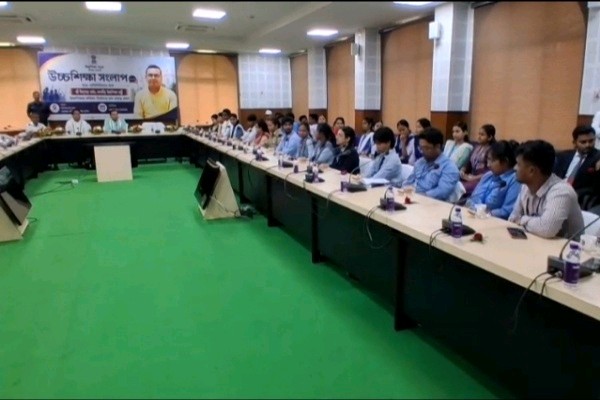
The Higher Education Dialogue, held today in Agartala, brought together student representatives from colleges across the state to discuss reforms, challenges and future priorities. Higher Education Minister Kishor Barman led the interaction in the presence of Higher Education Director Animesh Debbarma.
A New Model of Education Governance
Addressing the gathering, Barman described the programme as the first initiative of its kind in Tripura’s higher education history. He said the dialogue represents a fundamental change in how the government plans to formulate education policies.
Instead of following the traditional approach where the government speaks and students listen, the minister said the administration wants students to become active partners in policymaking.
He stressed that every constructive suggestion emerging from the discussions would help shape future reforms. According to him, a strong higher education system can only be built through collective participation and open dialogue among all stakeholders.
The minister called the event more than a government meeting. He described it as a platform for free exchange of ideas where every participant could openly discuss problems as well as practical solutions.
Building a Roadmap for Higher Education by 2030
The consultation focused on preparing a long-term roadmap for Tripura’s higher education sector up to 2030.
Students discussed the major challenges faced by colleges, expectations for improving academic standards and ways to strengthen campus infrastructure.
The discussions also covered the introduction of employment-oriented education, skill development programmes and measures to transform existing institutions into model colleges.
Another major objective was to increase participation in higher education. The government has set an ambitious target of achieving a 50 per cent rise in enrolment over the coming years.
Officials believe wider access to higher education will play an important role in improving human resource development and supporting the state’s economic growth.
Colleges Beyond Degree Distribution
The minister emphasised that colleges should not function merely as institutions that award degrees.
Instead, he said higher education institutions must emerge as centres of nation-building, innovation and responsible citizenship. Creating a positive academic environment and encouraging character-building should become integral parts of campus life.
The dialogue also explored ways to promote patriotism, civic responsibility and national consciousness through activities organised within college campuses.
According to the minister, these efforts align with the broader vision of Viksit Bharat 2047, which seeks to transform India’s education system into a key driver of national development.
Employability Remains a Key Priority
Improving graduate employability emerged as one of the central themes of the consultation.
Students and officials discussed how colleges can better prepare graduates for changing job markets through skill-based learning, vocational education and industry-oriented programmes.
Participants also explored strategies to strengthen employment-focused education so that graduates possess both academic knowledge and practical skills.
The government believes that closer engagement with students will help identify gaps between classroom learning and employment requirements.
Towards an Education Hub
Tripura has been actively pursuing its ambition of becoming an education hub in the Northeast. The Higher Education Dialogue forms part of that broader vision.
The minister said policymaking becomes more effective when those directly affected by policies are involved in the decision-making process. He noted that suggestions received during the consultation would influence policy formulation as well as implementation.
He also announced that future editions of the dialogue would include teachers, academic experts and other stakeholders connected with higher education. Expanding participation, he said, would strengthen the reform process and ensure that policies reflect diverse perspectives.
A Shift from Consultation to Collaboration
The significance of the initiative lies less in the event itself and more in the governance model it introduces.
By institutionalising direct interaction with students, Tripura has taken an early step towards collaborative education governance. The approach recognises students not only as beneficiaries of higher education but also as contributors to policy design.
If sustained through regular consultations and effective implementation, the initiative could help improve academic quality, raise enrolment, strengthen employability and accelerate Tripura’s journey towards becoming an education hub in Northeast India.
