

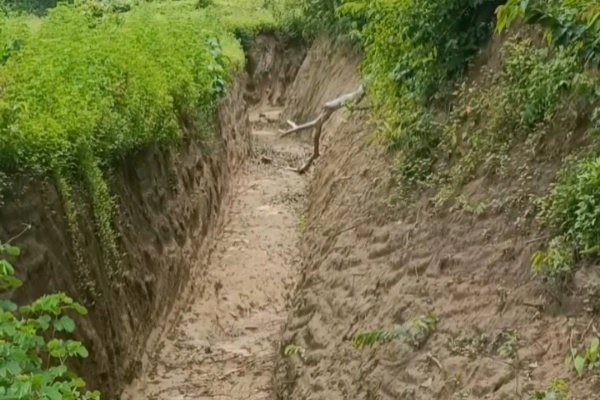
The Forest Department has intensified human-elephant conflict measures in Teliamura under Tripura’s Khowai district by installing solar fencing, Elephant Proof Trenches (EPTs), and ADS camps in vulnerable areas. Officials claimed the initiatives have reduced elephant intrusion in Chakmaghat, Uttar Krishnapur, South Maharani, and nearby settlements.
Quick Glance
- Solar fencing installed in Chakmaghat, Uttar Krishnapur, and South Maharani
- Elephant Proof Trench (EPT) developed from Mark Tilla to Chakmaghat
- Six ADS camps established in vulnerable forest fringe areas
- Forest officials claim elephant movement into localities has declined
Measures for Elephant Attack Prevention in Teliamura
Agartala/Teliamura: The Forest Department has stepped up efforts to reduce human-elephant conflict in several parts of Teliamura subdivision under Khowai district. Officials said the department has introduced multiple preventive measures after repeated incidents of wild elephant intrusion in residential areas over the last few years.
The latest initiatives include solar fencing, Elephant Proof Trenches (EPTs), and deployment of ADS camps in vulnerable locations. Authorities believe these measures are helping reduce the movement of elephants into populated zones.
According to forest officials, the department focused mainly on areas that witnessed frequent elephant attacks and road blockades in recent years.
Solar Fencing Installed in Vulnerable Areas
The Forest Department recently completed solar fencing work in different parts of Chakmaghat and adjoining areas under Teliamura.
Khowai District Forest Officer Ashok Kumar said the fencing system aims to stop wild elephants, especially tuskers, from entering human settlements.
Officials claimed local residents have already noticed a decline in elephant movement after the installation of the fencing network.
Apart from Chakmaghat, solar fencing has also become operational in Uttar Krishnapur and South Maharani. Forest authorities stated that the effectiveness of the system will be monitored over the coming weeks. However, preliminary observations indicate positive results.
The solar fencing project forms part of a broader strategy to reduce crop damage, road blockades, and threats to human life caused by elephant intrusion.
EPT Work Brings Relief to Villagers
Forest officials said Elephant Proof Trench work has been carried out from Mark Tilla to the Chakmaghat region. Earlier, residents in these areas had been facing severe elephant-related disturbances for nearly two years.
In many cases, elephant herds reportedly blocked highways and disrupted transportation. Local people often lived in fear during night hours because of repeated elephant movement near villages.
Officials said they recently visited the affected areas and spoke with local residents. Villagers informed them that elephant intrusion has reduced significantly after completion of the trench work.
The same EPT mechanism has also been implemented in Bhumihin Colony. Authorities claimed the strategy has helped prevent elephants from entering the locality.
Forest personnel described the EPT system as one of the most effective non-lethal methods for controlling elephant movement in forest fringe areas.
Six ADS Camps Set Up Across Sensitive Zones
To strengthen surveillance and emergency response operations, the Forest Department has also established six ADS camps in vulnerable regions.
Officials said trained volunteers and task force members remain on standby whenever elephant movement is reported. Though the volunteers may not stay at the camps round-the-clock every day, they respond immediately during emergencies.
The six camps have been established in the following areas:
| Camp Location | Purpose |
|---|---|
| Office Tilla | Elephant surveillance and response |
| Bhumihin Colony | Human-elephant conflict management |
| Bagber | Emergency monitoring |
| Mark Tilla | Elephant movement control |
| Champlai | Rapid response operations |
| Jumbari | Field monitoring and awareness |
Forest officials exuded confidence that these camps would improve coordination during emergencies and help villagers receive quicker assistance.
Rising Human-Elephant Conflict Remains a Concern
Human-elephant conflict remains a major concern in several forest-adjacent regions of Tripura. Increasing movement of wild elephants into populated areas often leads to property damage, crop destruction, and threats to human life.
Experts believe habitat disturbance and shrinking forest corridors have contributed to the growing interaction between humans and elephants in many parts of the Northeast.
The Forest Department stated that it is trying to balance wildlife conservation with public safety through scientific and community-based approaches.
Officials added that continuous monitoring, awareness drives, and cooperation from local residents will remain essential for the long-term success of the anti-elephant conflict measures.
People Also Ask
What is Elephant Proof Trench (EPT)?
EPT is a specially designed trench system built to prevent wild elephants from entering human settlements and agricultural fields.
Where has solar fencing been installed in Tripura?
The Forest Department has installed solar fencing in Chakmaghat, Uttar Krishnapur, and South Maharani under Teliamura subdivision.
How many ADS camps have been established?
The Forest Department has set up six ADS camps in vulnerable locations including Office Tilla, Mark Tilla, and Bhumihin Colony.
