

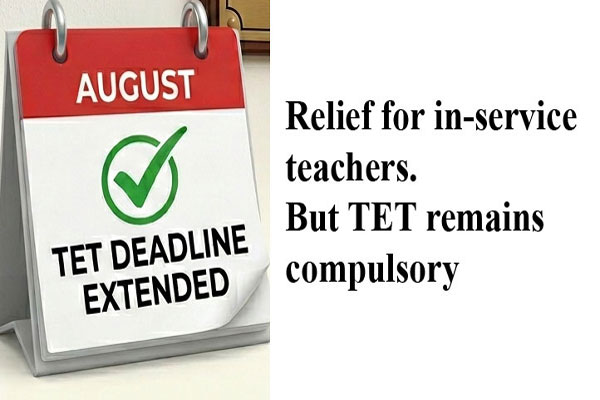
The Supreme Court of India has extended the deadline for in-service teachers to clear the Teacher Eligibility Test (TET) until August 31, 2028. According to an X Post by ‘The Hindu’, the decision came during hearings on review petitions related to teacher qualification norms and is expected to benefit thousands of educators working in schools across the country.
The verdict has brought relief to concerned teachers of Tripura.
Quick Glance
- Supreme Court extended the TET qualification deadline by one year.
- Teachers can now clear TET by August 31, 2028.
- TET remains compulsory for long-term teaching positions.
- Senior teachers nearing retirement may receive exemption benefits.
Agartala/New Delhi: In a significant development for India’s education sector, the Supreme Court has granted additional time for teachers to obtain the mandatory Teacher Eligibility Test qualification. The apex court shifted the deadline from August 31, 2027, to August 31, 2028.
“The decision will bring relief to teachers of Tripura especially for those who will be retiring. However, many of us expected that the Apex Court would consider the 2010 cutoff exemption plea. Certainly, it remains a point of contention”, said an Agartala based in-service teacher.
The order came during the hearing of several review petitions connected to teacher recruitment and qualification standards. A bench headed by Justice Dipankar Datta passed the ruling while examining concerns raised by teachers and educational institutions.
The latest extension offers relief to thousands of teachers who were struggling to complete the qualification process within the earlier timeframe. Many educators, especially those serving in government and aided schools, had expressed concern over the approaching deadline.
The court acknowledged these concerns while balancing the need to maintain educational standards across schools.
TET Qualification Will Continue to Remain Mandatory
Despite extending the timeline, the Supreme Court clearly stated that passing the Teacher Eligibility Test remains compulsory for teachers holding regular teaching positions.
The bench underlined that the extension should not be treated as a permanent relaxation of recruitment norms. Instead, the additional one-year period serves as a final opportunity for teachers to fulfil the required eligibility criteria.
The Teacher Eligibility Test plays an important role in ensuring quality education in schools. It acts as a benchmark for assessing teaching aptitude and subject knowledge among educators.
Education experts believe the court’s decision protects both teacher interests and academic standards. The ruling avoids immediate job-related uncertainty while reinforcing accountability in the education system.
Relief Likely for Teachers Nearing Retirement
The Supreme Court also introduced an important provision for senior educators nearing retirement. According to the observation made by the bench, teachers with five years or less remaining in service before retirement may receive exemption from clearing the TET examination.
However, the court indicated that such exemptions would depend on individual circumstances and applicable service rules. Authorities may issue further guidelines regarding eligibility for exemption in the coming months.
This part of the ruling has provided relief to older teachers who faced difficulty in preparing for competitive qualification examinations late in their careers.
Many education sector observers described the decision as practical and balanced. It recognizes the contribution of experienced teachers while preserving professional standards for future appointments.
Decision Expected to Benefit Thousands Across India
The Supreme Court’s order is expected to affect a large number of teachers across different states. Government schools, aided institutions, and several state education departments may now revise their compliance timelines in accordance with the new ruling.
The extension also reduces pressure on teachers preparing for the eligibility examination. Many educators had demanded additional time due to workload, administrative responsibilities, and changing examination schedules.
The ruling may further encourage state education departments to conduct awareness drives and support programs for teachers yet to qualify.
Educational institutions are also likely to monitor compliance more carefully before the revised deadline expires in 2028.
News Analysis
The Supreme Court’s decision reflects a balanced judicial approach toward India’s education system. On one hand, the court refused to dilute the importance of the Teacher Eligibility Test (TET). On the other hand, it recognized the practical challenges faced by existing teachers.
The extension indicates that the judiciary wants educational quality standards to remain intact while preventing sudden disruption in the teaching workforce. The provision regarding senior teachers also demonstrates sensitivity toward experienced educators nearing retirement.
The ruling may influence future discussions on teacher recruitment reforms and qualification norms in India. State governments and education boards could now face pressure to improve teacher training systems and ensure smoother implementation of qualification policies.
The judgment also highlights the growing importance of standardized teacher assessment in India’s evolving education framework.
People Also Ask
Why did the Supreme Court extend the TET deadline?
The Supreme Court extended the deadline to provide additional time for teachers to obtain the mandatory qualification without facing immediate employment uncertainty.
What is the new TET qualification deadline?
Teachers now have until August 31, 2028, to clear the Teacher Eligibility Test.
Will TET remain compulsory for teachers?
Yes. The Supreme Court reaffirmed that TET remains mandatory for long-term teaching positions.
