

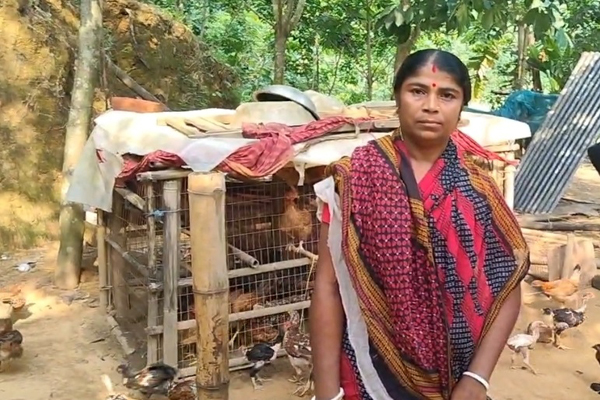
A homemaker from Haripur village in Tripura has emerged as a successful rural enterprise by strategic diversification of her income sources.
Through livestock rearing, poultry farming, rubber-based enterprises, fruit cultivation, and equipment rental services, Shukla Ray transformed financial hardship into prosperity and earned recognition as a “Lakhpati Didi.”
Quick Glance
- Shukla Ray of Haripur village built a successful rural enterprise through diversification.
- Her business journey began with two goats and expanded into multiple income-generating ventures.
- A ₹1.5 lakh Mudra loan and SHG support helped scale her operations.
- Besides entrepreneurship, she actively promotes education and campaigns against child marriage and child labour.
A Village Homemaker’s Journey Towards Entrepreneurship
In rural India, many women contribute significantly to household economies. However, only a few manage to convert limited resources into sustainable business enterprises. Shukla Ray from Haripur village under Rishyamukh Block in Tripura is one such example.
Today, she is known as a “Lakhpati Didi.” Yet her success story goes far beyond financial achievement. It highlights how strategic diversification, financial discipline, and entrepreneurial vision can create lasting economic transformation.
Born into a farming family, Shukla faced economic challenges from an early stage of married life. With five family members depending on a modest income, managing household expenses became increasingly difficult. Instead of accepting financial limitations, she decided to seek alternative livelihood opportunities.
That decision changed her life.
Small Beginnings Laid the Foundation
Shukla’s entrepreneurial journey started in 2000 with a simple investment. She purchased two goats and began a small livestock venture.
While the investment was modest, the approach was visionary. Rather than treating the income as temporary relief, she viewed it as seed capital for future expansion.
As earnings began to accumulate, she reinvested the profits into poultry farming. The additional venture generated a more regular cash flow and strengthened the family’s financial position.
This marked the beginning of a carefully planned diversification strategy.
Why Diversification Became Her Growth Engine
Many rural households depend on a single source of income. Such dependence often exposes families to market fluctuations, weather-related disruptions, and unexpected financial shocks.
Shukla recognized this risk early.
Instead of relying solely on livestock or poultry, she gradually expanded into multiple sectors. Each new venture added stability to her overall income structure.
Her approach reflected a core principle of successful entrepreneurship: never depend on one source of revenue.
To finance expansion, she utilized loans provided through Self-Help Groups (SHGs). Importantly, she repaid every loan on schedule. Her strong repayment record improved her credibility and enabled her to secure larger loans for future investments.
Tapping Into Tripura’s Rubber Economy
One of the most important turning points in her entrepreneurial journey came when she identified opportunities within Tripura’s rubber sector.
Rubber cultivation plays a significant role in the state’s rural economy. However, Shukla looked beyond cultivation itself.
She invested in rubber-processing equipment and related machinery. Instead of limiting their use to her own operations, she rented them out to neighbouring farmers.
This innovative move created a service-based revenue stream while simultaneously supporting agricultural activities in the community.
The strategy showcased her ability to identify unmet market needs and convert them into profitable business opportunities.
Mudra Loan Accelerated Expansion
As her entrepreneurial confidence increased, so did her ambitions.
A Mudra loan worth ₹1.5 lakh provided the financial support needed to accelerate growth. With access to additional capital, she diversified further into fruit cultivation and expanded her existing ventures.
Today, her enterprise includes several interconnected activities.
| Business Venture | Purpose |
|---|---|
| Goat Rearing | Initial income generation |
| Poultry Farming | Regular cash flow |
| Rubber Cultivation | Agricultural earnings |
| Equipment Rental | Service-based income |
| Fruit Farming | Long-term diversified returns |
The combination of these activities provides year-round income and reduces dependence on any single sector.
Building a Sustainable Rural Business Model
Over time, Shukla transformed individual ventures into an integrated rural business ecosystem.
Livestock generated quick returns. Poultry provided continuous income. Rubber cultivation strengthened agricultural earnings. Equipment rental diversified revenue sources. Fruit cultivation created additional long-term financial stability.
Together, these ventures formed a resilient enterprise capable of weathering economic uncertainty.
Her success demonstrates that diversification is not merely a growth strategy. It is also an effective risk-management tool.
By creating multiple income streams, she protected her family from financial instability while steadily increasing household earnings.
Entrepreneurship with Social Responsibility
Shukla Ray’s contribution extends beyond business success.
She actively encourages school dropouts to return to classrooms and supports educational awareness initiatives in her village. She also participates in campaigns aimed at preventing child marriage and child labour.
Her social engagement reflects a broader vision of development. For her, entrepreneurship is not only about personal prosperity but also about creating positive change within the community.
An Inspiration for Rural Women
As policymakers increasingly emphasize women-led economic development, stories like Shukla Ray’s offer valuable lessons.
Her journey proves that entrepreneurship does not require large investments or urban infrastructure. Instead, success can emerge from careful planning, strategic diversification, and consistent hard work.
From purchasing two goats to managing a diversified rural enterprise, Shukla Ray has demonstrated how a homemaker can become a successful entrepreneur and community leader.
Her story stands as a powerful example of women’s empowerment, rural innovation, and sustainable economic growth in Tripura.